Full article about Porto Martins: where lava meets Atlantic lace
Natural pools, salt-crusted vines and basalt whispers in Terceira’s smallest parish
Hide article Read full article
The salt-bright hour
Morning light strikes Porto Martins at a slant that makes the Atlantic look like hammered zinc. Each wave detonates against basalt, the rock so freshly black it might still be cooling, and the spray hangs for a second—white lace on volcanic glass. The air tastes almost drinkable, thick with brine and the metallic hint of kelp drying on the tide-line. You hear the sea before you see it: a slow metronome that resets every twelve seconds, the island’s own pulse.
Anatomy of a lava coast
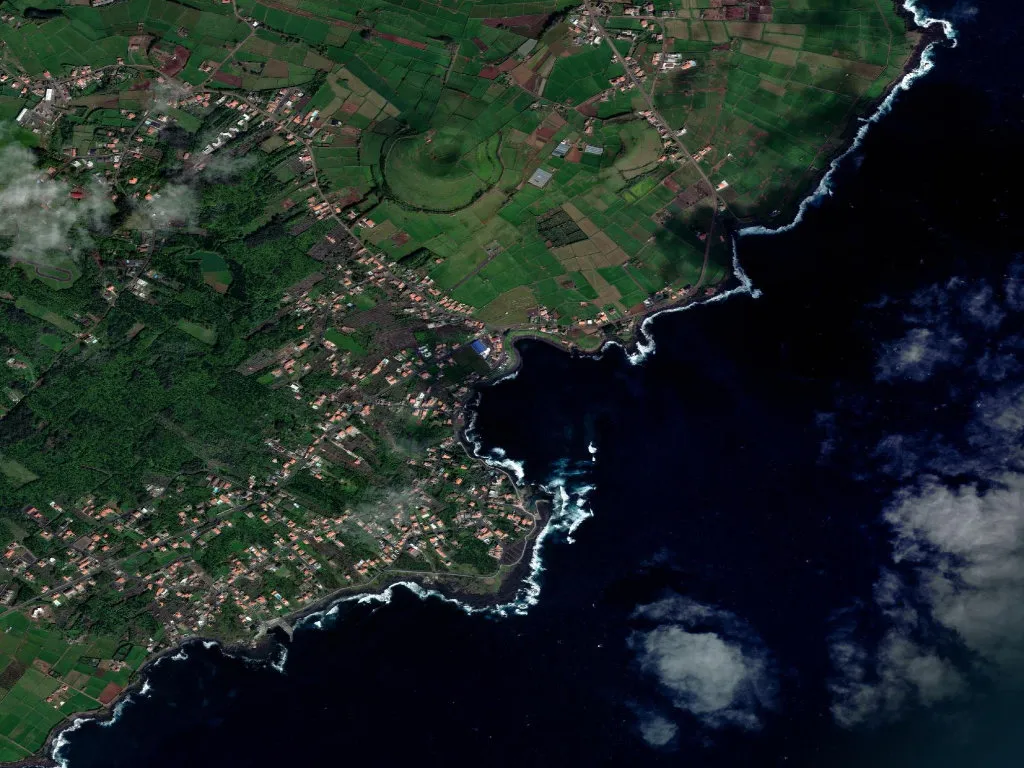
The parish occupies barely three square kilometres on Terceira’s eastern flank, yet every metre has been disputed by ocean and fire. Lava from the Algar do Carvão vent once poured downhill here, meeting the sea so violently that it shattered into the natural swimming pools now fenced off by municipal decking. Walk the foreshore at low tide and you read the island’s autobiography: ropy pāhoehoe surfaces, tide-gouged tubes, pockets of pumice light enough to float. UNESCO includes the entire coastline in the Azores Geopark, not for drama—the cliffs are only ten metres high—but for the textbook exposure of submarine lava chilling against salt water.
A grid that learned to bend
Behind the sea wall the streets obey a tighter logic. Whitewashed houses sit gable-to-gable, their chimneys angled away from the prevailing nor’wester, rainwater pipes painted the indigo used on fishing boats. Less than 1,200 people live here, yet the 2021 census shows a rare equilibrium: 175 under-18s, 182 over-65s, a demographic seesaw that actually balances. Most roofs still carry the family cistern, a reminder that until recently every drop arrived by tanker or was coaxed from the mist-catching grape vines.
Volcanic vintage
Those vines survive behind knee-high walls of loose scoria, the only windbreaks that work without rotting in salt. The Azores PDO covers the entire archipelago, but Porto Martins’ contribution is microscopic: half a hectare of Arinto dos Açores and Verdelho trained low to the ground, the bunches sheltered under fig leaves. The resulting wine is taut, almost iodine-sharp, better at accompanying limpets grilled with garlic and lard than any white from the mainland. Ask at the parish council and someone will fetch a bottle from under the sink; payment is refused, but a second glass commits you to an hour of conversation about sea temperatures and UEFA fixtures.
Lunch at the margin
There is no restaurant with ocean views; locals consider the idea vulgar. Instead, drive two minutes inland to O Pescador on Rua Conselheiro José Cardoso, where the daily catch arrives in plastic crates still fizzing from the boat’s hold. Order the cataplana loaded with blackmouth bream, prawns and a ladle of cream sharpened with island pepper; it arrives sealed like a brass planet, the lid lifted table-side so the steam writes temporary calligraphy on the window. Finish with Conde da Praia, a dessert invented here during the 1950s: thin layers of sponge bound with cinnamon-spiked potato custard, the Azorean answer to trifle.
The anti-crowd
Porto Martins scores fifteen out of a hundred on the regional congestion index. In practice that means you share the tidal pools with perhaps six teenagers practising backflips and a grandmother timing her swim by the church bell. No ticket office, no sun-lounger hire, no influencer backdrops—just basalt steps descending into water so clear you can watch your own shadow ripple across urchins five metres down. When the bell tolls noon the teenagers vanish; the only sound left is the Atlantic drawing breath between sets.
Dusk protocol
Evening light arrives sideways, the sun slipping behind São Jorge forty kilometres west. The rock pools warm like storage heaters; sit long enough and you feel the day’s heat seep through your jeans while the air temperature drops. Someone further along the wall strikes a match for the first cigarette of the night; a dog barks once, more out of duty than urgency. Nothing else is required of you except to notice how the waterline keeps perfect time, polishing the same sentence of basalt every minute, every year.