Full article about Praia da Vitória’s black-sand echo of a royal proclamation
Dawn on graphite-dark sand where a 1641 king-cry still trembles beneath Santa Cruz’s gilded stones
Hide article Read full article
Praia da Vitória: The Black-Sand Bay That Remembered a Battle
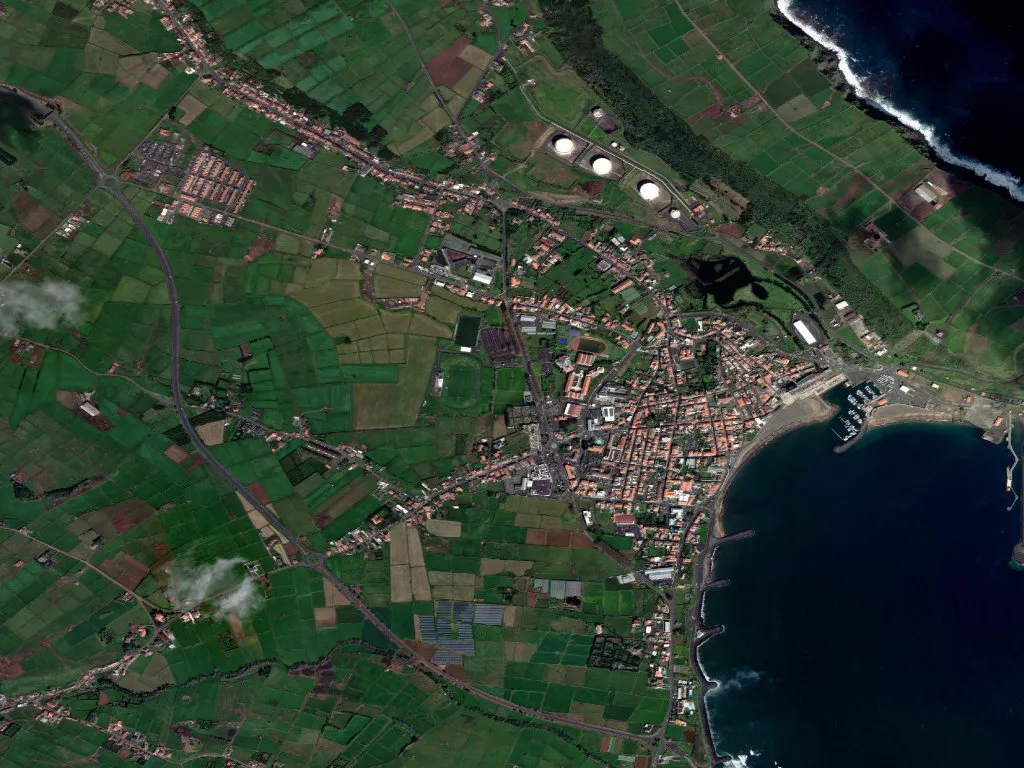
Salt-laden wind arrives in low, slow breaths, pressing warm moisture against skin. Beneath your feet the tide has just peeled back, leaving a skin of graphite-dark sand so compact it gleams like wet slate. Waves collapse somewhere out in the bay, but the sound is muffled, as though the Atlantic itself were being polite. At seven in the morning the town still belongs to its 5,956 residents; the cruise crowds are two hours and a lifetime away. Above the seafront the white bulk of Santa Cruz church catches the first sun, its façade sharp against the green wall of Serra do Cume that climbs behind the roofs.
The churchyard where a king was announced
Begun in 1456 on the orders of Flemish captain Jácome de Bruges, Santa Cruz grew for three centuries into the largest religious building in the Azores. Basalt buttresses store the afternoon heat and release it slowly, so the stone feels alive when you touch it. Step into the nave and you meet 150 catalogued treasures – gilded carving, 17th-century azulejos, a high altar that glitters like a reef. Outside, the cobbles are the same ones that witnessed a coup of distance on 15 March 1641, when local mayor Francisco Ornelas da Câmara proclaimed Dom João IV king – a declaration that stitched the islands to the Portuguese Restoration. Walk the length of the churchyard and the echo of that gesture still hangs between the walls, as if the square were a drum skin.
The town’s very name is a piece of 19th-century branding. After the Liberal Wars, Queen Maria II wanted the 1829 naval victory over the absolutist fleet kept forever in mind; “Praia” became “Praia da Vitória” overnight. Before the renaming it was simply the Beach Village, seat of Terceira’s first captaincy from 1456-70 and one of the earliest settlements in the archipelago. A dozen years after the rechristening the earthquake known locally as the Caída da Praia levelled most of the houses. Lisbon-born engineer Silvestre Ribeiro – born a few streets away in 1818 – drew up the reconstruction plan that still governs the street grid: straight lines, two-storey houses trimmed in dark basalt, sash windows set like dark eyes in white plaster faces.
The writer who never really left
Vitorino Nemésio arrived on 19 December 1901 at No 33 Rua de São João. Readers of Stormy Isles will recognise the salt-bitten light, the smell of turned earth and seaweed that still drifts up from the docks. His birthplace is now a house-museum: creaking pine floors, walls half a metre thick that keep out the Atlantic damp, the original walnut sideboard where the future novelist learned to spell. Around the corner the Battle of Praia Interpretation Centre walks you through the 1829 sea fight that gave the town its adjective – cannon smoke, musket volleys, and the sudden hush after the last sail disappeared over the horizon.
Clay-pot beef and a count made of sugar
Order alcatra – beef or fish, both legitimate – and it arrives in a hand-thrown pot, the lid sealed with a rope of dough that bakes into a bread crust. Inside, cubes of topside have collapsed into a dark soup of local white wine, garlic and pimenta-da-terra, the small, fierce chilli that Azoreans guard like a state secret. At O Pescador the house variation, bife à Mendes, is marinated for 24 hours, grilled, then returned to its juices. Grouper, black-spot seabream and limpets follow, their flesh firm because the surrounding ocean never climbs above 22 °C. Dessert is a slice of Conde da Praia, a fudgy sweet-potato custard heavy with cinnamon, or a forkful of Bolo D. Amélia re-imagined as gelado de Melinha. Wash it down with a mineral-driven white from the Azores’ own volcanic vineyards – vines curled inside basalt walls to keep the salt wind at bay.
Geometry lesson at 545 metres
Take the EN1 north-east and the road corkscrews to the lip of Serra do Cume. From the viewpoint at 545 m the interior of Terceira unrolls like a green quilt stitched by masons: rectangular paddocks, triangular meadows, every seam a basalt wall thrown up by hand over four centuries. The wind up here has teeth; the only sound is the faint lowing of cows grazing inside the crater of an extinct volcano. Footpaths drop to smallholdings where figs swell behind cane fences and vines are trained inside currals – horseshoe-shaped walls of loose black stone that trap heat and repel gales. The whole tableau is part of the Azores Geopark, a UNESCO label that changes nothing and validates everything. Beyond the walls tiny coves of charcoal sand beckon; the water is gin-clear and, at midsummer, barely touches 20 °C.
Runway that rewrote the mid-Atlantic
In 1934 the Portuguese army levelled a salt-marsh at Lajes and laid down a 1,400-metre runway. Five years into the Second World War RAF Hudsons and US Navy PBY Catalinas were using it to hunt U-boats; by 1949 a civilian terminal opened, giving this scatter of houses a permanent umbilical cord to Lisbon and, via the old Pan Am flying-boat route, to New York. The base still hosts the USAF’s 65th Air Expeditionary Group – a fact you remember when the roar of a KC-135 tanker rattles coffee cups in the marina cafés. Local memory is full of chocolate bars traded for fresh milk, of dances in the hangar where Glenn Miller’s ghost is said to linger.
Festivals that smell of bread and bay
On Pentecost Sunday the Empires of the Holy Spirit open their doors – tiny, Technicolor chapels unique to the Azores. Inside, brass crowns hang above tables piled with massa sovada loaves and pans of alcatra; outside, processions weave through streets carpeted with petals. Good Friday brings torch-lit parades and the scent of laurel branches burning. August’s Festa da Praia turns the waterfront into a midway of brass bands and nightly fireworks, while the first Sunday of the month belongs to Nossa Senhora da Guia, patron of fishermen whose statue is carried shoulder-high to the harbour for a blessing of boats and men. Between feasts, life retreats to the Jardim Municipal where old-timers play sueca under jacarandas and discuss the price of milk as if the rest of the world were a rumour.
When the sun drops behind the headland the bay fills with bronze light and the wet sand becomes a mirror. Somewhere a clay pot is lifted from a wood-fired oven, releasing a plume of wine and garlic that drifts straight into the salt air. That mingled scent – volcanic stone, seaweed, cinnamon, hot earth – is the signature of Praia da Vitória: not a postcard, but a palimpsest of lava, salt and stories still being written.