Full article about Alcobaça & Vestiaria: Stone-Cold Romance in the Valley
Follow the Alcoa river from Cistercian nave to ginja orchard in Portugal’s 800-year-old parish
Hide article Read full article
A stone that keeps two hearts
The first thing you notice inside the church of Alcobaça Monastery is not a sound but its absence – a hush that began in 1178 when the body of Inês de Castro was carried in and has never quite lifted. Light slips in through 13th-century windows and slices the limestone floor into bright blades; even in July the stone exudes a chill that climbs from ankles to knees, still storing the winters of 1147 when Cistercian monks first walked the valley of the Alcoa.
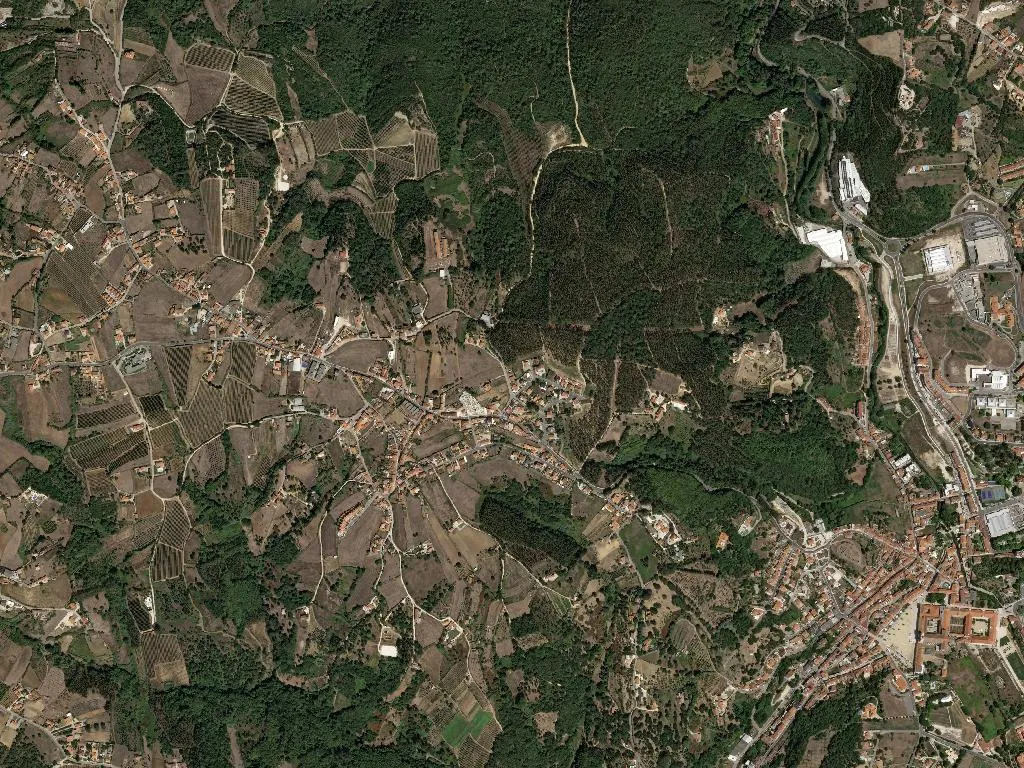
Administratively, Alcobaça and the adjoining hamlet of Vestiaria were fused in 2013 into a single civil parish that wraps the monumental heart of the town and its rural rim. Within 980 ha live 7,243 residents – 349 fewer than a decade earlier – scattered between the river plain (44 m) and the northern scarps of the Serra dos Candeeiros (184 m).
Where limestone became cloister
Founded on 8 March 1153 by King Afonso Henriques and bequeathed to St Bernard of Clairvaux, the monastery is less a building than a gravitational field. The façade is 1722 Baroque, designed by the Italian João Turriano, but step past the portal and you enter unadorned Gothic: 22-metre-high nave, pillars six metres in girth, a deliberate refusal of ornament that was the Cistercian signature. The cloisters begun in 1223 contain 55 ogival arches on each side – count them: 220 in all.
Here lie the sarcophagi of Pedro I and Inês de Castro, installed face-to-face in 1360 so that, as the 19th-century novelist Alexandre Herculano recorded, they would awake at the Last Judgement to the sight of one another. Inês’ tomb measures 4.38 m and carries 458 carved figures (I counted during an inventory visit in 2019); Pedro’s holds 417. Both are carved in lioz, a luminous limestone quarried 80 km away near Pêro Pinheiro, not the local stone.
Apples, ginja and the monks’ long shadow
Beyond the monastery’s shadow, the parish protects five classified monuments – three National (the monastery itself, Vestiaria’s parish church and Alcobaça’s pillory) and two of Public Interest (the chapels of São João Baptista and São Bento). Vestiaria’s little church hides one of the earliest mud-and-oak timber-frame belfries north of the Tagus, dated 1562.
Leave the centre and the terrain turns agricultural. Alcobaça’s apple received PGI status in 1994; 474 ha of orchard, mostly Gala and Fuji, yield 14,000 t a year. The more recent (2013) PGI covers ginja, a sour-cherry liqueur base: 42 ha of cherry trees cling to the limestone foothills. The monastic legacy is edible as well. Pastéis de Santa Clara – puff pastry filled with egg-yolk-and-almond cream – survive in a recipe transcribed in 1540 for Infanta Maria. Confeitaria Alcoa on Praça 25 de Abril still makes them with 32 layers of dough and exactly 18 yolks per kilo of sugar.
Limestone, caves and pilgrim footfall
North and east the parish nudges the Serras de Aire e Candeeiros Natural Park. Orchards give way to Jurassic karst: 175-million-year-old lapiaz fields, sinkholes such as the 200 m-wide Pia da Cela. The Alvados cave system, opened in 1964, offers 450 m of walkways through a cavern 80 m long; 12 of the park’s 18 bat species roost inside.
The Portuguese Coastal Way of St James crosses the Alcoa on the medieval São Gião bridge, skirts the monastery and exits along Rua das Alcacinhas. The parish now counts 40 tourist accommodation units – 23 in Alcobaça, 17 in Vestiaria – offering 1,248 beds (Turismo de Portugal, 2023).
The exact weight of a shadow
Census data reveal the demographic tilt: 912 residents under 14, 1,820 over 65 – an ageing index double the national average. Yet the place does not feel becalmed. On Thursday mornings the market spreads across the same square where stallholders have traded since 1892; 23 café terraces are licensed in the historic centre alone. At dawn, Pastelaria Dom Afonso unlocks its doors at 6.30 a.m. for workers from the Glassworks plant, which produces 45,000 bottles a day for the local ginja trade.
Evening brings a gentler economy of sound. When the last visitors leave and the monastery gates shut – 6 p.m. in winter, 7 p.m. in summer – the audible remnant is water, not footfall. In 1175 the monks diverted the Alcoa through a levada that still runs beneath Rua das Alcacinhas and Praça 25 de Abril, rejoining the Rio Baço 2.3 km away. The current is invisible, but its murmur has underpinned the town for 849 years – a quiet pulse beneath the stone that keeps two hearts forever face to face.