Full article about Maiorga: where Atlantic salt sweetens pear blossom
Limestone orchards, fossil-laden streams and custard tarts at noon—Maiorga distills land and sea
Hide article Read full article
The window is open to the Atlantic and the room fills with the scent of salt blown across pear orchards in flower. Forty metres above sea-level, Maiorga sits on a wafer-thin contact zone: limestone on one side, oceanic air on the other. Dawn light here behaves like a prism—dry interior brightness refracted through maritime moisture—so that even the well water tastes faintly of iodine.
Stone, water and pears
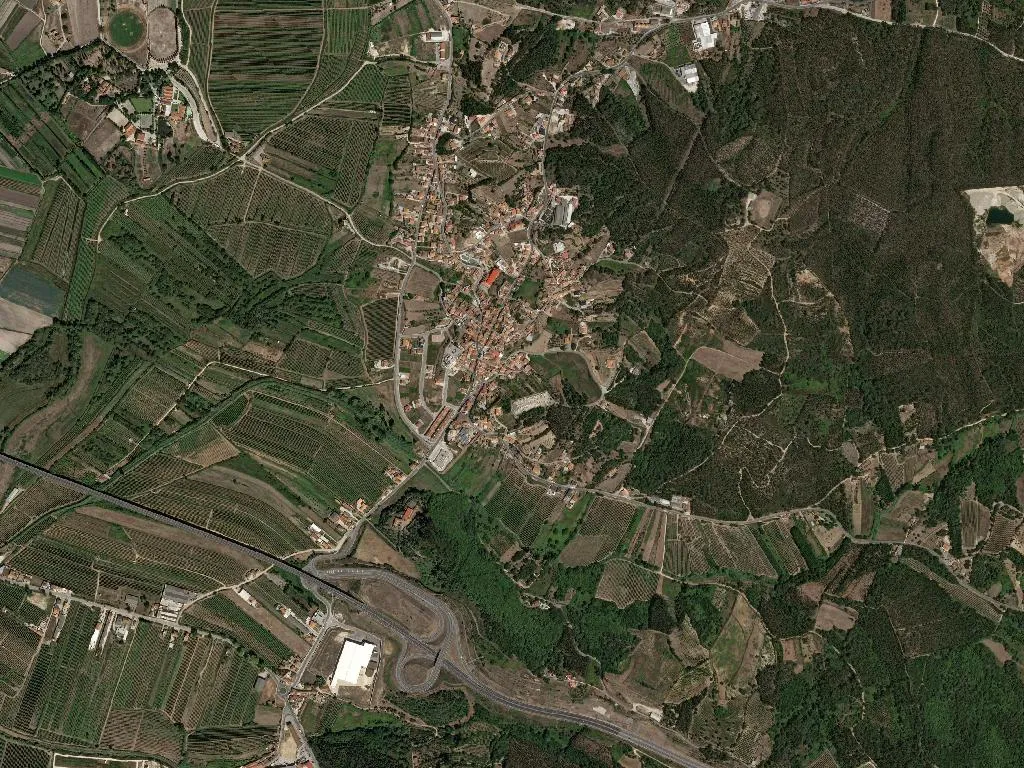
Little more than a thousand hectares, the parish is stitched together by dry-stone walls and irrigation ditches that keep the famous Pêra Rocha do Oeste DOP just humid enough to swell slowly. Come late August the same orchards give way to Maçã de Alcobaça IGP apples, their acidity calibrated by the same chalky soils that feed the olive presses producing Azeites do Ribatejo DOP. None of this is backdrop; it is simply the working calendar you hear in the clack of pruning shears and the hiss of the vacuum oil filter.
Fossils and footpaths
Maiorga is technically inside the Serras de Aire e Candeeiros Natural Park, yet the ridge is only a graphite line on the inland horizon. What dominates is a rolling plain gashed by seasonal streams that dive west to the sea. Between the fields, creamy limestone benches appear—marine strata packed with oyster fossils from an Oligocene lagoon. The Geopark Oeste lists the entire zone as a “geological sanctuary”; walkers on the Portuguese branch of the Camino de Torres tread across 30-million-year-old seabed without noticing. There are no albergues, no souvenir stamps, only a discreet yellow arrow on a cottage wall and, at the first crossroads, a café guarded by a sleeping hound. If you meet a rucksack with fifteen days of dust, point him towards the door; the bica is short and the custard tarts arrive at noon.
Pantry flavours
Local cooking is less recipe than distillation. Ginja de Óbidos e Alcobaça IGP—Morello cherry liqueur—ferments in five-litre glass balloons beneath pantry beams; the fruit is too sharp to eat raw, but after six months of sugar and aguardiente it turns into the burgundy-coloured shot served at every festa. Copper jam pans still bubble on Thursday afternoons: quarters of Rocha pear, translucent lemon peel, a ratio of sugar that would make a French pâtissier flinch. Knock on the blue door opposite the church and ask for Dona Amélia; tell her the tip came from the woman with the notebook. She will hand you a still-warm jar in exchange for the price of the postage stamp you forgot to buy.
The parish’s seventeen guest spaces—converted haylofts, ground-floor stone rooms, an entire 1950s bungalow—are scattered among working farms. Wake to roosters and the thump of the village bakery van dropping off yesterday’s broa. Proximity to the UNESCO-listed Cistercian abbey at Alcobaça funnels travellers who prefer their monastic art by day and their silence unpunctured by tour-bus engines at night. António, who lets the upper floor of his pear warehouse, leaves a brown-paper basket on the kitchen table: three Rock pears, a blunt knife and a note—“They ripen towards the coast.”
The census of conversations
Of 1,846 residents, 541 are older than the 1974 revolution. They occupy the evening with plastic chairs placed exactly on door-width centres, monitoring the slow traffic of neighbours heading for the fields. The 198 school-aged children pedal home in clumps, tyres hissing on damp tarmac. Population density—184 people per km²—means the grocer can pre-bag your favourite coffee before you reach the counter and the parish council minutes are still read aloud on the church steps. The single building classified as Public Interest is the Misericórdia chapel; its side door, forged from dark chestnut and iron in 1712, has never been replaced. The carpenter’s name is lost, but the priest claims he spoke only to his chisels and measured time in heartbeats rather than hours.
Dusk ends with the soft thud of falling fruit—pears releasing their hold when the temperature drops and the Atlantic breeze picks up. No one rushes to collect them; they know the sweetness will be there by morning, counted out in slow limestone time.