Full article about Roliça: where Wellington’s ridge meets pear-blossom wind
Roliça, Bombarral—stand on Wellington’s ridge, breathe orchard-scented air, sip Ginja among Jurassic hills and sleepy stone cafés.
Hide article Read full article
The lane climbs gently between orchards of apples and pears, the afternoon light turning the fruit the colour of burnished gold. Below, the valley unrolls in a ripple of low hills where vineyard green meets the ochre of freshly-turned earth. At 60 m above sea level, Roliça sits in this natural amphitheatre, far enough from the Atlantic to escape the weekend rush yet near enough for the evening breeze to carry the scent of salt and damp soil.
Two monuments, one battle
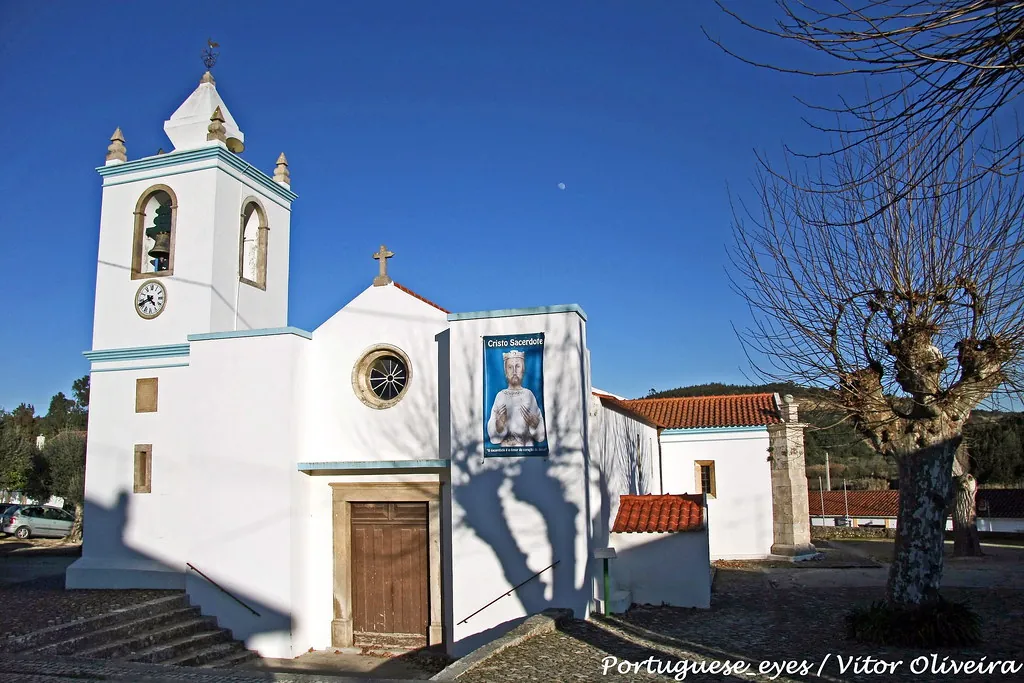
Official heritage is modest: the parish church of São Tiago, rebuilt after the 1755 earthquake, and an 18th-century fountain in the square. Everything else is remembered rather than built. On 17 August 1808, these fields witnessed the first Anglo-Portuguese victory of the Peninsular War, when Sir Arthur Wellesley—later the Duke of Wellington—deployed 14,000 troops against General Delaborde’s 4,000 Frenchmen. The ridge the British scaled is still referred to, in accented Portuguese, as “Rolinha”. Stand there at dusk and you can trace the line of redcoats in your mind’s eye, advancing through the gorse.
Today the land feeds its owners. Across 2,263 hectares, orchards produce Maçã de Alcobaça IGP and Pêra Rocha do Oeste DOP, fruit that leaves the cooperative in Bombarral in pallets bound for Berlin and Birmingham. In back gardens, sour-cherry trees supply the berries that become Ginja de Óbidos, the sticky liqueur sipped from dark-chocolate cups in the converted barn of Quinta do Freixo.
Life between blossom and harvest
2,545 people live here, 757 of them over 65, only 291 under 19. Yet public life persists: Café Central for espresso and grumbles, Pastelaria Rosa for Saturday cake, 11.30 mass, and a monthly market that sets up every seventh day. Twenty-two guesthouses—ranging from the tiled Casa da Eira to smart barn conversions at Monte Novo—absorb the trickle of visitors who use Roliça as a quiet base for the West Geopark, where Jurassic outcrops of Serra do Bouro and dinosaur tracks at Serra d’El-Rei lie within ten minutes’ drive.
Agriculture still writes the diary. March brings a snowfall of apple blossom; September smells of grape must when Fernão Pires and Vital arrive at the co-op winery. The EN8-4 snakes down to Bombarral in five minutes, flanked by dry-stone walls thrown up after the war and gates whose rust blooms the colour of local clay.
The weight of rural silence
Visitor pressure registers a gentle 30/100, so fields remain empty enough to hear a tractor’s diesel note change as the driver shifts gear on the hill. Access is simple: leave the A8 at Bombarral, follow the signs past the roundabout where an olive-green tank guards the junction, and you’re here.
Twilight is when the place becomes three-dimensional. Low sun fires the reed-thatch roofs, cypress shadows stretch like pointing fingers, and the valley fills with small, insistent sounds: the 19.30 bell of São Tiago, Bobi the mastiff staking his territory, the diesel growl of Zé Manel’s John Deere returning from Lagoa field. It is the hour that reveals Roliça not as a vignette but as a working parish whose orchards were planted by grandparents and defended by grandchildren who refused to leave when the last bank branch pulled out in 2015.