Full article about Amoreira’s Cork-Smoke Dawn & Mulberry-Sweet Air
Watch wheat-loaves rise by a 1732-charted stream where kingfishers hunt above vanished mills.
Hide article Read full article
The scent of burning cork arrives before the village does. On Wednesdays and Saturdays it drifts across the wheat stubble, announcing that António has fired the communal oven since four in the morning. By the time you reach the low, whitewashed houses, the first loaves are being lifted out with a peel longer than a man is tall, their crusts singing as they cool.
Three mulberry trees stand in the church square, replacements planted in 1952 after the storm of 1941 snapped their predecessors. Their sweetness threads through the smoke, a reminder that Amoreira takes its name from Amoraria—a Latin coinage meaning “mulberry grove”—and not from any romantic notion the word might now imply. The parish appears in a 1338 Leiria archive document under that spelling; a 1732 chart by the royal cartographer João Teixeira Albernaz already writes “Amoreyra”.
Between the stream and the stone walls
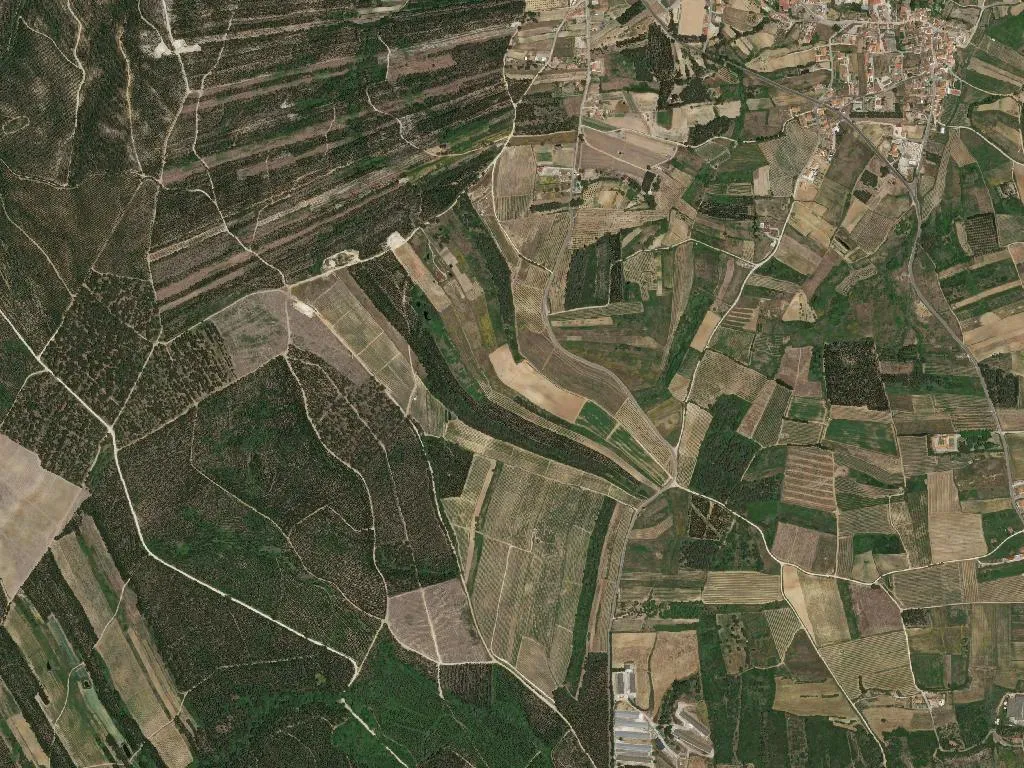
A seasonal ribbon of water, the Ribeira de Amoreira, cuts the settlement from east to west. Kingfishers flash above it; herons pose motionless among the reeds. Two stone mills once drew their power here – the Moinho do Sapo, grinding wheat until 1963, and the smaller Moinho da Ribeira, its wheelhouse now converted into a private wine cellar. Dry-stone walls, exactly 1.20 m high and consuming 800 tonnes of local limestone and schist per kilometre, still parcel the land into inheritance-sized rectangles. From the 18th-century granite cross at the miradouro (82 m above sea level) you can pick out the Óbidos lagoon seven kilometres away and, on very clear mornings, the silhouette of the Berlengas archipelago. The trick is to arrive before 9.30 a.m., while the sun sits low enough not to bleach the view.
What the parish records say
The Church of Nossa Senhora da Conceição was rebuilt in 1878 after the 1755 earthquake toppled its tower. Inside, a 1724 baroque altarpiece glints with gilt, and sixteen blue-and-white azulejos narrate the life of the Virgin, ordered from the workshop of Gabriel del Barco, one of the masters who introduced the trompe-l’œil style to Portugal. Next door, the eight-by-twelve-metre chapel of São Sebastião hosts a procession every 20 January: forty residents walk the dirt lane to bless the vineyards, a rite that lapsed in 1997 when the last commercial grower uprooted his vines.
With 5.2 inhabitants per km², Amoreira is the second-most sparsely populated parish in Óbidos municipality, just above A dos Negros. The 2021 census counted 1,033 residents in total – enough to keep the primary school open, but few enough that everyone recognises António’s dough before they see him.
Tastes that map the territory
Lunch might begin with ensopado de enguias, an eel stew that uses twelve 30-cm specimens from the stream, garden coriander from Sr Aníbal and local purple garlic. It simmers for two hours in a red-clay pot commissioned from the last potter in Vau. The tomato-sauce rice topped with sardine arrived only in 1987, invented when the restaurant O Pinhal needed something quick for golfers en route to the new lagoon-side course. Roast kid is still done the old way: three hours at 180 °C in D. Rosa’s domestic oven, basted every sixty minutes with vinhaça, the lightly acidic grape must that doubles as seasoning and glaze.
For pudding, ask for the esquecida (“forgotten”), a rolled sheet of egg-yolk sweet made with twelve yolks to the kilo of sugar, wrapped in 15-cm squares of greaseproof paper that Adelaide cuts with tailor’s shears – her mother sold the same parcels at Caldas da Rainha market in 1954. August visitors will find blackberry cakes, although the berries themselves were picked in May and frozen at exactly 200 g per tray to outwit the short season. At the counter, the ginja cherry liqueur comes from 300 trees planted in 1932 on the Feiteira plot; each 50 cl bottle contains the macerated flesh of fourteen fruit and the annual run is a mere 800 bottles.
Pedal, walk, listen
The Amoreira loop (PR1) has way-marked yellow-and-green stripes since 2017. Six kilometres start at the church side gate, pass the Sapo mill – now roofless but with its 1.80 m wooden axle still centred in the wall – and end at a bandstand that sank in 1998 when the soil beneath it subsided. Cyclists can join the 4.3 km tarmac-and-1.2 km gravel lane to Bom Sucesso beach; by the third kilometre the air turns saline as you skirt the 1976 pine plantation – 5,000 maritime pines ordered by one Ventura who wanted to stabilise the dunes.
On the first Saturday of September the parish council advertises a participatory harvest: thirty wicker baskets of 20 kg each, followed by a magusto roast of Serra da Vigia chestnuts and a free pour of 2022 muscatel still clocking 11 % abv. In a shed behind the chapel, Rui throws local clay from the Casal do Coelho quarry, presses 18th-century tile moulds and fires at 980 °C. Forty-five minutes per tile, three tiles a week, €25 each – the kiln only holds so many.
When the sun drops behind the stone walls and the smoke column rises again, you know António has swept the last embers and sealed the oven door. The loaves will travel no farther than the neighbouring parishes; the mulberries will fatten quietly; the stream will keep the herons company. Amoreira returns to being a place you smell before you see, a grid of walls and trees whose history is measured not in centuries but in baking cycles.