Full article about Vau’s Briny Breeze, Pear Blossoms & Lagoon Mirage
Vau village near Óbidos mixes sea-salt air, March pear blossoms and treacherous lagoon sandbanks where candy-striped bateiras rest.
Hide article Read full article
The salt wind you taste before you see the sea
The breeze arrives freighted with brine that, minutes earlier, was still foaming across Praia do Bom Sucesso. Walk down Rua da Igreja and you’ll taste it on your lips before the Atlantic even glints into view. Beside the cemetery—where headstones carry the names of men who knew no trade but the pull of nets and soil—Grácia’s pear trees begin to flower in mid-March: white petals first, then crimson, so heady that village widows mutter the scent “could make you sick with longing”.
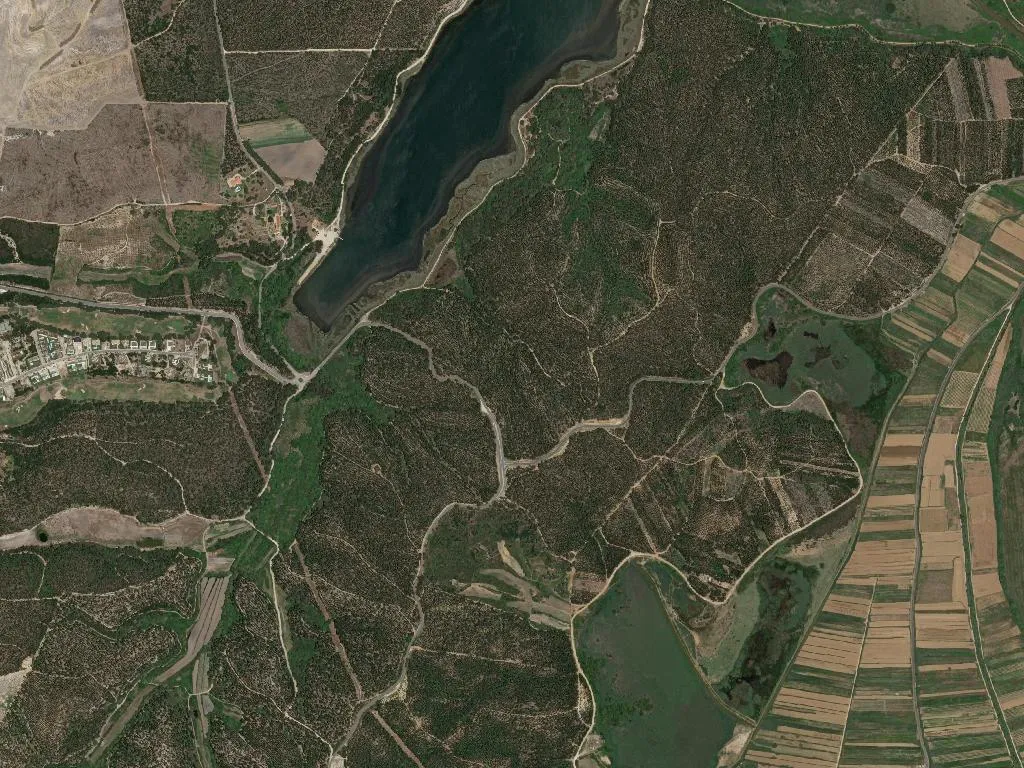
Vau is not flat. A low ridge rises behind the former primary school; climb twenty metres and the Óbidos lagoon unfurls like a clay basin left out to dry. At spring-tide low the shellfish bateiras sit keel-to-mud, candy-striped hulls mirrored in still water. Along the lanes dry-stone walls still carry the ghost of a felt-tip boast—“Há melões”—three winters of rain have not quite washed away. No visitor notices, yet this is where Zé Moleiro once flagged down every passing car, sliced melons from his back garden on the hoof, and dusted the green ones with sugar so they could be eaten straight away.
The lagoon that refuses to be crossed
First-timers assume they can walk across. They’re wrong. The bottom is a shifting mosaic of sandbanks; yesterday’s solid footing is tomorrow’s channel. Local fishermen—perhaps a dozen remain—carry two oars: one to probe depth, the other to pole free when the silt grabs the boat. On a crystalline January low tide the salt-marshes of Fonte da Bica glint like shattered emerald glass. In the October spring tide the water noses up to the straw eaves of huts that once sold goose barnacles to weekenders from Lisbon. Now only roofless walls smell of sun-dried wrack.
What to eat, and exactly when
Wednesday is market day in Caldas. Vau housewives leave before seven, string bags slung like bandoliers. They come home with whatever landed at Peniche at dawn—first-class mackerel for grilling, monkfish for stew, sea bream if the auction favoured them. But the dish that tastes of Vau itself is lagoon eel caldeirada. The pot goes on the moment the sun drops and the tide begins to push, when the eels wake and start sliding through the channels. Ripe tomato, onion shaved translucent, a pinch of local smoked paprika, a thread of cooperative olive oil from Benedita—nothing more. It must simmer for exactly the time it takes to recite a rosary: rush and the broth clouds; linger and you lose the faint taste of the mud that gives the fish their sweetness.
The apples no exporter wants
Yes, Alcobaça apples carry IGP status, but the grading shed in Mexilhoeira skims off every flawless globe. What remains are the runts—small, freckled, tasting of hot sky and cool loam. On doorsteps the grandmothers peel them with short knives, the fruit spinning like tops in their right hands. The resulting jam is never labelled: it sets in washed yogurt jars, pink elastic stretched over waxed paper. Look for them on the counter at Café O Pescador, served with toasted cornmeal loaf, lightly salted butter and an espresso António still grinds by hand in the cast-iron mill his father carried home from Brazil in 1953.
Silence falls at half-past seven
The A8 motorway skims one edge of the parish, but inside the dirt lanes you hear only the gulls when the organic bin is dragged out, Celestino’s dog giving a half-hearted bark, Zé da Bica’s tractor coughing awake at six. By seven-thirty every engine stops: it is suppertime, the television murmuring SIC Notícias in kitchens where the flame is never turned high. Windows light up one by one, golden rectangles reflected on freshly limed walls. If the moon is full no streetlamp is needed: the cabbage fields become a silver plate on which the silhouettes of three churches—Vau, Nossa Senhora das Neves, São João Baptista—float like upturned boats.
Who stays, who lands
Of 936 residents, 273 are over sixty-five. Many have never left the parish except for appointments at Caldas hospital or a season in the canning factories of Peniche. Now French, German and Dutch number plates appear. They buy tumbledown cottages with wells in the courtyard, strip the warped shutters, paint the exteriors matt white and call it “quality of life”. The old boys laugh: quality is being able to walk the lagoon for goose barnacles without asking anyone’s leave. Still, they swap surplus hens for French lessons and teach newcomers to tell the soft hush of drizzle on thatched reed from the drum of heavy rain on the bakery’s tin roof.
Walk Vau at night and you meet the same breeze that has travelled fifteen kilometres of open ocean without meeting a single obstacle. It slips in past the cemetery, drifts across the football pitch where grass grows in the goalmouth because no one ever wins a penalty, then lifts again towards the Atlantic. It carries the scent of flowering myrtle, cow manure, pine kindling still burning in iron stoves. Pause by the church door and you’ll catch the low thud of waves against the Fossil Cliffs—a sound unchanged for two million years, yet each generation hears it as if for the first time.