Full article about Roman mosaics, Jurassic stone & pear-scented lanes in Guia
Pilgrims, fossils and DOP Rocha pears share the quiet limestone hills of Guia, Pombal
Hide article Read full article
A morning field, a Roman echo
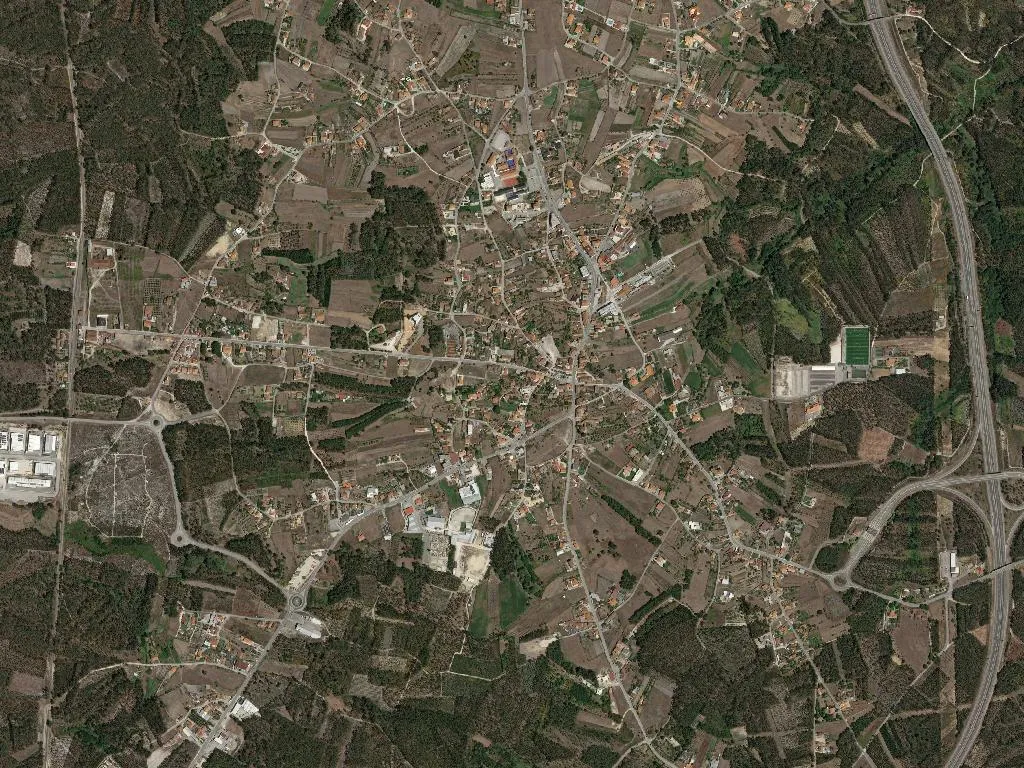
Slanted light slips across plots of Rocha pear trees, their fruit DOP-certified since 2003, and across low olive groves that feed the cooperative mills of Pombal. The land is neither flat nor truly mountainous—an intermediate roll of limestone and sandy loam that makes Guia easy to overlook. Yet the Romans paused here: in 1986 archaeologists uncovered a villa at Herdade de Cabeço de João Roque, the mosaics now re-buried to protect them. The modern road still follows their alignment, curling past smallholdings where Sr Carlos starts his 1978 John Deere and Bobi, the Silva family’s dog, keeps tempo with the tractor’s diesel knock.
Crossroads of two pilgrimages
Two St James routes—the Coastal Way and the Torres variant—braid through the parish. Medieval way-markers have been refreshed with yellow arrows, and walkers heading to Santiago or nearby Fátima refill plastic bottles at the marble trough on Praça da República. Some stay: six self-catering houses—Casa do Castanheiro’s cedar-clad studios and Quinta do Pinheiro Manso’s white cottages—offer night-time silence instead of albergue snores. With only 2,013 residents spread over 37 km², the village absorbs the extra footsteps without fuss.
180 million years in a single wall
Eight minutes south-east of the centre, a padlocked gate gives onto the old Avelino quarry, closed since 1983. What looks like a modest amphitheatre is, in fact, a textbook exposure of Upper Jurassic limestone: 40 m walls banded in dove-grey, biscuit and pale mushroom. Fossilised oyster shells, sea-lilies and the odd bullet-shaped belemnite stud the bedding planes, while pick scars record the hand-to-hand extraction that supplied stone for the A1 motorway and the Arunca bridge. Gravel crunches like brittle bone underfoot; the hush inside feels almost ecclesiastical.
Flavours that stay close to the soil
Guia’s cooking is dictated by what surrounds it. Extra-virgin olive oil from Pombal’s cooperative registers <0.3 % acidity; Rabaçal sheep’s-milk cheese travels 12 km from Quinta do Rabaçal; António Augusto’s 1956 pear orchard still delivers the first Rocha crop each August. Back-garden plots raise red Guia beans, Portuguese kale and “abóbora menina” squash, while clay pot dishes—kale soup shot through with Mr Mário’s smoked chouriço, rice punched with galician greens, salt-cod roasted over a wood-fired oven—taste of firewood and patience rather than technique.
A future measured in pruning cycles
The parish is greying: 2.3 pensioners for every child under fourteen, a density barely half the national average. Yet 42 ha of vines are still pruned by lunar calendar; 85 ha of olive groves qualify for EU subsidies; and the town hall resurfaced the lanes in 2019. Pombal’s hospital, court and nearest Pingo Doce supermarket sit eight kilometres away—close enough for convenience, distant enough to keep tractors in pole position. On 8 September the Feast of Nossa Senhora da Nativity pulls 500 people into the 1755 mother church, the square scented with roast kid and pot-pourri of late-summer dusk.
As the sun tilts, terracotta chimney pots glow against whitewash, and seven church-bell strikes echo off tiled roofs. Inside José’s bakery the wood oven that has burned since 1962 exhales a final yeasty sigh. Guia offers no postcards, only permission to linger between Jurassic stone and the still-warm bread on the counter.