Full article about Mata Mourisca: Limestone, Silence & Pears
Walk fossil quarries, pilgrim paths and pear orchards in Portugal’s quietest plain
Hide article Read full article
A Road Through Time
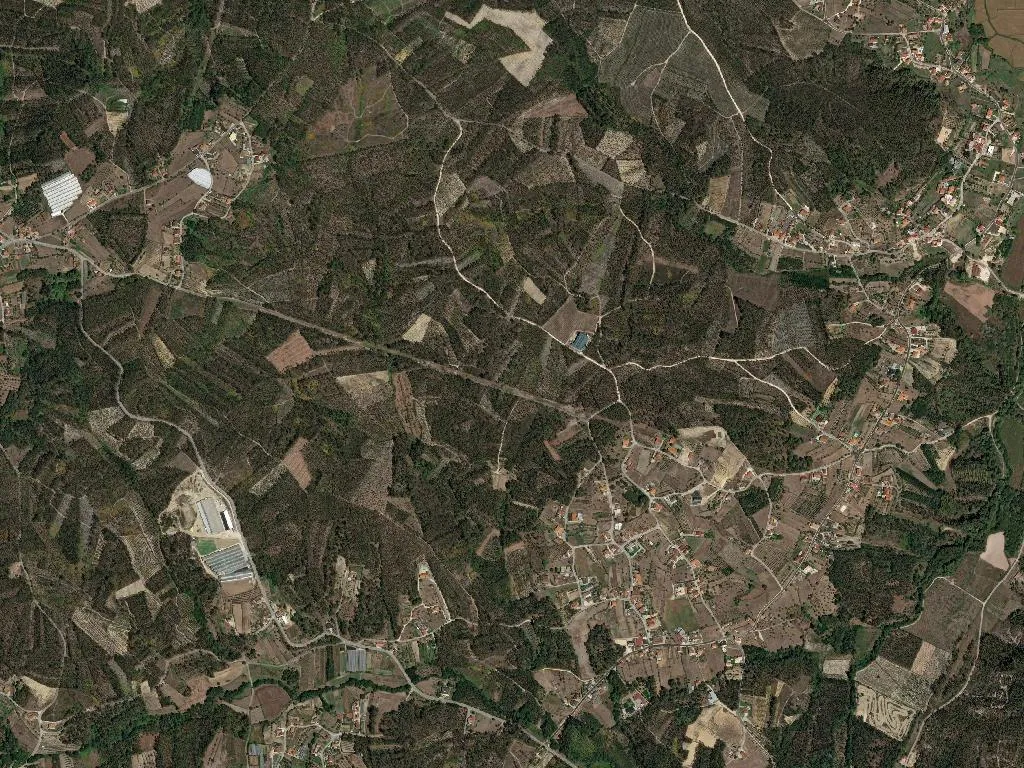
The road through Mata Mourisca unspools between fields where dawn light lies flat across the soil, slow and deliberate. Tractor diesel and wood smoke mingle in air that still carries the memory of last night’s hearth. At just 79 m above sea level, the parish covers 27 km² of gently tilting plain, its boundaries stitched by olive terraces and pear rows that change colour with the Agricultural calendar. Only 2,013 people (2021 census) live here, enough to fill a London Underground train twice over, yet the silence is so complete you can hear a Valtra engine three farms away and the neighbour’s sheepdog answering back.
Stone That Remembers the Sea
Mid-village, the abandoned Pedreira do Avelino quarry has become an open-air ledger of deep time. Thirty-metre walls of limestone, last hacked in 1983, reveal 15-million-year-old strata crowded with Miocene cockles and sea urchins—creatures that swam when this farmland was Atlantic shallows. Rainwater has since flooded the floor, turning the pit into a sky-mirror where kestrels now circle instead of cranes. Locals still call the stone “white gold”; it built half the houses in Pombal province and even the art-déco cinema in Leiria, 35 km west.
Waymarks to Santiago
Mata Mourisca sits at the junction of two lesser-known pilgrim arteries: the coastal Caminho da Costa and the inland Caminho de Torres. Both converge on the small square beside the 19th-century parish church before pointing north-west to Alvaiázere. Yellow arrows appear on electricity poles and schist walls, guiding walkers along 50-m-wide crop belts and past dry-stone walls rebuilt after the 2017 fires. There are no cathedral spires here, only the geometry of hedgerows and the sudden widening of sky once you crest the Cerqueira ridge—space enough for thought to stretch its legs.
Tastes with Postcodes
Flat, fertile ground and an Atlantic breeze create a pantry of protected produce. Pêra Rocha do Oeste, the DOP pear with a trademark granular skin, ripens in orchards skirting the São Pedro stream; the fruit’s high malic acid content means it keeps its bite even after the lorry ride to the Pombal co-operative. Centenarian olive trees—varieties Galega and Cobrançosa—supply the Ribatejo DOP oil pressed in the 1954 co-op mill whose granite millstones rotate twice a month from October to February. Creamy Rabaçal DOP sheep’s cheese arrives every Wednesday from Ansião, while the sour-crust “matured bread of Pombal,” awarded IGP status in 2019, is still warm when Zézinha’s bakery opens at seven.
A Feast That Feeds the Town
On 6 and 7 September the parish empties into neighbouring Pombal for the Festa do Bodo, a feast whose roots reach back to King Afonso Henriques’ 1165 charter. Twelve tonnes of veal are simmered in vats the size of plunge pools, then handed out free to anyone holding out a plate—an edible insurance policy against hunger that predates the welfare state. By 4 a.m. volunteers from Mata Mourisca are already sharpening knives in the São Sebastião square, portioning meat against the clock while brass bands tune up for the procession. The event draws 200,000 people, yet the choreography of ladles and loaves feels closer to a barn-raising than a food festival.
Continuity in Blue and White
Demography tilts elderly—575 over-65s versus 235 children under 14—but the fields refuse to stand still. Maize for silage stands shoulder-high by June, and 1,800 dairy cattle rotate through paddocks managed by the Agrimal co-operative. Olive prunings are burned according to the waning moon; John Deere drills sow winter wheat within a two-day window set by the agronomist’s WhatsApp group. At dusk, when low sun gilds the blue-and-white trimmed façades and smoke rises straight in still air, the village settles into its oldest rhythm: feet on terracotta, bread on the table, soil still warm from the day’s labour.