Full article about Pelariga: Where the Bell Outruns Phone Signal
Granite, fossils & goat stew perfume a 2,012-soul parish above the Mondego.
Hide article Read full article
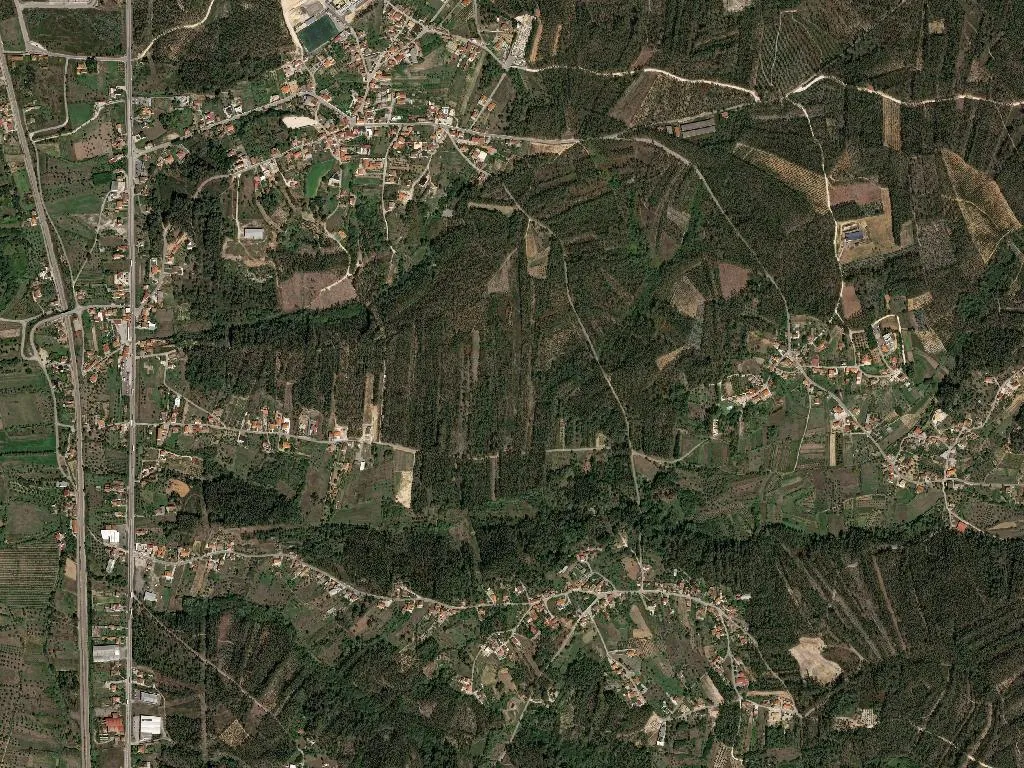
The church bell counts the hours like a tardy regular at the café: nobody checks their watch, yet the whole parish notices when it falls silent. Heat still pulses through the granite churchyard; beyond it, wheat and olive terraces ripple downhill to the Mondego like a badly tucked sheet. At 82 m above sea level, Pelariga inhales slowly—2,012 souls, a micro-climate warm enough for cherry and olive to argue over the same sunbeam.
New parish, older stories
Carved from Santiago de Litém in 1928, the parish arrived the way bills are split after a round of beers—quickly, pragmatically. The etymologists are still arguing: one camp traces the name to Latin pelare, “to fish”, harking back to a time when the Mondego ran thick with shad; the other prefers pedra-riga, the ruler-straight seam of Jurassic shale that ribs the hills. Either way, the mother church went up almost immediately—no frescoes, no frills, just whitewash thick enough to reflect candlelight and a bell that still carries farther than mobile reception. Higher up, the hamlet of Aldeia Nova keeps a pocket-sized chapel to St Sebastian; on 20 January the key turns, the door creaks, and the only other sound is wind worrying the oaks.
Fossils still in their beds
Follow the quarry lane west for five sun-bleached kilometres and the roadside shale begins to glitter. Embedded sea-urchins—Cidaris genus if you carry a guidebook—look as though they missed the evacuation notice 150 million years ago. Unlike most Portuguese fossil sites, these were never picked clean by collectors; farmers simply ploughed around them. From the ridge the Mondego becomes a slack silver ribbon someone forgot to spool up.
Wood-smoke and clandestine ovens
Kitchens here are governed by the firewood calendar. Kid goat is blistered until the skin sings; chanfena—goat stewed in red wine and pig’s blood—simmers overnight in unglazed clay pots that pre-date the parish itself. Mid-morning on any given Monday, Marta’s smoked sausages surface in the communal cozido; no sauce required—their own fat supplies the gloss. Finish with dona Alda’s milk-custard buns, dissolving just short of the tooth, and a thimbleful of Rui’s medronho, distilled in the family olive press. DOP Rabaçal cheese, Ribatejo olive oil and Pêra Rocha pears are not souvenirs; they arrive at table because the producer lives two lanes away.
Fire, procession and a parish-scale reunion
On 8 December the village square converts to an open-air canteen: mass at ten, procession at eleven, grilled sardines by midday and Super Bock at €1.20 a glass. Easter Sunday brings the Compasso, a clerical house-to-house delivering wafer and wine; bring a napkin—the priest pours for everyone, including the dog. In alternate years the three-way Bodo fills the night with bonfire smoke, cake auctions and a band whose repertoire begins and ends with the 1930s fado “São os Verdes Louções”. With 76 inhabitants per km², every festival is a family gathering; even the spaniel from across the river turns up.
Dusk drains the colour from the orchards; the Pelariga stream carries off cherry petals like pale receipts. Wood-smoke leaks from a chimney hidden behind lemon trees, and a blackbird rehearses tomorrow’s descant. No one hurries. Beneath your shoes the sea-urchins still sleep their 150-million-year sleep, and until the bell strikes again history stays politely on hold.