Full article about Alqueidão da Serra: Portugal’s silent limestone balcony
Limewashed cottages, late-ripening pears and goat-bell echoes at 461 m above Leiria’s karst plateau
Hide article Read full article
The air thins at 461 metres
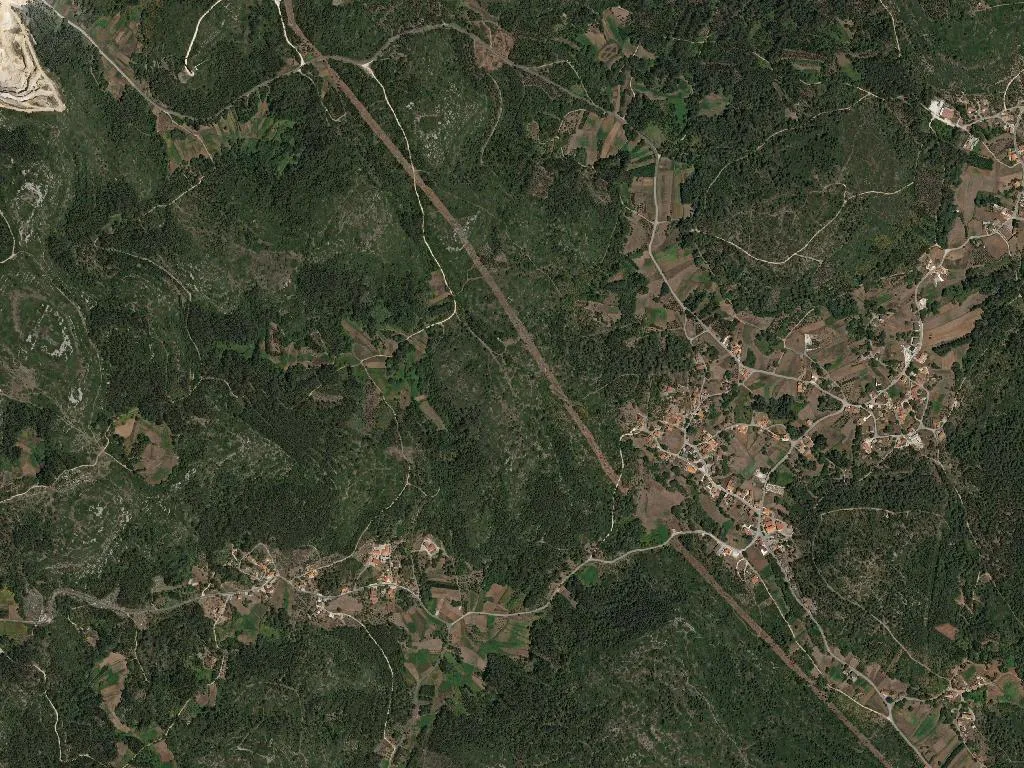
Above the limestone bench that marks the eastern rim of the Serras de Aire e Candeeiros Natural Park, the Atlantic breeze loses its salt and gains pine resin. Grey karst shelves jut between the green of maritime pines and the silver flicker of olive leaves; the hamlet of Alqueidão da Serra clings to the drop like a white limpet. Single-storey houses, their walls limewashed the colour of fresh curd, appear to have germinated straight from the bedrock. Behind them, walled gardens let the local Pêra Rocha pear ripen fifteen days later than in the valley below, sugar concentrating while late frosts stay safely beneath.
Spread across 2,060 hectares of fractured plateau, the parish numbers exactly 1,549 souls – more than a quarter past retirement age. Walk the red-dirt tracks and the loudest sound is your own footfall, followed – if the wind shifts – by the faint brass clonk of a goat bell. Only 160 children were counted in the 2021 census, yet on Saturday afternoons the thud of a football against the primary-school wall still ricochets through the silence before dissolving into the scrub.
Stone, water and oil
The park is not backdrop; it is rule-book. Thin rendzina soils force patience, outcrops forbid large machinery, subterranean springs surface or vanish according to winter rainfall. Terraces hold olives entitled to the Ribatejo DOP, their fruit crushed in the cooperative press at Porto de Mós, and orchards of Alcobaça apples (PGI) picked by hand each September. Every backyard carries a grafted pear whose fruit keeps its crunch for the haul to Lisbon markets; altitude is the invisible ingredient.
The logistics of stillness
No coach parties turn off the N243 onto the municipal road; the inventory of beds remains stubbornly below twenty. What exists is discreet: five village houses restored by Porto de Mós town hall between 2018 and 2020, two B&Bs where breakfast arrives with quince jam from the communal wood-oven that fires only on Fridays. Visitors come to trace the PR2 “Mills Trail”, to sketch in a notebook balanced on the Penha outcrop, to photograph lichen rather than selfies. There are no signed viewpoints, no painted murals; instead, the westering sun ignites the whitewash and throws olive shadows longer than a shepherd’s crook – light so dense it feels tactile.
Taste at height
Gastronomy advertises itself only by word of mouth. Friday means salt-cod açorda at Café Central (open since 1987); August brings grilled rabbit during the parish feast of Nossa Senhora da Saúde. Local oil anoints everything – migas that soak up wood-oven pork, tomato soup sharpened with mountain mint. After the first October rains, wild mushrooms appear between limestone blocks; at dawn, dew still glinting, children hunt snails in the meadow grass. Dusk drops quickly. Wood smoke scented with pine and rosemary threads from chimneys, and you stand there, coat collar up, listening to wind comb the branches until the cold forces you back inside.