Full article about Limestone Lions: Arrimal e Mendiga’s Echoing Quarries
Arrimal e Mendiga, Leiria: explore abandoned limestone amphitheatres, subterranean lignite tunnels and rye-scented hamlets in Portugal’s Aire e Candeeiros.
Hide article Read full article
The Roar of the Stones
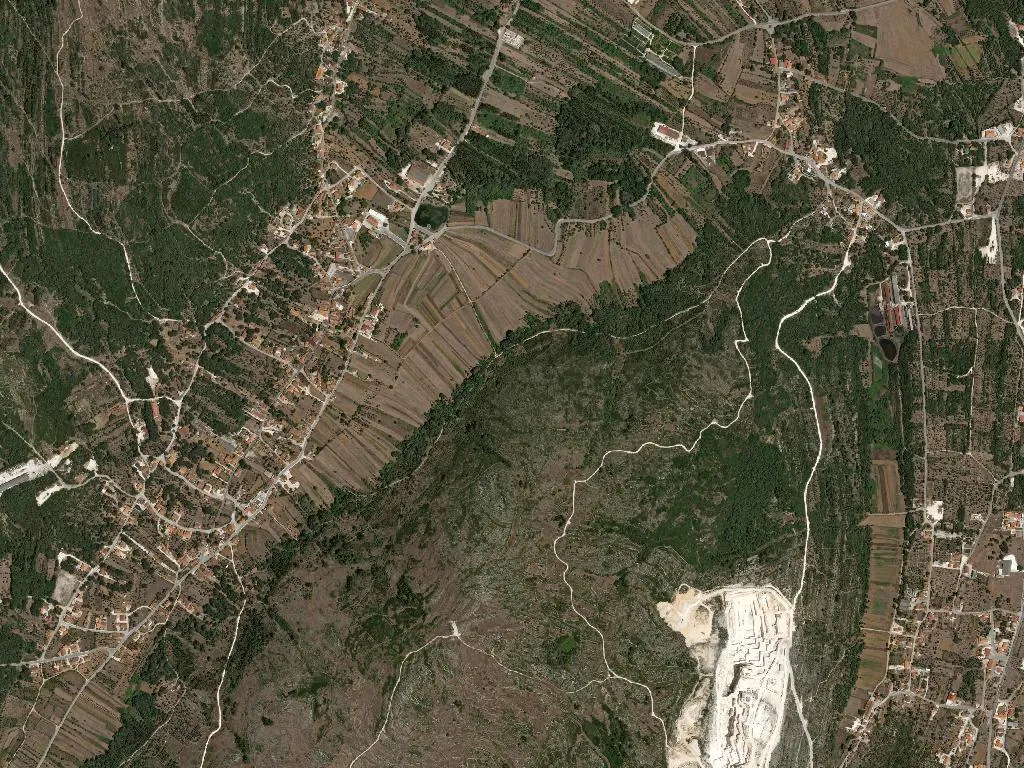
The ground shifts beneath your feet. It is not packed earth, nor polished stone: it is splintered limestone, fracturing into white flakes that heap along the paths like the aftermath of a geological shipwreck. Here in the civil parish of Arrimal e Mendiga, the horizon is a study in absence—rock quarried away, craters left open, cliffs where the noon sun strikes without filter. Silence is dense, broken only by a goldfinch singing from a rock-rose thicket or the far-off grind of a still-working rig somewhere on the plateau.
What the mountain gave
The story of this land is inseparable from what has been carved out of it. From the early 1900s dozens of limestone quarries scarred the flanks of the Serras de Aire e Candeeiros, feeding Portuguese pavement and ornamental stone to Lisbon, Porto and beyond. A handful still operate; the rest stand abandoned, colonised by bramble and rainwater, turned into natural amphitheatres of vertical walls and slanted light. Less visible is the carboniferous chapter: between 1900 and 1962 five lignite concessions tunnelled beneath the same ridge, an industrial interlude now recalled only by sealed galleries and the occasional whiff of cordite that older residents swear still lingers after rain.
The 2013 administrative merger stitched together Arrimal—whose name derives from the Latin arremal for nearby hill—and Mendiga, said to be named after the goats (mendes) that once grazed here. The resulting parish covers 38 km² and is home to 1 574 people, scattered among hamlets where granite farmhouses butt against raw limestone outcrops. In Mendiga village the bakery unlocks its door at seven; wood-smoke and the smell of crusty rye mingle in the lane.
Water and rock
Inside the Natural Park of Aire and Candeeiros, Arrimal e Mendiga present a karst landscape of grey lapiás fields cracked by fissures, caves masked by Mediterranean scrub, and abrupt escarpments rising over valleys of contorted holm oak and thick-barked cork. Average altitude is 355 m; the air carries a dry freshness, resinous with Cistus ladanifer that sweetens in spring to something close to wild honey.
The seasonal ponds at Arrimal—mirrors of water ringed by willow and reed—offer visual respite. Grey herons and mallards trade places with families spreading weekend picnic blankets. The pork-ceviche served in the hamlet bar—raw loin cured in mountain herbs—tastes of both soil and water. Rural trails meander through olives destined for Ribatejo DOP oil, orchards of Alcobaça PGI apple and West DOP Rocha pear, and improbable terraces of old-vine Vital and Fernão Pires.
What lies on the surface
Exploring here demands calves and curiosity. Mountain-bike tracks climb and drop over loose stone, thread through Portuguese oak thickets, then burst onto the Mendiga Plateau where the horizon is nothing but limestone, sky and the distant saw-tooth ridge. In the disused quarries the late-afternoon light paints walls ochre and rose; photographers and birders return for the uncanny acoustics and the chance of a soaring lesser kestrel. The silence is so complete you hear blood in your ears.
The population is ageing—359 residents over 65, only 194 under 14—and at 41 people per km² quiet is guaranteed. In Café O Pátio, men play sueca at dusk while sipping 60-cent espresso. The eleven guest rooms and cottages scattered across the parish host mainly slow hikers and star-chasers: light pollution is nil, and satellites cross the sky like clockwork toys.
When the lowering sun ignites the airborne limestone dust, the land appears to burn without flame—an almost blinding whiteness that turns craters into mirrors and the lapiás into exposed bone. The image sticks to the retina, along with the sound of stone grinding under every step.