Full article about Porto de Mós - São João Baptista e São Pedro
Hear rival São João & São Pedro chimes while river Lena laps the quarried ridge
Hide article Read full article
Porto de Mós: Where Limestone Speaks Across Centuries
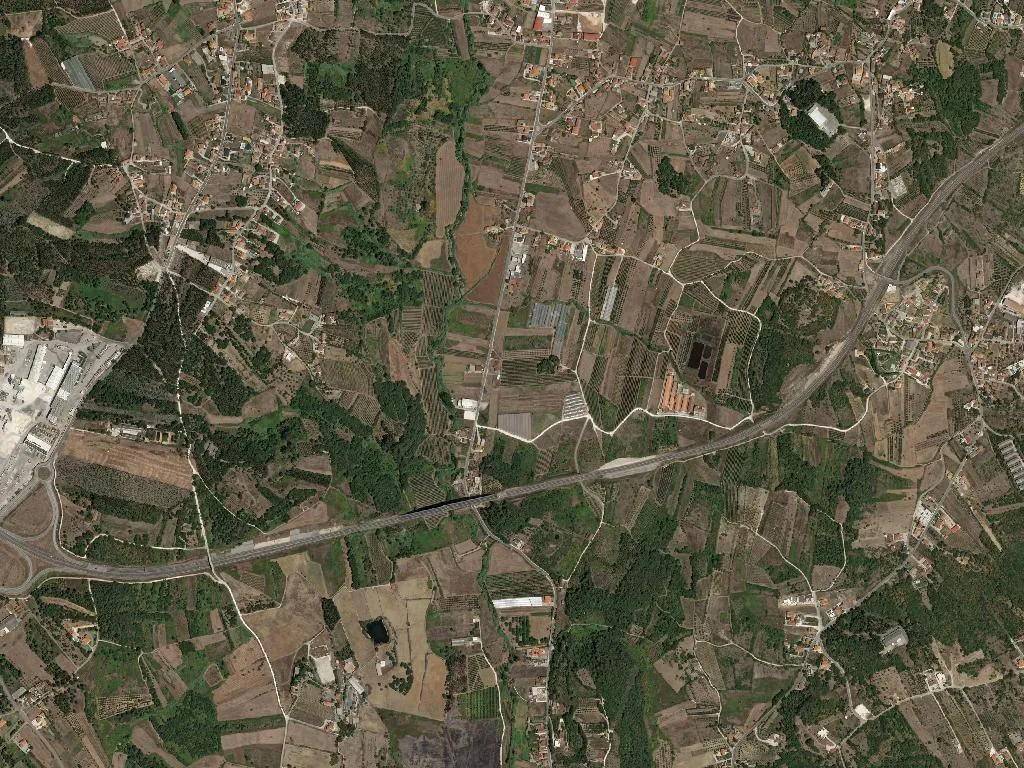
The sound arrives before the sight. A low river-song – the Lena sliding between reed and willow – then, suddenly, a green-scooped skyline: the Castle of Porto de Mós, its conical turrets tiled in ivy, rising from a limestone ridge as though the rock itself had shrugged it upwards. Dawn light strikes the Gothic-Manueline façade and the stone answers back in two voices: bone-white where the sun hits, honey-yellow where it lingers. At 104 metres above sea-level the town inhales slowly, pinched between the open valley of the River Lis and the first buttresses of the Serras de Aire e Candeeiros Natural Park, a pale wall of karst that begins just east of the last house.
The mill-stone port
The name is practical, not poetic. A riverside quay on the Lena once received mill-stones hewn from the quarries of the Serra de Aire – dead weight floated downstream to grind the cereals of Coimbra and Leiria. King Afonso Henriques granted the settlement its first charter in 1169, acknowledging a place that already lived off stone, water and the traffic between plain and mountain. For centuries the two parishes – São João Baptista and São Pedro – operated as rival siblings, each with its own church, churchyard, bell-cycle and feast-day. Only the 2013 administrative shake-up forced them into a single civil parish of barely 6,000 souls, yet a five-minute walk still separates the two bell towers, and locals continue to give directions according to whose turf they stand on.
Limestone, carving and cobalt glaze
The castle refuses to behave like a fortress. Rebuilt in the late 15th and early 16th centuries, it flaunts palace flourishes – scalloped Manueline windows, slender arches, stone worked so finely it seems bored by its own weight. From the battlements the Lis valley unrolls in mismatched greens: silver-leaf olive groves, orchards of pear and apple, scattered cork and oak on the higher ground.
Drop down the calcário cobbles and the parish church of São João Baptista presents a mannerist façade and a 17th-century gilded altarpiece that drinks candle-light and returns it as liquid warmth. On the opposite slope, São Pedro keeps a different register: 18th-century patterned azulejos in cobalt and snow-white, tessellated into hypnotic geometry. Between them the Manueline pillory marks the crossroads, while the 18th-century aqueduct – arches now ferrying shade instead of water – guides you into gardens where limestone benches soak up midday heat.
Add the Franciscan Convent of the Annunciation and two rural chapels – Nossa Senhora da Conceição and São Sebastião – and you have a two-hour loop, assuming you don’t yield to invitations from doorways.
Lamb stew, trembling sponge and throat-prickling oil
Resistance is futile. Porto de Mós eats like a place that has never doubted the marriage of mountain herbs and lowland livestock. Ensopado de borrego arrives in a clay bowl: lamb shoulder collapsed into a dark, clove-scented gravy, the bread beneath it dissolving into sauce. Wood-oven kid goat carries the smell of ember on its skin; chanfana – goat slow-braised in red wine – stains the fingers a week-long purple. Winter’s stone soup (feijão, chouriço, cabbage and every garden vegetable that ever met a ham bone) lingers into spring, lubricated by Rivatejo DOP olive oil the colour of early straw and with a finish that scratches the throat like the stone it grew on.
Dessert is equally territorial. The local pão de ló is no airy roll but a trembling slab of eggy sponge that wobbles when you breathe on it. Walnut biscuits, queijinhos-do-céu and pastéis de feijão fill the bakery trays, while in the surrounding orchards Alcobaça apples and Rocha pears ripen at the same contemplative speed that governs everything here.
The range that opens beneath your feet
East of the last street the earth changes character. Cultivation stops; limestone stands raw, cracked, hollow. You are on the western rim of the Serras de Aire e Candeeiros Natural Park where, within kilometres, the land vaults from 100 m to 700 m. It is textbook karst: white scarps, dry sink-holes, caves that yawn without warning. Way-marked trails leave the town for the Moeda and Alvados caverns, interpretative routes that let you walk inside the planet and listen to the slow drip of stalactites overhead.
Above ground the thin soil and arid air nurse a discreet biodiversity: wild orchids on road-cuttings, rock-dwelling birds on the cliffs, and in the olive and cork plots, self-guided bird trails that make use of the mountain’s thick silence. Holm oaks with twisted trunks and broad-crowned oaks survive in sheltered valleys, while small estate presses open for informal tastings and direct-sales, the owner wiping green oil from the neck of the bottle with the back of his hand.
A final impression
Late afternoon, when side-light bronzes the castle walls and swallows stitch the sky above the aqueduct, a particular smell lifts from the narrow lanes – wood-smoke from bakery ovens laced with the dry, mineral breath of limestone that has been warming all day. It is a scent impossible to bottle because it depends on this exact equation: this rock, this river, this escarpment rising like a promise to the east. You leave it on your coat collar long after the town has disappeared in the rear-view mirror, a reminder that some places travel with you not as postcards but as atmosphere.