Full article about São Bento: Silent Stone Village Above Aire-Candeeiros
Granite cottages, pear orchards and shepherd trails in Porto de Mós’s quietest parish
Hide article Read full article
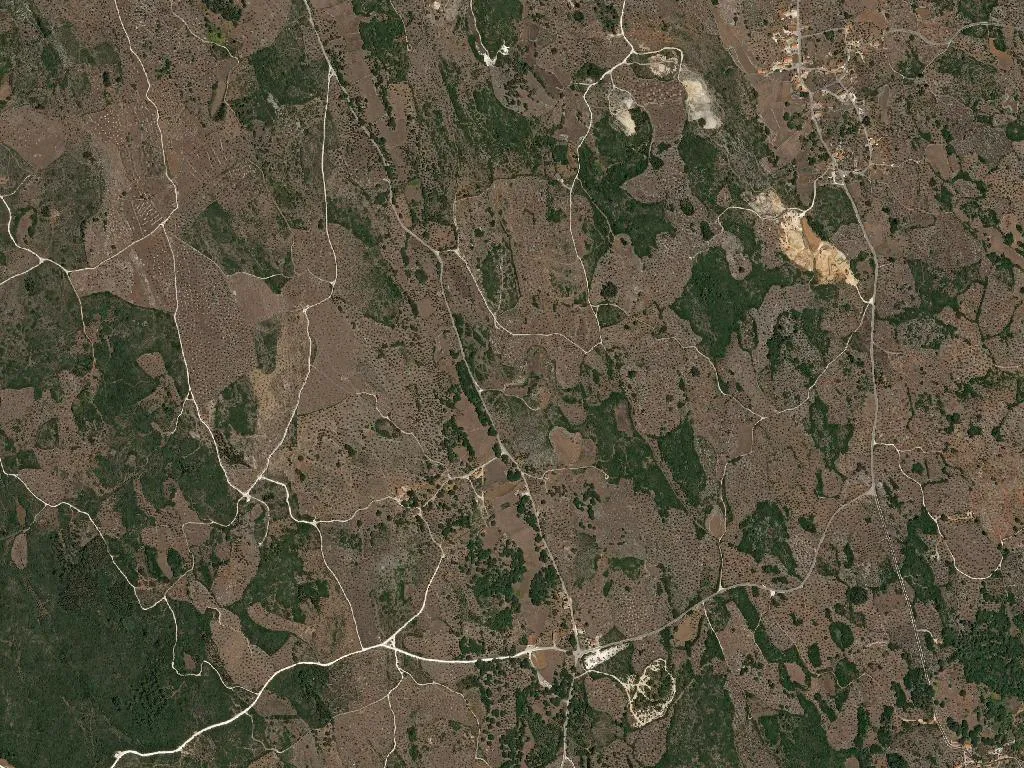
Granite elbows its way through the parish at every turn: along the lanes, in the low cottages, under the scuffed thresholds of doors. At 327 m above sea level, São Bento inhales the same dry air that scours the limestone ridges of the Serras de Aire e Candeeiros. Water sinks instantly here, vanishing into dollines and fissures, leaving the ground tattooed with signs of every civilisation that tried to scratch a living. Only 751 souls remain, scattered across 41 km² – a ratio that turns silence into something you can almost weigh.
Between stone and soil
The parish spills down the south-western flank of the Natural Park, a buffer zone where the karst plateau meets pockets of cultivable ground. In the irrigated plots, pickers still twist Pêra Rocha do Oeste pears from the branches by hand and stack IGP Alcobaça apples into slatted wooden crates. Olive groves – the source of Ribatejo DOP oil – give way to rough pasture; both are worked at the pace of a dwindling population. Census figures read like a slow-motion departure: 238 residents over 65, just 90 children under 14. Tourism is almost self-effacing – three stone cottages let directly by their owners, no booking platforms, no welcome packs, just a key under a flowerpot and the promise of absolute quiet.
The mountain as refuge
North and east, the park unrolls into a labyrinth of lapiás fields, sinkholes and cave mouths carved out over 180 million years. Trails are unsigned and stony; ankle-turning ruts disappear under thyme and rosemary. You can walk for an hour and meet only a shepherd shifting his coarse-wooled flock between clumps of kermes oak. Their bells clank across the valley with the metallic regularity of a metronome, the only clock that matters once the mobile signal dies away.
What the land gives the pot
The kitchen follows the harvest calendar. Olive oil is poured with the generosity of someone who made it: to soften winter kale and bean stews, to enrich garlic-thick açorda, to anoint salt-baked cod punched open with roasted potatoes. Pears and apples re-emerge as amber-coloured compotes, sealed with wax discs and stored in cool pantries. Bread is a 24-hour affair – sour, dense, crust thick enough to splinter. Sunday means kid goat, rubbed with garlic, white wine and pork fat, then slid into a wood-fired bread oven whose smoke drifts down the lane like an olfactory dinner bell.
The stories the stones keep
The chapel of São Bento, rebuilt in 1727 over a 14th-century hermitage, carries the coat of arms of Dom Frei José de Lencastre, the Lisbon archbishop who paid for the new roof. Inside, a gilded baroque retable rescued from the suppressed Convento da Conceição in Porto de Mós fills the apse with carved cherubs and twisted columns. Five hundred metres away, a squared-off boulder is etched “1897 C.M.P.M.” – the initials of the Porto de Mós Mining Corps that once hacked limestone from the Pedreiras do Galvão. The quarries closed in 1978 when the park was created; older residents still recall the white dust that settled on vines like inverse frost whenever the wind swung northerly.
Evening light slants across the granite façades, turning them the colour of burnt honey. A woman in carpet slippers sweeps her threshold with a broom of rice-straw, each stroke a soft rasp against the hush. Somewhere uphill a single bell rings – two short notes, unhurried. The echo lingers just long enough for the hills to answer before everything settles back into the deep, deliberate stillness that defines São Bento.