Full article about União das freguesias de Alenquer (Santo Estêvão e Triana)
Santo Estêvão e Triana guard Manueline altars, 1212 charters and vines that once armed João I
Hide article Read full article
Where limestone keeps the wine and the memory
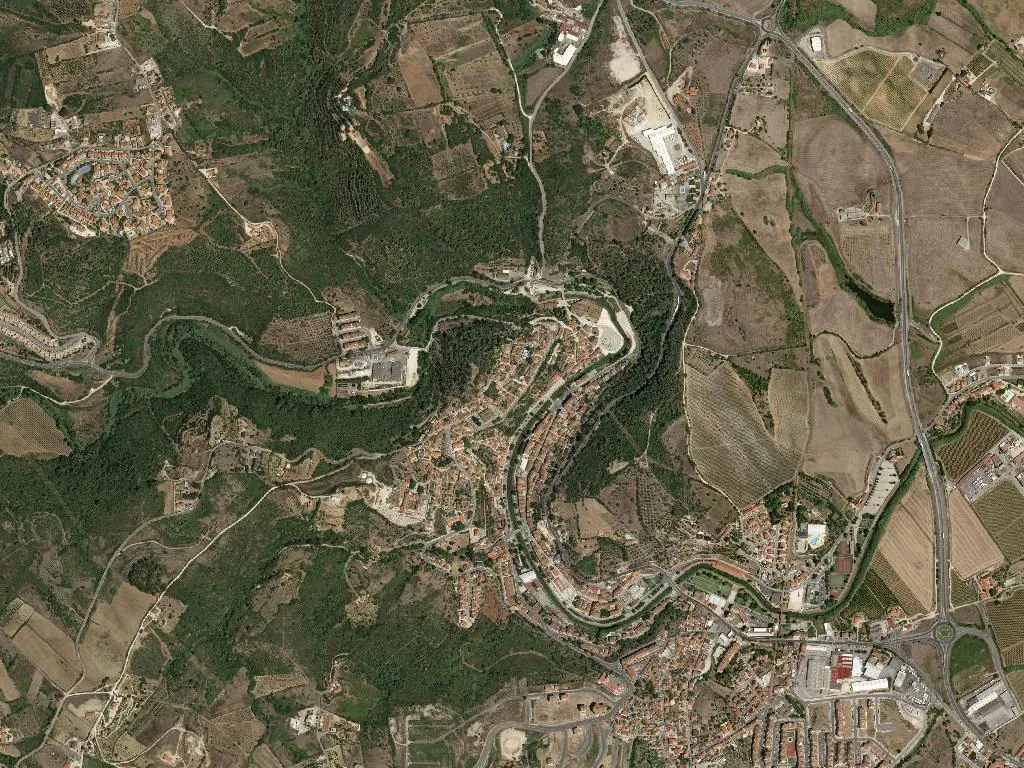
The smell arrives before the sight: a sweet-acid tang of fermenting must, damp chalk and wood-smoke that has clung to whitewashed walls since last winter. Footsteps ricochet down a lane barely shoulder-wide, where plaster flakes off to expose the honey-coloured lioz beneath. At the small square the pillory rises like a stone exclamation mark—King Afonso II’s 1212 charter made flesh—reminding you that Alen-quer, from the Arabic al-Ahnikár, once meant “bridge of dawn”. You are standing 75 m above the valley the River Alenquer cuts on its dash to the Tagus, in the civil parish of Santo Estêvão e Triana, and everything here grows slowly: vines, traditions, another skin of limewash over the last.
Charter, court and battles long gone
Santo Estêvão is already a line in a 1157 royal grant; Triana, halfway up the slope, began as a scatter of smallholdings tied to vines and olives. For centuries the two settlements lived back-to-back, each with its own church, patron saint and festival ledger. An administrative merger in 2013 stitched them together, yet a short walk from the upper ridge to the river-front still reveals two distinct accents, two shades of stone, two ways of saying “up here” and “down there”.
In June 1385 Dom João I installed his court here while assembling the army that would march to Aljubarrota, and local growers insist the same red that fuelled the troops was poured at the king’s 1387 wedding to Philippa of Lancaster—an anecdote repeated with quiet certainty, finger tapping the royal accounts that list “vinhos de Alenquer” among the nuptial expenses.
Manueline altarpieces and tiles that tell the hours
The parish church of Santo Estêvão, rebuilt 1530-60, impresses less by size than by saturation. A Manueline gilded altarpiece attributed to João de Castilho survived both the 1755 earthquake and nineteenth-century “improvements”; 1720 cobalt panels wash the nave in a blue that morning light turns almost liquid. Silence inside is viscous, broken only by the timbers clicking as the temperature shifts. In Triana the 1692 chapel of Nossa Senhora da Conceição is calmer still—whitewash, single altar—yet on 8 December it bursts open for a parish Mass and street fair that runs long after the candles have guttered. Ten buildings are listed, two of them National Monuments, and scattered through the vineyards are seventeenth-century manor houses such as Quinta da Serralheira where agricultural wings and family wings share the same symmetrical façade.
Terraced vines and the taste of chalk
Landscape dictates plate, and plate dictates landscape. Terraced vineyards ride the limestone ridges, interrupted by olive groves and umbrella-crowned cork that nibble the horizon. This is the Alenquer sub-region, Lisboa wine zone: Touriga Nacional and Tinta Roriz draw a seam of flint that winemakers call “chalk dust on the tongue”. Arinto and Fernão Pires give quieter whites, green-citrus, whistle-clean. Since 2015 the old barrel-hall at Quinta da Aveleda has housed the Alenquer Wine Interpretation Centre, while the Tagus Wine Route stops at family properties such as Quinta do Monte d’Oiro, where Azeitão sheep’s-cheese and Alenquer custard tarts are lined up on a table already grooved by decades of glass rims.
At lunch the clay-pot leek-and-meat soup arrives steaming, thick with Beira fat-streaked bacon; eel stew from the Ribatejo flood-plain and kid roasted over vine-prunings jostle for centre-plate, while asparagus migas give a green, earthy counterpoint. For pudding the egg-knots, walnut biscuits and the local pão-de-ló—recipe traceable to the 1830 Convento do Espírito Santo—demand a siesta under the orange trees. Lower down the slope, Pêra Rocha do Oeste DOP pears ripen with the patience the calcário-cárceo soil teaches.
Caves turned Nativity scenes and scallop-shell paths
Alenquer bills itself the “Nativity Town”: each December limestone caves and old stone vats become shadow-box cribs, lit by candles that catch the damp glitter of the rock. The feast of St Stephen on 26 December keeps the mood, while Holy Week processions haul eighteenth-century Baroque images up gradients that test even the strongest shoulders. November’s São Martinho fair revives a medieval formula: new wine, chestnuts popping on the brazier, artisans selling from plank tables.
If you want the landscape to yourself, the 11.5 km Serra de Montejunto trail (PR1) gives Tagus views and stepped-vineyard perspectives, and the Alenquer wetlands host grey herons among the reeds. Since 2015 the Caminho de Torres, a Santiago detour, has way-marked the lanes; expect to meet backpackers with scallop shells stitched to their hats, measuring distance in stories rather than kilometres.
The sound that stays
Late afternoon, when the sun copper-plates the vines and the cooling air carries limestone on the throat, the bell of Santo Estêvão strikes seven. The note rolls downhill, skims the trellises, vanishes somewhere near the river. It is the sound you take away—not a postcard, but a low vibration that lingers in the ribs long after the road has turned north.