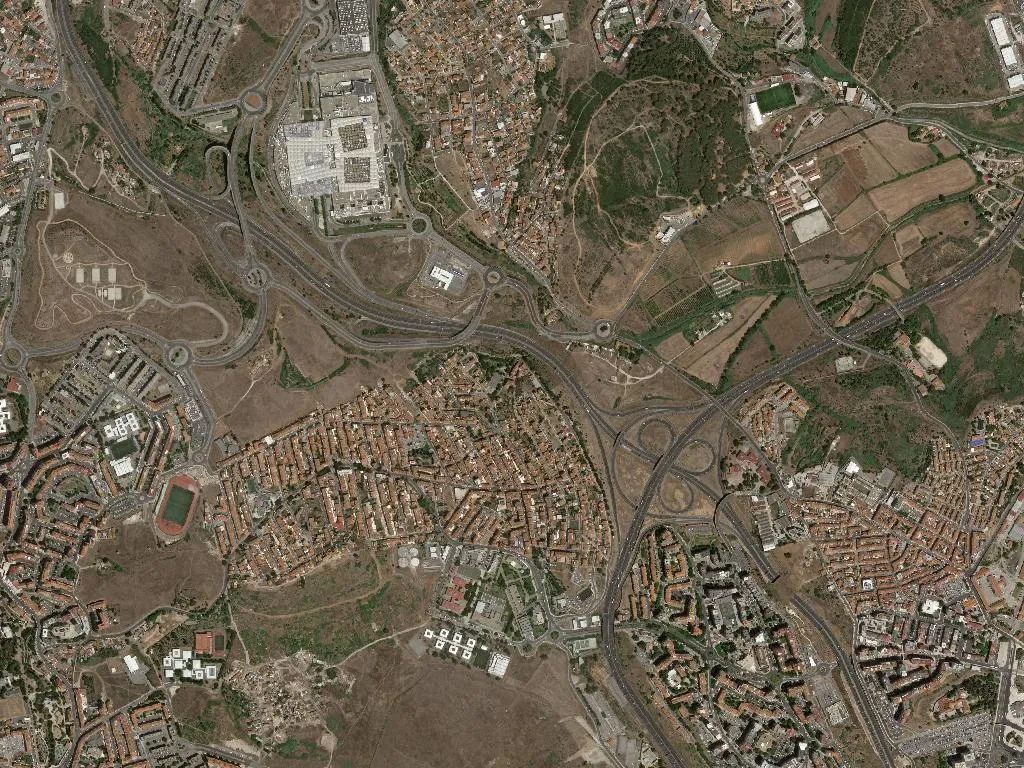
Full article about Sun-splashed Encosta do Sol: Amadora’s vertical village
1980s tiles blaze on a 74-m slope where 27,000 neighbours turn concrete into community
Hide article Read full article
A slab of light: morning in Encosta do Sol
At 09:00 the sun squares up to the six-storey blocks and the light ricochets off 1980s tiles – avocado, custard, terracotta – turning every façade into an accidental colour chart. A bus exhales, a Yale key scrapes an aluminium door, a wheelie-bin growls across concrete. No church bells here; time is kept by the Metro timetable, the far-off whistle of the Sintra-line train, the synchronised clack of roller-shutters rising. Encosta do Sol, 27,000 people in under three square kilometres of lawn rectangles and rebar.
Where allotments once grew, storeys sprouted
The name is literal: a 74-metre south-facing slope that still catches the last rays when the rest of Amadora is already in dusk. Before 1997, when it became a civil parish, this was smallholdings and vegetable plots swallowed by Lisbon’s 1960s expansion to house families from Alentejo, Angola, Mozambique. No castle, no Roman bridge; the heritage is mirrored balconies sealed with aluminium and satellite dishes prickling the rooftops like steel cacti.
Density as a way of life
9,700 inhabitants per km² is not a spreadsheet figure; it is the smell of espresso colliding with fabric-softener on a stairwell, the third-floor argument audible at pavement level when the wind drops. Inside Colina do Sol shopping centre footsteps echo between shuttered units. The demographic has greyed: 5,600 residents are over 65, 4,000 still carry school rucksacks. By 10 a.m. the re-landscaped gardens are occupied by pensioners balancing supermarket bags and hours they’d gladly trade for cash.
The flag nobody saw coming
In 2023 Encosta do Sol won Portugal’s Gold Green Flag – 97 % – without a river or public park. Sustainability here is DIY: repair cafés, Saturday street-sweeps organised by WhatsApp, drought-proof shrubs planted in old paint tins. Not postcard ecology; neighbour ecology.
A pilgrim in trainers
The Portuguese Way of St James cuts straight through. On foggy mornings a backpacker with scallop shell and trekking pole waits at the same pelican crossing used by teenagers late for class. Medieval and mortgage-bound share the asphalt for 300 metres.
After-image
At 18:30 the sun lies flat against the western elevations and, for roughly 120 seconds, the blocks appear to combust in silence. Then shadow climbs storey by storey, ending with the metallic click of a tilt-and-turn window snapping shut – the most intimate gesture of a district that turns inwards when the light finally gives up.