Full article about Falagueira-Venda Nova: Lisbon’s Sky-High Suburban Mosaic
Arabic-named, centre-less parish rises 98 m above the Tagus in a thrum of flats, yeast and commuter
Hide article Read full article
The Plateau Where Lisbon Unravels into Suburbia
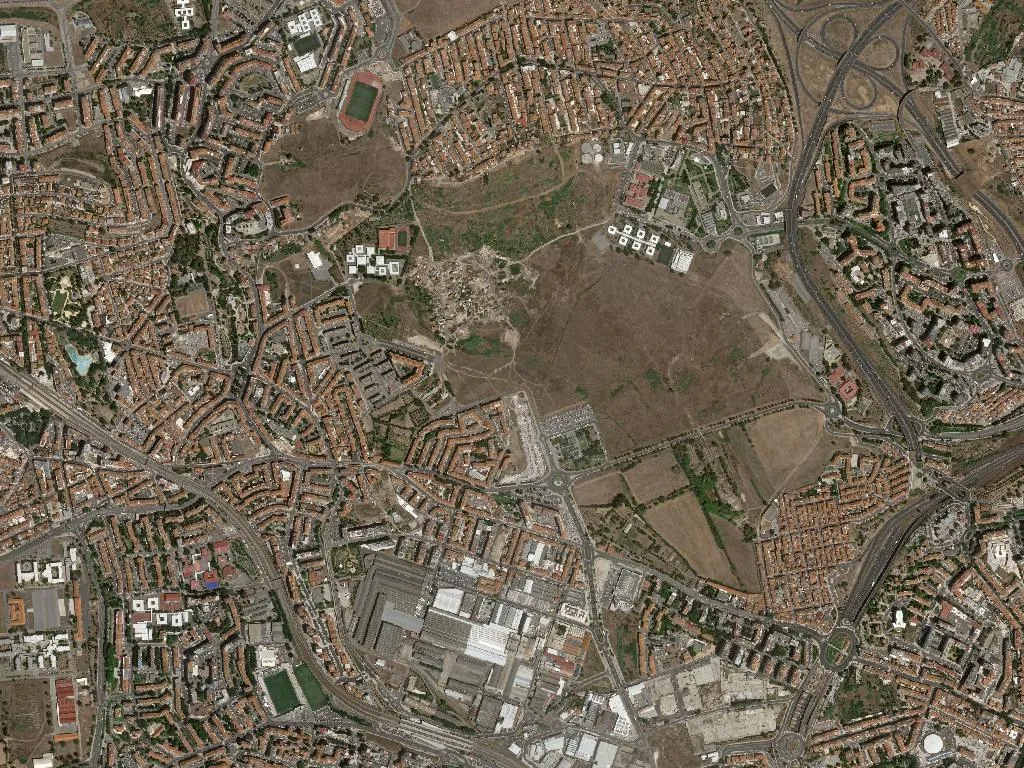
The bus exhales, brakes hiss, and the doors fold back to release you into air that feels abruptly 300 feet above the Tagus. No Atlantic breeze reaches Falagueira-Venda Nova; instead, the heat reflected from five-storey façades slaps the skin, flavoured with the yeasty sigh of the Padaria Marquesa on Rua 25 de Abril. Twenty thousand neighbours are compressed into little more than a square mile, yet the place has never acquired a centre – just a continuous, low-frequency hum of lives stacked upon one another. You do not ‘discover’ this parish; it discovers you, usually at 07.18 when the Cascais commuter train rattles past the sixth-floor kitchen window and the day begins without ceremony.
An Arabic Echo in Concrete
Say “Falagueira” aloud and you are pronouncing eight centuries in two syllables. The word drifts down from the Arabic falaiseira, a nod to terraces and scarps long since planed flat by bulldozers. No castle, no church, no Manueline balcony remains: the Moors and the medievals survive only as sherds boxed away in the municipal archaeology depot, buried again beneath the poured foundations of the 1960s apartment boom. What did endure is the topography – a subtle, 98-metre shrug that lifts the quarter above Lisbon’s haze and lets residents claim a sky they can almost call their own. Administratively, Falagueira-Venda Nova is a mere adolescent: the parish council was stitched together from two older neighbourhoods only in 2013, which may explain its disinclination to brood on the past. Listed heritage is limited to a modest 19th-century fountain in Largo José Sanches; everything else is still being written in concrete and clothes-line linen.
Yellow Arrows on Tarmac
Beneath the commuter flow runs something older than the A9 orbital: the Central Portuguese Route of the Camino de Santiago. The arrows appear without fanfare – a daub of cadmium on a lamppost, a scallop shell sticker beside the traffic lights on Rua Professor Francisco Gentil. Pilgrims in boots and carbon-fibre sticks wait at the pedestrian crossing beside grandmothers wheeling tartan trolleys of oranges. The suburban stage of the Camino offers no vineyards or stone bridges, only the discipline of the next step between parked Citroëns and the intermittent shade of plane trees planted the year Portugal joined the EEC. It is a stripped-back rehearsal of medieval travel: walk, trust the way-mark, ignore the absence of romance, notice instead how the asphalt softens at 37 °C and how a stray cocker spaniel barks in 5/4 time behind every second gate.
A Rectangle of Breathing Space
Jardim da Falagueira was never designed to be grand – 1.2 hectares of lawn and gravel locked in by apartment wings – yet it performs the alchemy expected of urban greenery. Children escape the primary school named after Dr José Sanches and sprint straight into the gravel path’s Rorschach of dusty footprints. Octogenarians occupy the peeling wooden benches before the afternoon news begins, the light sliding from white to honey, softening even the greyest façades. Planted in 1987, the planes now knit a canopy high enough to let residents forget the density figure of 7,268 souls per square kilometre, if only until the next police siren reminds them where they are. Botanists will not swoon, but lungs and retinas register the transaction: chlorophyll for anxiety, shade for rent.
Culture Without a Stage
Falagueira-Venda Nova does not do folk costumes or fireworks. Its calendar is municipal, modest, efficient. In December the parish hall hosts a craft fair where you can buy soap stamped with sardines and earrings shaped like trams; August brings Dead Combo’s reverb to the garden gazebo, the duo’s western-tinged fado drifting over prams and plastic cups of cloudy beer. The true civic theatre is the market hall (open Mon-Sat, 07.00-14.00): Silves oranges stacked like cannonballs, the butcher who remembers how you like your entrecôte trimmed, the fishmonger who will fillet espada while debating yesterday’s Sporting score. Across the car park, the Café Progresso keeps its espresso at 65 ¢ and its décor in the key of 1974: formica, mirrored wall, a television permanently tuned to rolling news. No gastronomic DO label protects the cooking because none is needed; identity here is measured in daily competence – a tasca called O Palerma where the menu is marker-penned on the window and the arroz de cabidela arrives exactly as it did before the euro existed.
Where the City Confesses
Strip away the guide-book adjectives and this is what remains: 20,788 people negotiating ageing, school runs, price rises, laundry cycles. Density is not an abstraction – you feel it in the stairwell tremor as the 07.15 train passes, in the echo of a bin dragged across tiles at 22.00, in the smell of massa de pimentão drifting through a summer window left ajar for ventilation. The yellow arrows of the Camino fade under street-light sodium, and the evening plateau breeze – finally, a breeze – carries the clink of shopping trolleys and the last bark of the cocker spaniel. No cathedral marks the end of the pilgrimage, only the next intersection, the next block, the next espresso machine still exhaling at Café Progresso. Falagueira-Venda Nova offers no revelation except the city’s own reflection: bruised, functional, alive.