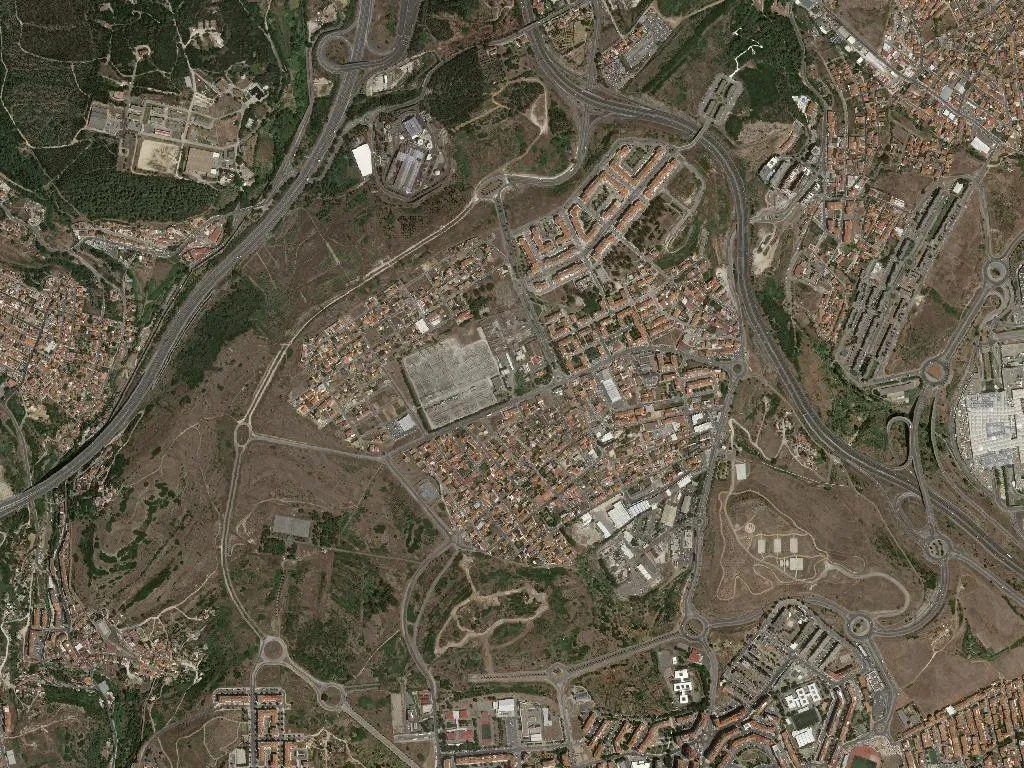
Full article about Mina de Água: Lisbon’s Sky-High Parish of Echoing Arches
Breathe cooler air above the Tagus where 43,000 voices hum around 127 aqueduct arches.
Hide article Read full article
The bus lurches uphill and the engine complains
We are 233 m above the Tagus—higher than anywhere else in Amadora—and the air is already a fraction cooler, a fraction cleaner. Below us, the city’s coastal plain unrolls like crumpled tissue, tower blocks glittering in the haze. Step off the 227 at the Mina de Água stop and the wind arrives first, slipping between the high-rises, worrying the plane trees and rattling the aluminium shutters that still cling to older walls. This is not a parish that offers itself up in a single glance; it yields its stories slowly, in the rhythm of shopping bags, school runs and the 06:30 clatter of bottle banks.
Forty-three thousand lives stacked eight square kilometres high
Read the numbers properly and they become flesh: 5,300 people per km²—more than Bloomsbury, less than Barceloneta. The queue for pão da manhã at the branch of Padaria Portuguesa on Avenida das Cegonhas begins at 07:10. By 08:00 the EN117 is a slow-moving vein of headlights. Inside the Palminheira Pingo Doce you’ll hear Cape Verdean creole, Brazilian Portuguese, Ukrainian and the flat vowels of second-generation Punjabi—all within three aisles. Age skews older: 8,200 residents are over 65, only 6,750 under 18. That imbalance settles on the benches of Jardim da Fonte Nova after lunch, where card games outnumber pushchairs, and the only thing quicker than the slow shuffle of slippers is the flick of dominoes on stone tables.
A monument that refuses to move
Cutting straight through the concrete is the Aqueduto das Águas Livres, 127 granite arches slung across the parish on their 18 km march from Lisbon to the Carenque springs. Begun in 1731 under military engineer Manuel da Maia, it was listed even before Portugal had a listing system—1910, the same year the republic was declared. The aqueduct predates every surrounding structure: the 1952 social-housing stripes of Palminheira, the 1980s HLM slabs, the 2004 glass-and-stucco towers of Porta do Sol. Satellite dishes bloom from façades like grey mushrooms, laundry flaps overhead, yet the arches hold their ground, a stubborn bookmark in a story that keeps being rewritten.
Pilgrims between zebra crossings
Few walkers realise they are on the Central Portuguese Route of the Camino de Santiago until a yellow arrow appears on a lamppost outside the 224 bus stop on Rua Professor Francisco Gentil. There is no creak of ox-carts, no scent of eucalyptus; instead, the scent is of espresso and diesel, and the soundtrack is Café Avenida’s television tuned to Benfica. Yet the suburban stage is oddly honest: the pilgrion merges with the commuter, the meditation of footstep meets the blunt choreography of the city. The waymarking threads past the Alfragide shopping park, past take-away queues and cash-and-carry loading bays—an unvarnished slice of contemporary Portugal, no filter applied.
Bedrooms among the neighbours
Accommodation is scarce and mostly unlicensed: 37 listings on the parish books—aparthotels, spare rooms, a single hostel bunk-bed wedged into a former maid’s quarters. You do not sleep here as a tourist; you sleep as a temporary neighbour. At 06:00 the clank of the communal rubbish shoot becomes an alarm clock; at 06:30 the rev of the refuse lorry confirms it. Coffee aroma rises from the ground-floor pastelaria; someone two floors up is already arguing with Sport TV. It is accidental immersion, and precisely why some travellers seek it out.
Outskirts that outnumber cities
Call Mina de Água a “suburb” and the statistics laugh back: 42,961 souls—larger than Cambridge or Canterbury, only fractionally smaller than Reykjavík. Reach it on the Sintra commuter line (12 minutes on foot from Amadora station) or aboard the Vimeca 025 express: 25 minutes from Marquês de Pombal when traffic on the IC17 behaves. Crowds remain manageable; there is no tourist crush, no queue for the perfect shot. Instead, space to sit on a striped bench in Jardim da Estrada da Caparica and watch generational choreography: grandfather in a flat cap pushing a pram, teenager dribbling a scuffed football, woman on a fifth-floor balcony shaking sheets into the wind until they billow like lateen sails.
The sound you leave with
There is no babbling brook, no nightingale. What follows you home is the layered white noise of 40,000 overlapping lives—the neighbour’s eight o’clock news leaking through the wall, a child’s laugh ricocheting across the 25 de Abril estate, the distant horn on the EN117, the scrape of a plastic chair on Café Imperial’s terrace. So constant it almost registers as silence, yet it is the opposite: the breathing of a parish suspended 233 m above the sea, caught between the open sky of the Serra and the glint of the river far to the south.