Full article about Cadaval & Pêro Moniz: Atlantic-breathing schist vineyards
Terraced vines, ducal gateways and sour-cherry firewater in Lisbon’s quiet western serra
Hide article Read full article
The light on the hills above Cadaval behaves like a guest who hasn’t decided whether to stay for dinner. Thirty kilometres short of the Atlantic, vineyards tilt south-west on terraces so shallow they appear to float. Salt arrives on the breeze, but only as a suggestion; the serra still keeps a hand on the thermometer. Between cane-pruned rows you hear the Cadaval stream before you see it—an undertone of water heading for the Alviela, a tributary that will slip, eventually, into the Tagus.
Two villages, one ducal memory
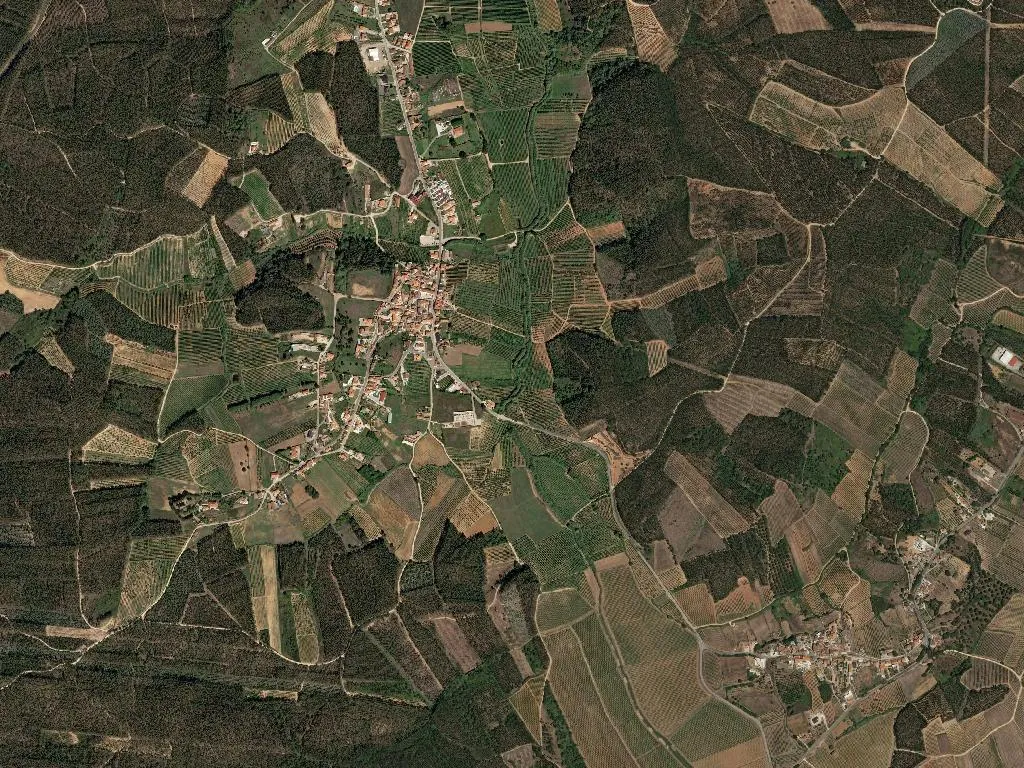
Cadaval and Pêro Moniz were yoked together in the 2013 municipal reshuffle, yet each keeps its own pulse. The older settlement takes its name from the Latin Cadaualis: an inhabited place that refused to be abandoned. Pêro Moniz honours a medieval tenant—Pêro, son of Moniz—whose name fossilised into topography. Since 1648 both have answered to the House of Cadaval, a ducal dynasty whose coat of arms still caps the stone gateway at Quinta da Serra. The estate’s symmetrical fields follow the same sesmaria boundaries once rented out to tenant farmers; from the air the parcel lines look like green origami.
With only 96 inhabitants per square kilometre, space is the main crop. Low schist walls divide vegetable plots where winter kale grows wild-haired; gates hang on rusted strap hinges that squeal in D-minor. Demography skews old—937 pensioners to 500 teenagers—so mornings begin with the school bus grinding up the lane while the afternoon settles on a bench outside the café where Zé Manel and Sr Alfredo rehearse the same Sporting–Benfica argument they started in 1983.
Wines, pears, sour-cherry firewater
The Cadaval co-op, opened in 1958, still receives grapes from 300 smallholders. Arinto and Fernão Pires for whites, Touriga Nacional and Tinta Roriz for reds: Atlantic mornings and clay-limestone soils draw out the ripening until the berries taste of damson skin and pencil lead. Inside the cathedral-sized winery the air is thick with carbonic maceration; taste the tank sample of “Quinta do Cadaval” Reserva and you’ll find bergamot on the nose, iron on the finish—an echo of the limestone that pokes through the vineyards like broken bones.
Pears are the other signature. Pêra Rocha do Oeste DOP orchards are trained on horizontal wires so the fruit can hang without shoulder-rub; picked in August, the flesh is granular, almost winey. Between pear rows you’ll spot the smaller, darker fruit that supplies Óbidos ginjinha—Morello cherries macerated in aguardente, served in thimbles of dark chocolate at Sr Joaquim’s tasca. One sip delivers sour, sweet and heat in that order, a Portuguese negroni without the theatre.
A Geopark that whispers
Cadaval sits inside the UNESCO-designated Oeste Global Geopark, but forget cathedral-sized caves and granite theatrics. The story here is subtler: marine sediments lifted 200 million years ago, then folded into the Serra do Bouro. Fossilised oysters sometimes tumble from ploughshares; kids use them as coinage. Gruta do Alviela, a limestone slit hidden behind a curtain of vines, shelters a resident colony of greater horseshoe bats—best visited at dusk when the air fills with the soft click of echolocation.
There are no chain hotels, only five-room conversions such as Casa da Eira, where the caretaker’s mongrel announces breakfast, or Quinta da Serra, whose breakfast sourdough is fetched still warm from the village bakery. Wi-Fi is negotiable; silence is guaranteed. Ask at the parish council and you’ll be lent a hand-drawn map marking the fossil beds, the ruined windmill and the single-track road where storks nest on telegraph poles.
Afternoon leans west, gilding the vines the colour of old vermouth. Somewhere a screen door slaps; a dog inventories the breeze. You catch the scent of newly-turned earth and, drifting from Casa do Forno, the first tang of eucalyptus smoke. Cadaval and Pêro Moniz may have been merged on paper, but they remain two villages sharing a valley, a ducal past and a light that can’t decide whether it belongs to the coast or the hills—an in-between glow that makes everything, even the dust on your shoes, feel provisional and precious.