Full article about Alcabideche: Holy Spring & Yellow-Quartz Peaks
Village fountains still murmur beneath Pedra Amarela before the Atlantic mist rolls in.
Hide article Read full article
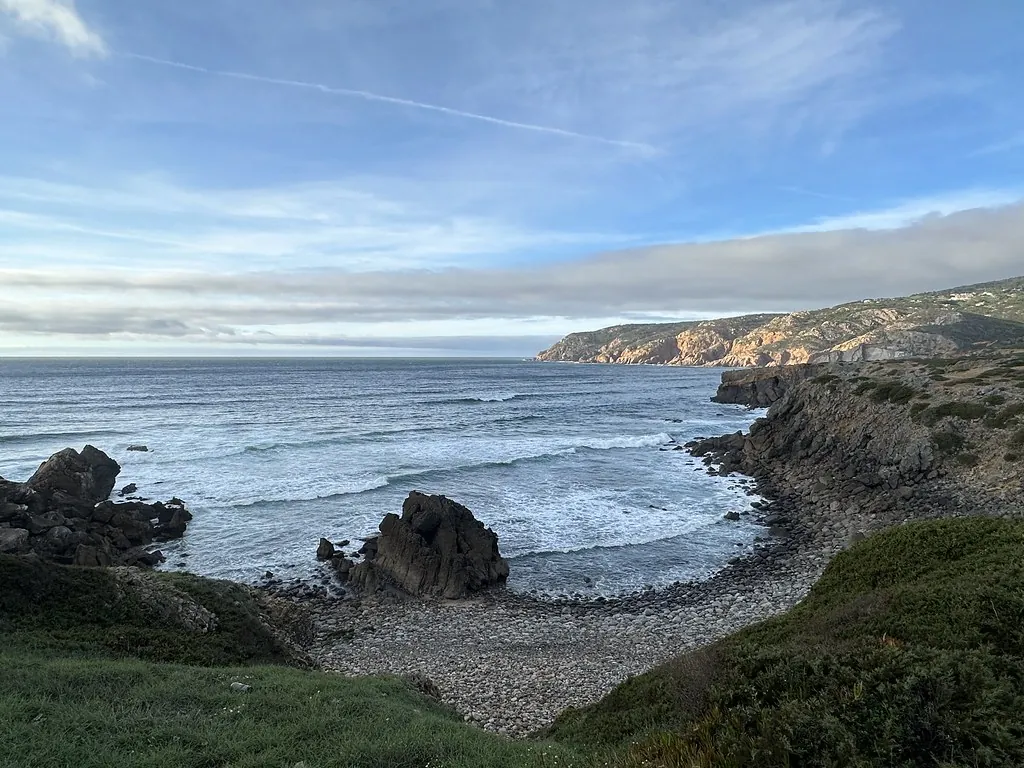
The sound arrives before the sight. A ribbon of water slips through a stone channel – the 1843 village fountain – still murmuring so softly it could be wind in the plane trees. The water is knife-cold; pensioners swear “once you drink here, the taste stays with you.” Nineteenth-century pilgrims called it the Holy Spring, convinced it dissolved kidney stones. At 6 p.m. the square fills with clinking five-litre bottles: “Better than anything that comes out of a tap.” We are 115 m above sea-level in a natural amphitheatre that climbs to the 377 m yellow-quartz summit of Pedra Amarela and drops three kilometres west to the salt spray of Guincho. Alcabideche is the largest parish in Cascais – almost 40 km², 44 000 people – yet turn off the EN9 at Alagoa and the IKEA car park vanishes; all you hear is a garden gate groaning or a dog practising scales in the distance.
A poet counted the springs
Long before the parish was created on 22 January 1852, the eleventh-century Arab poet Ibne Mucana wrote that “the land of Alcabithecum has waters so generous even the stones split their lips to drink.” Islam left mostly nomenclature – Alcabideche, Murches, Manique – and the faint grid of irrigation channels that still feed smallholdings. In the 1960s amateur archaeologist Mário Cardoso dug up Hispano-Moorish fragments in his back garden on Rua da Liberdade; the street now carries his name, though children still call it “Mário’s road” because it trips off the tongue more easily. The royal road to Sintra once passed along what is today Alagoa Lane; the dip in the tarmac marks the watering place where mules drank before the climb. The hamlet of Fartapão keeps the name farmers gave it when the spring overflowed – after heavy rain the water still races fast enough to soak your shoes.
Stone, azulejo and the ghost of old olive oil
The parish church of São Vicente stands foursquare on its terrace, watching rooftops multiply around it. Inside, the air is a cocktail of beeswax, starched linen and refrigerated stone. Eighteenth-century azulejos are worn to a sheen at shoulder height – the exact spot where worshippers lean to pray. On the ridge above, the whitewashed chapel of Nossa Senhora do Cabo receives barefoot penitents every 22 January; the elderly complete the last hundred metres on their knees, while teenagers in Nikes pause halfway to Instagram the Tagus estuary. In Manique the old community olive press is locked but not silent: open the door and the smell of thirty-year-old oil rises like a throatful of liquid green. Quinta da Alagoa – now a software campus – still opens its gardens on Sunday mornings; security guards know every local child by name and turn a blind eye to footballs that bounce perilously close to baroque statuary.
Clay-pot goat, rye-bread wine
Tasca do Chico serves chanfana – goat slow-poached in blackened clay – the colour of an espresso roast. “Take it or leave it,” shrugs Chico, ladling meat that collapses before the fork reaches it. The sauce clings to Manique rye like industrial glue; the wine is poured by the tablespoon into thimble-sized glasses “to slow you down.” Murches cheese tarts arrive wrapped in foil that grandmothers unfold like origami; the pastry is translucent enough to reveal the custard trembling inside. Manique bread has a crust that threatens dental work, a yellow maize crumb and a smoky after-scent that lingers on fingertips. At the October fair the agricultural co-op sells honey still freckled with comb; the stallholder insists it’s “proof it’s real”, though laziness is the more honest filter.
Windmills, boar and a silver blade of estuary
The Windmills Trail begins where Café O Sinal raises its shutters at 6 a.m. for hunters in waxed jackets. Eight kilometres door-to-door: past the Penedo mill where José stores aguardiente among the millstones, along the Levada swimming hole where children ignore the drowning-warning pictogram. From Pedra Amarela’s summit the estuary lies like a polished knife blade between dunes and sea; the Atlantic wind is strong enough to launch an iPhone into orbit. At dusk in Manique’s pine belt the wild boar are smaller than BBC documentary specimens; one whiff of rolling tobacco and they vanish. The Alcabideche stream smells of damp schist and animal musk; old men claim eels still wriggle here, though no one has seen one since the 1998 floods.
Jazz, cante and the first Sunday market
A ceramic plaque marks the house where Raul Indipwo – half of the jazz duo Raul & Nelo – spent summers with his grandmother; it’s above the bread counter, so locals buy their pão and forget to look up. Cante alentejano duels still begin with the same hoarse man in a felt hat who complains about his throat yet never misses a note. On the first Sunday of each month the parish council car park becomes an open-air market: Maria sells lettuces with the soil still clinging “so they last”, António brings eggs and a biro to write the laying date on each shell, and Manel Junior now accepts MB Way but still doles out gummy bears when coins run short. Walk down from the windmills at 5 p.m. and you reach Malveira smelling of rock-rose and dust; an imperial lager at O Pátio tastes of carbonated sunset. And there, with beer spilling down the glass and the ridge turning indigo behind you, you realise: in Alcabideche the water – in fountains, streams, the rising hill fog – is just the excuse to come back.