Full article about Bucelas: Jurassic chalk, Arinto vines & a spring-fed square
Sniff Jurassic marl, sip flint-edged Arinto, linger by 1512 charter stone
Hide article Read full article
The scent hits you before the vines appear: a cool rasp of wet chalk carried on the morning air, laced with the green snap of Arinto leaves warming in the sun. It is the smell of a landscape that has been fermenting since the Jurassic—marine fossils crumbling into marl, Roman cuttings still tracing the contours of the hills. Less than half an hour north of Lisbon, Bucelas is the smallest demarcated wine region on mainland Portugal, yet its 3,396 ha once supplied the cellars of George III and earned a cameo in Shakespeare’s Henry VI under the anglicised name “Charneco”.
A village that began with a spring
Bucelas takes its name from the Latin bucale—a bubbling source. The Fonte da Pipa still spouts lightly sparkling mineral water, feeding a narrow stream that slips between vegetable gardens and 19th-century town houses. In the main square the pelourinho stands complete with its original 1512 Manueline charter stone, one of the very few in Portugal never to have been re-carved. After Sunday mass at the Igreja da Purificação, locals gather beneath it in exactly the alignment shown in 18th-century baptism records; the church’s mannerist altarpiece glows gold against the cold granite floor, rectangles of raw winter light falling through high windows.
Schist barns and Arinto arcades
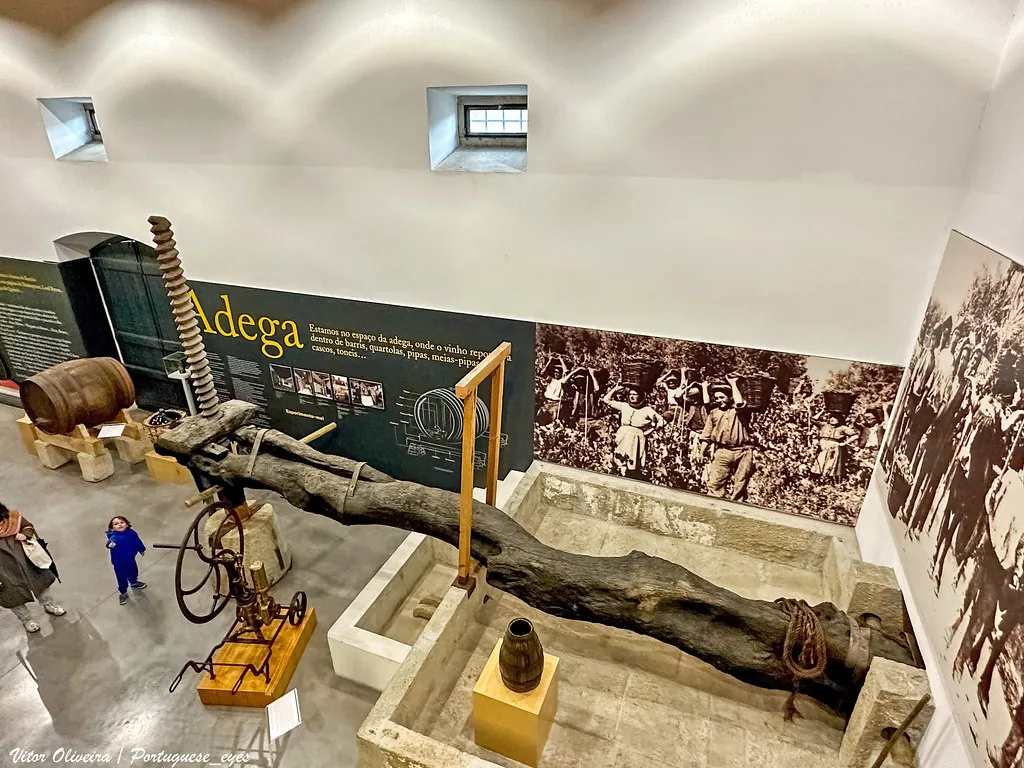
Drive five minutes out of the centre and the lanes narrow between low schist walls smothered in morning-glory. Inside Quinta da Murta or Caves Velhas, the cellars are built to the old talha pattern: dark slate walls, clay-tile ceilings, oak gates warped by decades of humidity. French barriques rest in symmetrical ranks; the air carries a hush usually reserved for libraries. Arinto dominates—by law it must make up at least 75 % of any wine labelled Bucelas DOC—and the result is a vertical, flint-edged white that can age longer than many Burgundies. During the September harvest, wicker baskets translucent with grapes are carried to open granite lagares while cantadores improvise rhyming challenges; the annual Festa do Vinho turns the village square into an open-air cellar for a night, pouring the normally private yield into every glass in sight.
Clay-oven bread and kid roasted right
The cooking is as mineral and uncompromising as the soil. Kid goat is blistered in a wood-fired oven until the skin crackles like thin toffee, the fat scented with rosemary and brushed over potatoes that have absorbed the drippings. Winter brings sopa de hortelã com ovo escalfado—mint broth with a slow-poached egg—eaten with dense pão de barro baked in communal ovens, its crust thick enough to dredge through meat juices. Dessert splits loyalties between tigeladas (cinnamon-dusted clay-pot custards) and Odivelas white-quince preserve, protected by IGP and still potted on neighbouring farms. Throughout the meal, Arinto is served at 10 °C in small, thick glasses that exaggerate the wine’s citrus-wire tension.
The vineyard loop
The PR 2 LRS footpath uncoils from the pillory, climbs through Arinto terraces, olive groves and umbrella-pine shadows, then drops into a shallow valley where fossil-studded limestone outcrops bleach almost white against summer straw. To the north the Serra da Calhandriz ridge cuts the sky; lower down, arbutus and rock-rose scent the air with resin. Fanhões stream, fed by the same spring that gave the town its name, glints between willows whose branches bend to inspect their own reflection. Half-rural, half-commuter belt, the landscape feels suspended—close enough to Lisbon for 5G, far enough for a stone curlew to whistle you off the path. Set out after lunch and the 6 km circuit will deposit you back in the square as the church bell strikes six, shadows of the vines stretching like clock hands across the road.
By early evening the aroma changes: wood-smoke drifts from chimneys, and in the cellars someone slips downstairs to check barrel temperature—an inherited reflex older than electricity. Bucelas closes quietly, shutters thudding against stone. Inside, the wine settles, and outside the limestone keeps breathing, waiting for tomorrow’s sun to coax the next exhalation from vine and soil alike.