Full article about Trancão clay & Franciscan calm in Santo António dos Cavaleir
Roman tiles, market-garden scents and a 1600s cloister survive between Loures tower blocks
Hide article Read full article
Where the Trancão still remembers Lisbon’s market gardens
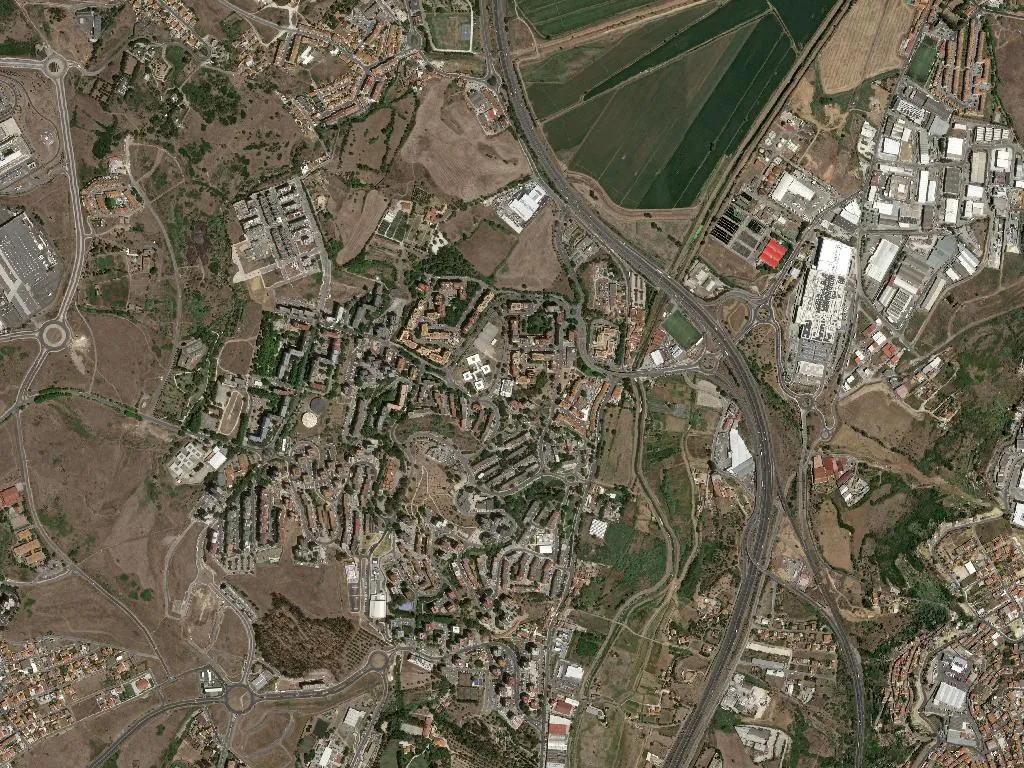
The river slides the colour of wet clay under Frielas’ single-arch bridge, making a sound closer to a sigh than to running water. It is a September morning, the air thickened by residual humidity that hovers above the Jardim do Lago before the low sun begins to warm the pale concrete of Santo António dos Cavaleiros’ apartment blocks. We are 47 metres above sea-level on the north bank of the Tagus estuary—too far inland for salt breeze—yet a vegetal draught rises from the Trancão valley, carrying the smell of irrigated soil from the surviving allotments of Frielas and reminding anyone who breathes it that this was not always edge-city suburbia.
A coat of arms that came out of the ground
When bulldozers carved the “Cidade Nova” housing scheme in the 1960s, a labourer’s shovel clinked against a limestone escutcheon: the Flamenga family arms, once borne by knights who rode these same fields. The fragment was hoisted straight into the new parish crest, as though the ground refused to surrender its title deeds. Archaeology here is stubborn—Casal do Monte pushes human settlement back to the Palaeolithic, while Frielas keeps Roman roof-tiles and Arab irrigation channels under successive coats of whitewash. In 1401 the royal palace next to Frielias’ church hosted the wedding of Afonso, first Duke of Bragança, to Beatriz Pereira de Alvim; the match redrew Portugal’s political map. The granite church still stands, its nave cool even when Lisbon swelters under a cloudless sky.
A Franciscan cloister between tower blocks
Turn off Avenida General Humberto Delgado and you step straight into the Conventinho: thick-walled, lime-plastered, built by Franciscans in the early 1600s and now the municipal museum. Afternoon light falls diagonally across the cloister; the air smells of chalk dust and centuries-old roof timber. Inside, exhibition cases hold Iron-Age pottery, agricultural tools and a scale model of the flat-bottomed boats that once carried cabbages down-river to the capital. The building is an anachronism wedged into a grid designed for 28,000 people—density exceeds 3,000 per km²—yet it functions as the district’s memory-anchor, flanked by children’s playgrounds where 4,500 under-14s shriek after school.
Quince, wine and a river that was once a highway
Frielas’ market gardens survive in pockets, fed by alluvial soil and the same medieval levadas that Moorish farmers cut. The parish sits inside the Lisboa wine region: look for sharp, flinty whites from neighbouring Bucelas that want grilled sea-bass and a late afternoon. More idiosyncratic is the marmelada branca de Odivelas IGP, a translucent quince cheese so dense it can be sliced with a cheese wire. Walkers on the Caminho de Torres—a Santiago tributary that crosses the parish—leave with dusty boots and, if they time it right, a slab of that quince in their packs.
Garden-city ideals and the green that outlived them
The 1960s “Cidade Jardim” plan was more than sales copy. Terraced slopes of the Parque Urbano da Encosta are still shaded by London planes, while Jardim do Lago gives apartment façades a rippled mirror to stare into. At dusk the lawns fill with West-African families grilling chicken, Portuguese teenagers comparing scooters and pensioners walking dogs whose leads match their owners’ jackets. These lungs of green survive because planners wrote them into the blueprint before value-per-square-metre became the only metric.
The Frieleiros still dance
Every 29 and 31 August the Jardim da Avenida João Branco Núncio closes to traffic and the Rancho Folclórico os Frieleiros take over. Boys in scarlet waistcoats stamp out a vira; accordions compete with the hiss of sardines laid on open grills. The choreography has hardly changed since 1980, and no one pretends it is heritage theatre—this is simply how the parish reminds itself who it is. When the lights dim and the river slips into darkness, you may hear the squeal of an un-oiled garden gate somewhere among the last vegetable plots: a domestic hinge announcing arrivals and departures like a private bell that refuses to be silenced.