Full article about Vimeiro: Where Atlantic Wind Still Carries Gunpowder
Stand on Wellington’s ridge above Lourinhã, hear flintlocks crack amid vineyards.
Hide article Read full article
The Atlantic wind arrives salt-laden and humming. Between the sea and the limestone ridge of Montejunto it flattens the grasses, stripes the light across low vineyards, and rattles the apples still clinging to their boughs. Most afternoons the only reply is the blackbird switching perch. Then, on one weekend every July, the valley fills with a different soundtrack: the crisp crack of flintlock muskets, the hollow thud of drums, shouted commands in English and French. Vimeiro, a scatter of white houses 39 metres above sea level and an hour north-west of Lisbon, remembers on its sun-bleached earth the battle that tilted the Peninsular War.
Wellington’s ridge
Shortly after dawn on 21 August 1808 Sir Arthur Wellesley—still four years from becoming Duke of Wellington—dragged six cannon to the top of a low basalt outcrop. From the crest he commanded the coastal road, the village wells, and the open fields up which General Junot’s French columns would have to climb. The engagement lasted six hours; by late morning the French were in retreat and British control of Portugal was never again seriously challenged.
Today the ridge is crowned by a slender stone obelisk planted with rosemary and immortelle. Red arrows on a 3-D map inside the former village primary school—now the Battle of Vimeiro Interpretation Centre—trace the choreography of the attack: red pulses for artillery, blue for infantry, a sub-woofer thump for every theoretical broadside. Display cases show thick-wool redcoats, a rusted bayonet, a sepia map annotated with the same grid references Wellington inked by candlelight.
Across the lane, the 16th-century parish church of São Miguel doubled as a field hospital; if you angle your head you can still pick out dark splinters in the lime-wash where surgeon’s implements met stone. During the annual re-enactment the square fills with canvas tents, women in worsted shawls, and the smell of woodsmoke and lamb stew. At dusk comes the Cerimónia do Arriar das Bandeiras: a rolling musket volley that scares the swallows into spirals and leaves the valley smelling of gunpowder for minutes afterwards.
Between vine and orchard
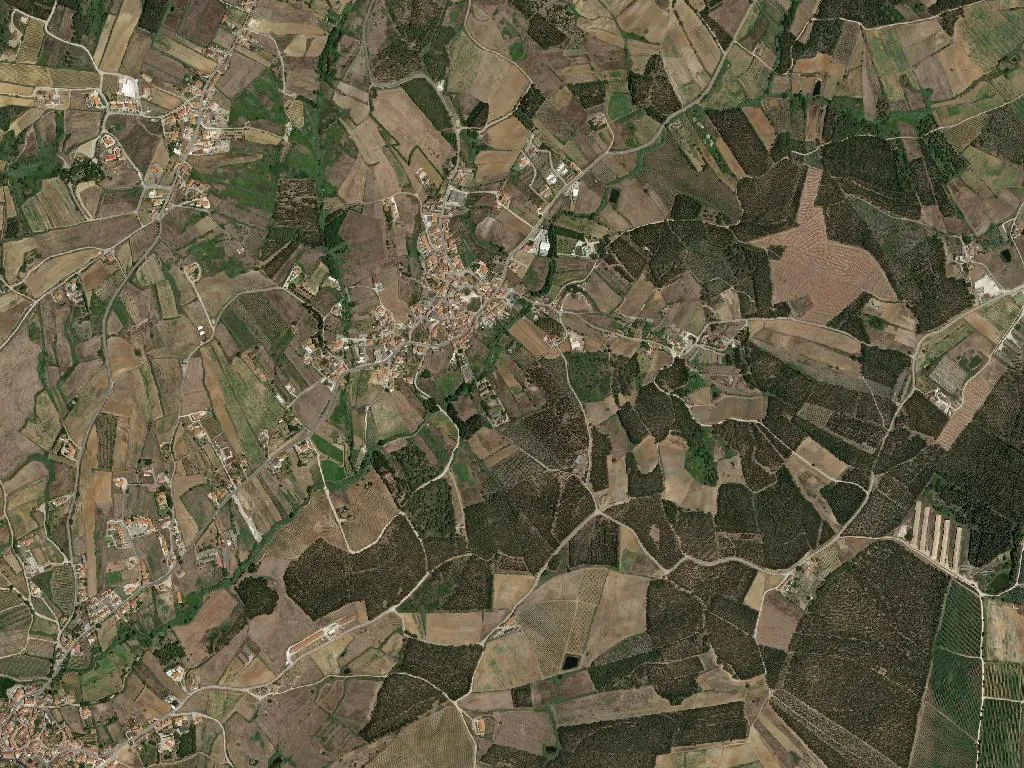
Vimeiro’s fields are colour-blocked like a patchwork quilt: pale green rows of Arinto and Fernão Pires trained on low trellises; white confetti of apple and pear blossom in March; the sudden umber of turned earth after harvest. The parish sits inside the Lisboa wine zone, turning out brisk, lemon-scented whites that appear on lunch tables along the coast with grilled sea bream from Lourinhã market. Holm oak and cork oak interrupt the farmland; their shade is thick enough to muffle even the cicadas.
Dirt tracks link the village to the battle ridge, crossing vegetable plots where purple-veined cabbages grow to the size of steering wheels. Yellow arrows painted on stone stiles mark the coastal branch of the Camino de Santiago; the occasional backpacker with scallop shell swings through, heading for the cliff-top sanctuary at Cabo Espichel. Ten kilometres away, Areia Branca beach unrolls a gold-foil ribbon of sand and a dependable right-hand surf break, but here you sense the ocean only as a cool exhale on the back of the neck and a thin blue seam between hills.
The entire municipality is a member of the European Global Geopark Network. A 20-minute scramble south-west brings you to the base of the cliffs, where 150-million-year-old limestone slabs carry the buttress-shaped footprints of Jurassic sauropods, pressed when this land lay under a warm, shallow sea.
Where to eat and what to take
O Peleiro roasts kid goat in a wood-fired oven every Wednesday and weekend. There are just twelve tables; call ahead (+351 261 980 342). For wine, follow the unmarked dirt lane two kilometres past the monument to Quinta do Rol. The owner opens between 2 pm and 6 pm, unless the bottle runs out first—then he simply locks the gate. Stay at Solar dos Amieiras, a low, white house with two simply furnished bedrooms looking east to Montejunto (€80 a night, shared kitchen, no television).
The echo in the stones
Late afternoon, when the sun grazes the olive trunks and the wind drops, the obelisk becomes a private belvedere. Below lies the valley of the Lis, the dark seam of eucalyptus, the ruler-straight orchard lines. The sound that lingers is not the blank-fire cannons of the re-enactors but the soft whistle of air moving through the obelisk’s limestone joints—an uninterrupted breath that has crossed these fields since 1808, still listening for an order that will never come again.