Full article about Ericeira: Cobbles Salt-Crusted by Atlantic Roar
Sea-urchin lanes, hexagonal chapel, royal last steps; surf echoes off Mafra coast
Hide article Read full article
Ericeira: where salt dries on the stone and the Atlantic sets the clock
The first thing you register is sound. Long before the ocean slides into view, a low Atlantic growl climbs the whitewashed lanes and settles under the ribs. In Ericeira the sea is not scenery; it is the house next door. Step down into Largo do Jogo da Bola – officially Praça da República since 1886, though no one uses the new name – and the cobbles are dished by four centuries of soles. Grilled sardine smoke drifts from an unseen kitchen: noticeboards announcing the daily catch are wedged against restaurant doors. This is not a village to be admired from afar; you walk inside it.
Sea urchins, false kings and a final farewell
The name comes from “ouriços”, the spiny sea urchins prised from the reefs and swallowed alive by old-school fishermen. Documents from the 1230s list Ericeira as a salt-makers’ outpost of the Mafra commandery. In 1585 the cobbler Mateus Álvares married in the same square while claiming to be the lost King Sebastian, the “Hidden King” whose return still flickers through Portuguese folklore. Three centuries later, on 5 October 1910, the royal yacht Amélia waited off Praia dos Pescadores while Manuel II, last of the Braganças, stepped across wet sand into exile. The beach where towels now lie was the final scrap of Portugal their feet would ever touch.
Stone, lime and a hexagonal saint
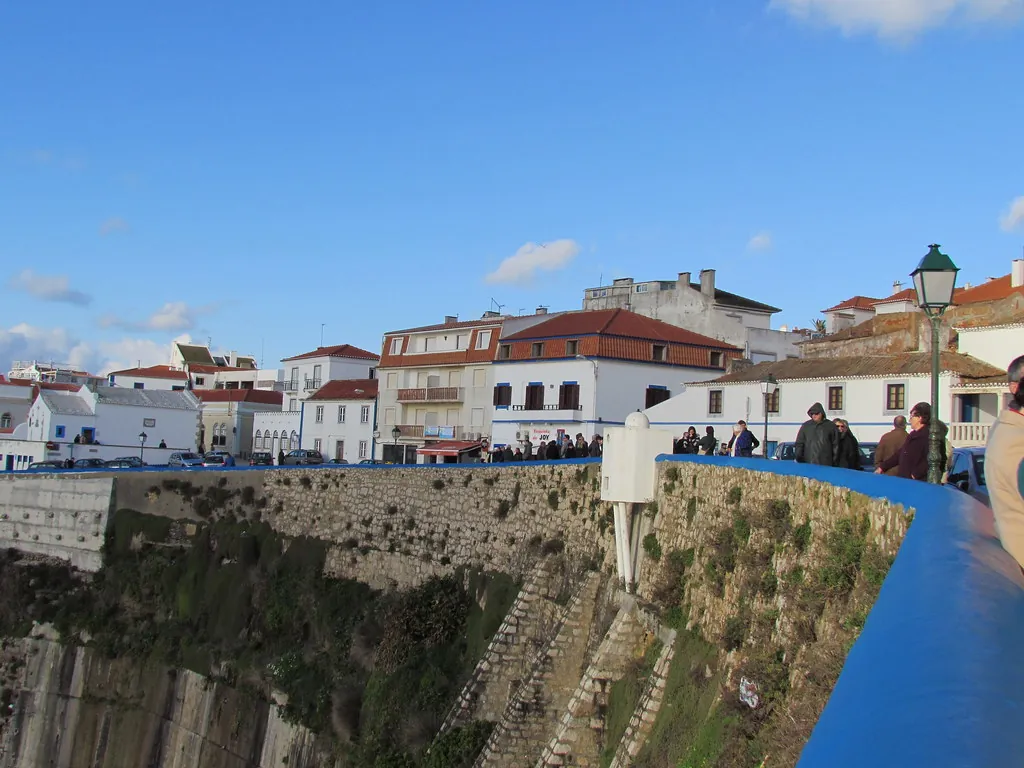
Dawn light strikes the Manueline portal of São Pedro (1470). Forty metres away, the sailors’ chapel Nossa Senhora da Boa Viagem keeps votive models of trawlers donated after safe returns. Further uphill, São Sebastião is the only hexagonal chapel in the country, its six sides built in 1577 to ward off plague. The fortress of Nossa Senhora da Natividade, finished 1643, still points iron cannon at the horizon; the Art-Deco former casino and the blue-shuttered Casa das Cavacas complete the centre’s mosaic of facades.
Caldeirada, urchins and a pastry with a name
Fish stew does not appear on menus – it announces itself by scent. Bay and tomato drift from half-open kitchen windows. You will find clams Bulhão Pato style, breadcrumbed sardines and razor-thin fish broth that steams glass cups. For pudding, Casa da Fernanda’s almond “ouriços” – hedgehog-shaped cakes rolled in sugar. At O Pãozinho das Marias the custard tart leaves the oven with pastry still crackling like thin ice. Locals wash lunch down with a glass of Lisboa-region white, sold by the jug for €4.
Cliffs, blow-holes and Europe’s only surf reserve
The coast is a serrated 8 km ribbon of limestone where winter storms have punched caves and “foles” – blow-holes that sigh when the tide is high. Since 2011 the whole strip has been a World Surfing Reserve, the first in Europe. Ribeira d’Ilhas, a natural amphitheatre, hosts QS contests every autumn, yet a five-minute walk north brings you to Praia da Baleia where toddlers chase shallow ripples. The cliff-top loop trail strings together seven beaches and four headland miradouros; paragliders launch from Ribeira to ride thermals above the reef.
Refugees, pilgrims and the everyday
On New Year’s night 1942 eighty refugees squeezed into a fishing smack and slipped out towards neutral waters. Today the same lanes form part of the coastal Camino to Santiago; scallop-shell way-marks share walls with surfboard racks. Inside 12 square kilometres live 12,359 permanent residents – enough to keep butchers, bookshops and infant schools alive when the swell is flat. After midnight Largo do Jogo da Bola empties, yet the Atlantic keeps speaking – the same bass note that woke the first medieval fishermen seven hundred years ago.