Full article about União das freguesias de Venda do Pinheiro e Santo Estêvão das Galés
Limestone ridges, pine-scented air and medieval pilgrim trails unite two Mafra parishes.
Hide article Read full article
Where the road meets the pine forest
The wind arrives from the west, carrying a faint memory of salt that thins out before it reaches the hills. At 257 metres above sea level, the air no longer belongs to the Atlantic or to the Ribatejo plain; it occupies a limestone interlude where the Serra de Mafra breaks the surface between cork-oak roots and the dark silhouettes of maritime pines. Their resinous scent lingers like an echo of the place-name: Venda do Pinheiro, “the pine-trader’s halt”.
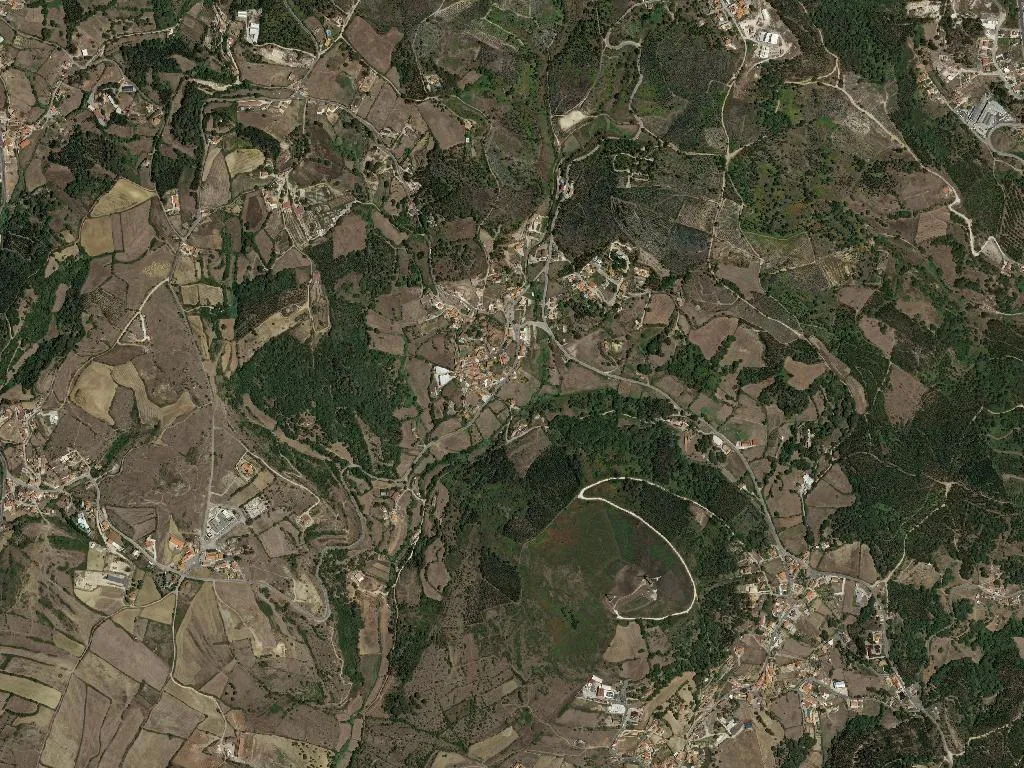
Stand still on a dirt lane between two rows of Rocha pear trees and the silence has the density of a September morning. Only a blackbird repeats its two-note claim from somewhere inside the canopy. This is the merged parish of Venda do Pinheiro and Santo Estêvão das Galés, 30 km north-west of Lisbon, administratively united in 2013 but sharing the same valleys, streams and chalky soils for centuries.
A market among pines, a chapel for pilgrims
The toponymy is literal. Medieval freight routes that linked the coast to the interior once paused here beneath dense pinewoods; resin and timber were exchanged for grain and salt. On the far side of the present-day parish, Santo Estêvão das Galés hints at a different story. The suffix “das Galés” – “of the Galicians” – may record 12th-century settlers from northern Spain, or simply mark the passage of pilgrims bound for Santiago, a branch of the coastal Camino that still crosses the territory.
Way-markers appear discreetly: a yellow arrow on a dry-stone wall, a scallop shell stencilled on a telegraph pole. Follow them and you drop into the Safarujo valley, cross a Roman-arched bridge of granite slabs, then climb through holm-oak and strawberry-tree scrub until the Atlantic reappears, a silver stripe on the horizon.
Stone, lime and the echo of a bell
The parish church of Santo Estêvão mixes Manueline doorways with 17th-century baroque: limestone blocks the colour of pale honey, afternoon light falling in warm rectangles across the flagstone floor. In Venda do Pinheiro itself, the bell-tower rises straight from the façade, an 18th-century shaft of whitewashed masonry. At six o’clock its single bronze bell still strikes the hour with a metallic timbre that rolls across vegetable plots and galvanised roofs.
Smaller wayside shrines – São Sebastião, Nossa Senhora da Conceição – punctuate the lanes between orchards. Most are locked, yet their whitewashed presence orients both the landscape and the calendar: processions on 20 January, a candle-lit vigil on 8 December. Beside them, stone bridges no wider than a cart-track span streams just substantial enough to turn a mill wheel; the abandoned mills, roofless, recall an economy that once ground wheat and maize with water-power alone.
The pear that ripens on chalk
Rocha pears enjoy PDO status here, and the agricultural year is still paced by their cycle. In April the terraces foam with white blossom; by late August the branches droop under fruit whose yellow-green skin carries the characteristic russet freckles of limestone soils. Bite into one warmed by the morning sun and the juice runs like chilled Sauternes – a sweetness impossible to replicate at lower altitudes or on sandier ground.
Vineyards share the slopes, classified within the Lisboa wine region. Light, aromatic whites and early-drinking reds accompany a cuisine that has changed little since the 19th century: lamb stew scented with mint, a Portuguese cozido rich with chouriço and winter greens, sopa da panela thick enough to support a spoon upright. On feast days the conventual repertoire resurfaces – pastéis de feijão (bean-paste tarts), trouxas de ovos (sugar-syrup egg rolls) – desserts conceived to use up yolks left over when the nuns starched their linen with egg-whites.
Hills, streams and ten thousand souls
Covering 29 km², the parish shelters 10,815 inhabitants – enough to support a pharmacy, a primary school, a market on the first Sunday of each month, yet sparse enough that every house can keep its own vegetable plot and drying lines of laundry. Demography is almost perfectly symmetrical: 1,785 children under 14, 1,796 over 65 – proof that families stay.
The topography is a gentle roller-coaster of chalk hills; no vantage exceeds 300 m, yet each curve reframes the light. The Safarujo and Galega streams have carved narrow, fertile corridors where willows and alders thicken. Bee-eaters drift overhead in May; in late summer turtle-doves purr from the telephone wires. Waymarked rural paths link the two former parishes in loops of 6–10 km – broad tracks, way-leaved across private land, with no gradient steeper than one in ten. Walk them at pear-harvest time and the air smells like a tin of fruit salad opened in the sun.
The precise weight of a pear in the hand
Towards evening, when low light turns the dry-stone walls the colour of old gold and the 18th-century bell counts the hour, the parish seems to pause between past and present. Hold a Rocha pear in your palm: 190 g, russet-rough, still warm. That weight – measurable, specific, local – is what remains when the day-trippers have driven back to Lisbon and the wind once again carries nothing but the smell of resin and distant salt.