Full article about Póvoa de Santo Adrião: onde a pedra resiste ao betão
Olival Basto’s Manueline portal, olive-scented lanes and 18th-century fountain survive amid commuter
Hide article Read full article
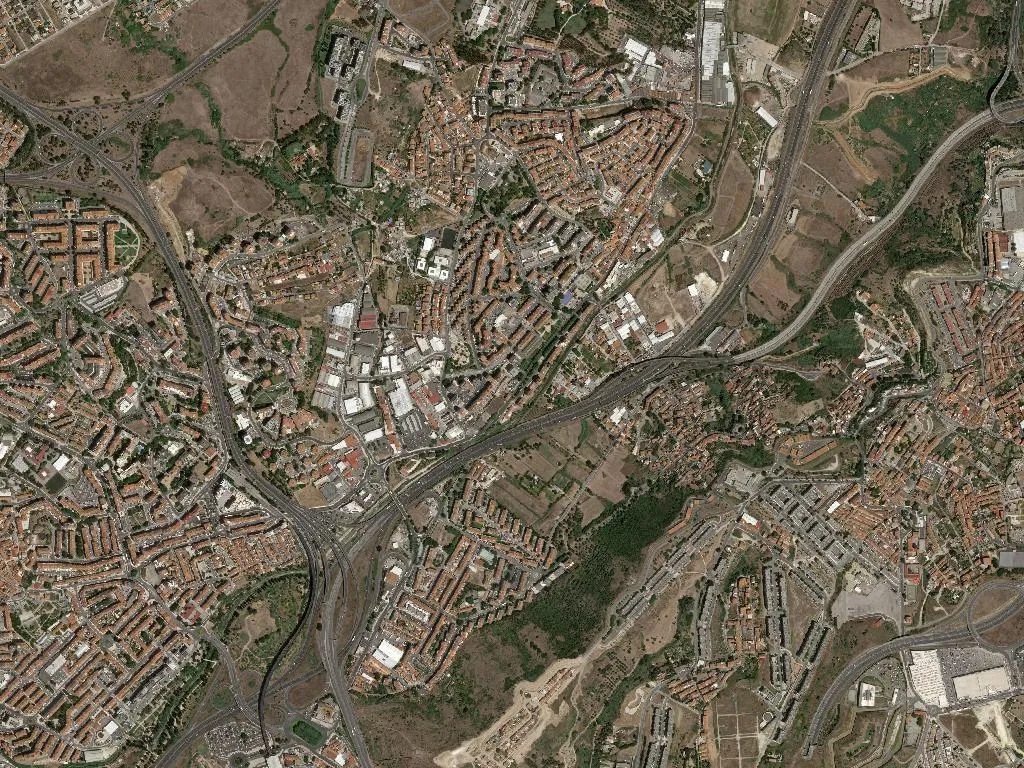
The sound arrives first: a bus sighing to a halt on the N8, air brakes hissing against June-warmed tarmac. Between two engines comes something older — a low murmur of water sliding over stone. Chafariz d’El-Rei, an 18th-century public fountain, still gushes at the heart of Póvoa de Santo Adrião, a cool lung inside a grid of 1970s apartment blocks. Touch the granite: it is moss-soft, almost damp to the fingertip. We are 30 m above sea level on a slab of territory barely three kilometres across, home to almost 19,000 people — one of Portugal’s densest parishes, over 7,000 souls per square kilometre — yet pockets of quiet survive.
Where olive groves named a road
To read the place you have to look down. The smooth asphalt of the national highway gives way to irregular cobbles near the church, then to beaten earth between estate walls that no longer grow food but have not quite surrendered. The toponym Olival Basto is not decorative: it remembers the silver-green terraces of olives that once quilted this slope before Lisbon spilled north. For centuries the N8 was the umbilical cord linking the capital to Torres Vedras; a tollhouse stood here in 1900, and between 1855-56 the Malaposta de Olival Basto changed horses for the royal mail. The smell of oiled leather and animal sweat hung in a cloud of dust raised by stagecoaches. Today the building survives as Teatro da Malaposta, its austere 1840s façade reminding commuters that this suburb was once a waypoint, not a destination.
A Manueline portal between tower blocks
The parish church is the only national-monument status building in the union — and it stops the traffic. Carved in the early 1540s, the Manueline portal was protected as early as 1922, long before conservation became fashionable. Ropes of stone twist into seaweed knots; sunflowers and artichokes bloom from the capitals. At 19:30 on a summer evening the low light picks out every groove, each twisted column casting its own micro-eclipse. Approach with care: the stone seems to breathe. The village took its saint’s name — Adrian — sometime in the 16th century; before that it was simply Póvoa de Loures, “the hamlet near Loures”.
Estates the map still remembers
Before the 1960s apartment boom this horizon was pricked by quintas: Bom Sucesso, Mineiro, das Flores. Windmills caught the breeze that rides up the Tagus floodplain; a few stone sails survive as garden ornaments. Look closer and you’ll find a dry-stone wall here, a lily-choked tank there, a medlar tree older than the Second Republic leaning over a car park. On the edge of the parish the Casal do Monte Palaeolithic station confirms that people have been choosing this ridge for at least 5,000 years — close to Lisbon, but not in it.
Quince paste and yellow arrows
One edible relic remains: marmelada branca de Odivelas, a translucent white quince cheese with PGI status. Nuns in the 16th-century Convento de Odivelas perfected the recipe; today it is sold in firm slabs that smell of honey and sharp autumn orchards. Walkers following the Torres variant of the Camino de Santiago cut through on their way north: way-marks appear on lamp-posts and garage walls, guiding pilgrims between roundabouts and vegetable plots that refuse to vanish.
The weight and lightness of 18,806 lives
Póvoa de Santo Adrião was promoted from village to town in 1986; Olival Basto followed in 1997. The 2013 administrative merger simply formalised what concrete and bus routes had long since decided. Census 2021 shows the over-65s (4,735) almost doubling the under-14s (2,503) — a demographic tilt you feel on the street: benches occupied before 09:00, chemists with lunchtime queues, cafés where a galão takes ten minutes because the conversation takes fifteen. Nine registered guest-houses — mostly spare-room Airbnbs — hint that some travellers have worked out that sleeping here, twelve minutes by metro from Rossio, costs half the price of a Bairro Alto studio and still delivers pastel-coloured mornings on a real neighbourhood street.
The last impression is not visual. Stand by Chafariz d’El-Rei after 22:00 when the commuter traffic thins: water keeps slipping over the same 18th-century lip, a thin continuous note that outlasts censuses, pensions and the concrete that rose around it.