Full article about Barcarena: River Echoes in Oeinas’ Green Pocket
Where tide-kissed quays, gunpowder canals and pine-scented trails lie nine kilometres from Lisbon’s
Hide article Read full article
Barcarena, where the river still murmurs through the street names
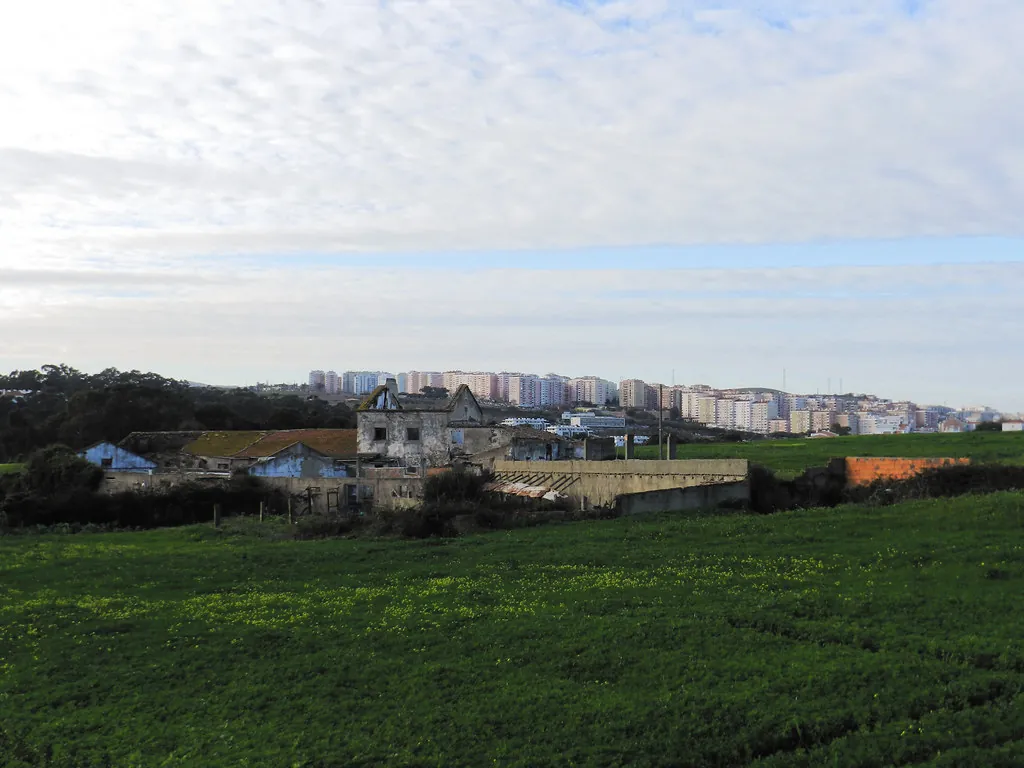
The morning settles over Barcarena Urban Park with the smell of wet soil and pine resin that clings to cotton like static. Mist unpicks itself from the folds of the valley, unveiling – slice by slice – the Tagus estuary: a mercury-bright blade glinting between treetops. Footsteps crackle on the bark paths; the sound is private, almost conspiratorial. You are nine square kilometres from Lisbon’s financial district, yet the decibel level belongs to another latitude. Fourteen thousand people share this parish, a density that should hum. Instead you hear water heading west, birds stitching the air, and the motorway reduced to a faint Doppler echo that never quite arrives.
The boat that never left the name
“Barcarena” is itself a fragment of Latin: barca plus the locative suffix –ena, simply “place of small boats”. Before asphalt threaded the coast, cargo moved on these tidal fingers; the first charter, issued by King Afonso III in the 13th century, already lists the settlement as a river post. In 1836 the old municipality of Oeiras was dissolved and Barcarena was absorbed into the new Oeiras council, yet the toponym refused to forget its oars. What remains are slipways and cracked stone quays where you can still descend to the waterline – not to embark, but to taste the brackish updraft that drags Atlantic salt over the 109-metre contour line.
Industry arrived in the nineteenth century: cork dust and kiln smoke drifted across the valley. The Fábrica da Pólvora – now the riverside campus of Atlântica University – once supplied gunpowder to Portuguese Africa and Brazil; today its canals power hydroelectric labs rather than grinding mills. The worker paths, however, are still readable in the terrain: stone walls that once corralled nitre now frame doctoral debates.
Gilt carving and the minister who holidayed here
The parish church demands the first full stop in any itinerary. Classified in 1982, the Manueline portal cuts morning light into interlaced knots, a stone cipher of Portugal’s brief moment of architectural self-confidence. Inside, seventeenth-century gilded altarpieces drink candlelight and return it as slow amber, the colour settling in ceiling corners like cognac in a balloon glass. The style hesitates between late-Gothic ribbing and Renaissance roundels – a building caught between two aesthetic continents.
Two kilometres uphill, in the hamlet of Queijas, the Palácio do Marquês de Pombal keeps a different beat. The summer retreat of the eighteenth-century statesman who redraw Lisbon’s street grid after the 1755 earthquake is all sober rationality: symmetrical fenestration, mathematical pilasters, gardens that impose Cartesian order on the scruffy valley folds. Stand on the terrace and you understand the Enlightenment as landscape: perspective tamed, wilderness politely asked to wait outside.
Rice that knows the river, wine that knows the Atlantic
Barcarena’s cooking is a function of tide and topography. The Carolino rice of the Ribatejo floodplains – a protected IGP – arrives as loose, creamy seafood rice, each grain still audible under the tooth. Caldeirada from the Tagu’s shoal fish is thickened with red pepper and coriander; açorda turns yesterday’s bread into a fragrant porridge punched through with garlic and green-gold olive oil. For contrast, the Lisbon wine region begins just beyond the ridge. Atlantic breezes gift whites with a rapier acidity and reds with measured tannins that never cloy; tasting them here is to drink the same wind that cools the valley at 4 p.m.
Valleys that hoard green
The parish sits on the hinge between the Tagus estuary and the Monsanto ridge; the word for that hinge is microclimate. Narrow valleys pocket humidity, while the cliffs serve as natural balconies whose colour temperature flips from steel-blue at 9 a.m. to molten gold by 6. The Urban Park is the easiest key to this mosaic – 11 km of footpaths where nightingales rehearse over weekend picnics – but the older text lies along the river itself. Follow the unofficial goat tracks downstream and the air grows maritime: reeds replace eucalyptus, gulls replace jays, every breath tastes of silt and iodine. The ground is uneven, occasionally flooded; the Tagus, once an industrial highway, reverts to a half-wild fjord.
The sound that lingers
At the end of the afternoon, when the sun lies flat and the estuary becomes a sheet of beaten copper, the wind pivots. It stops blowing from the hot interior and rolls in off the water, carrying estuarine breath – mud, salt, cold iron – up the valley. In that second you realise why the name of this parish still carries a boat inside it: the river never really left. It only stepped back, waiting for you to listen.