Full article about Carnaxide-Queijas: Pombal’s fountain amid tower blocks
Red-earth lanes, royal spring, poets’ ridge—Lisbon’s western fringe hides its own past.
Hide article Read full article
Water left over from the earthquake
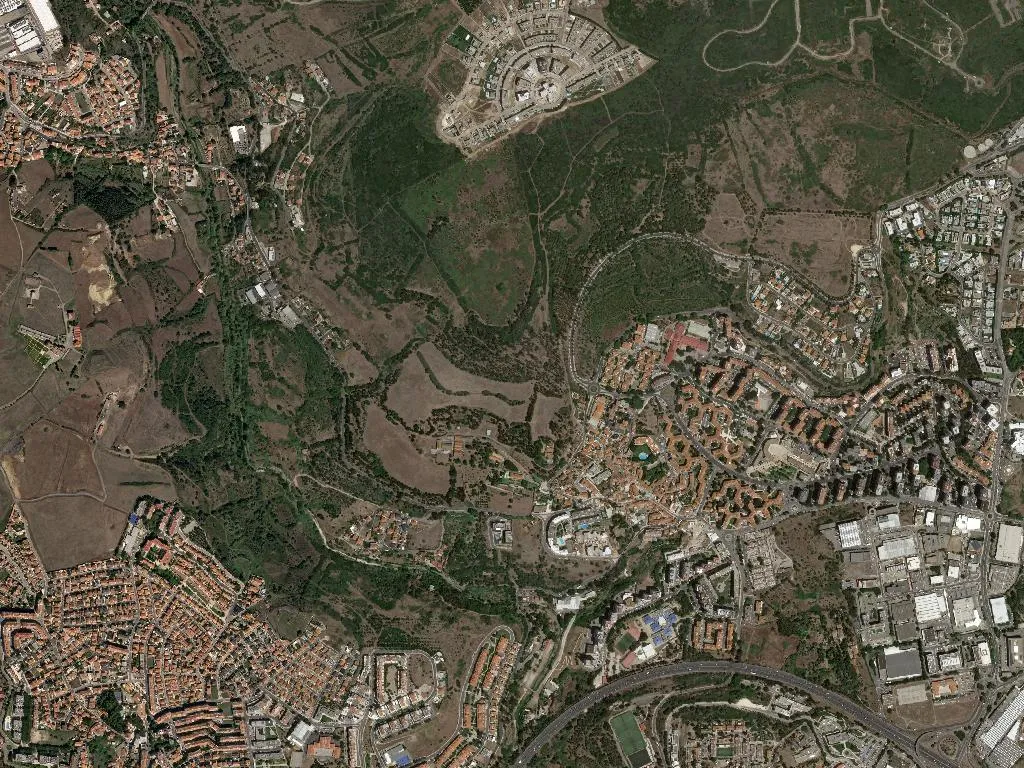
The spill of the Chafariz de D. José I slips lazily across its stone basin, a liquid whisper threading through commuter traffic on Rua Primeiro de Maio. Stand still for a second and the rest of Carnaxide recedes: 36,000 people squeezed into eight square kilometres, tower blocks, delivery vans, the perpetual hum of the A5. Yet here, beside an eighteenth-century fountain ordered by the Marquês de Pombal while Lisbon was still rubble, the city pockets its breath.
Red earth, loose stones
Carnaxide’s name is older than the nation. Twelfth-century charters call the place Carnaxide; philologists argue over Arabic carna-axide (“red-earth hill”) or Celtic carn-achad (“scatter of stones”). Both fit. August sun bakes the clay to rust, and limestone ribs jut through the lane that once linked the village to the royal estate at Algés. Across the parish boundary, Queijas has kept its own linguistic riddle—spelt Queijas since the 1500s, a pre-Roman echo no linguist has cracked. A district that refuses to be translated.
The fountain the earthquake built
Pombal’s engineers erected the fountain in 1762, seven years after the quake. Carved limestone, two spitting masks, the royal coat of arms—an assertion of running water when the capital still slept among ruins. Now it is listed, polished by generations of hands filling plastic jugs on the way home from Lidl. Cafés have replaced taverns, but the axis holds: distances in Carnaxide are still measured in steps from the chafariz.
Where Pedro V went for the air
Victorian guidebooks extolled Carnaxide’s “excellent waters and western exposure.” Pedro V slipped out of Belém palace to ride the ridge; Almeida Garrett, Camilo Castelo Branco and Tomás Ribeiro followed, hoping the altitude would clear lungs fogged by downtown dust. The poets’ countryside is gone—concrete arrived in the 1960s, then dual carriageways, then 80,000 souls crammed into sixteen square kilometres. Yet on a clear winter afternoon the elevation still delivers: Tagus estuary flashing like pewter, Sintra’s range floating offshore.
Between the stadium and the shrine
At the northern edge the Jamor sports complex unclenches the city. Cyclists swap tarmac for pine-shade paths; joggers circle the track where Benfica and Sporting train in winter. Golf fairways and tennis lawns stripe the valley, improbably green against apartment grey.
In Queijas the fifteenth-century Senhora da Rocha shrine interrupts the weekday tempo. Pilgrims park on the hard shoulder, light tapers, queue for confession. Outside, the only bakery still baking pãezinhos de Queijas works through the night: slow-rise dough, wood-fired crust, the smell clinging to coats like incense.
Slow rice, no hurry
The parish sits inside the Arroz Carolino das Lezírias Ribatejanas IGP zone, so restaurants steam the same plump grain you’ll find upriver in Santarém. Duck rice and seafood ensopados appear on blackboards at neighbourhood cervejarias; no tasting menus, just plate-of-the-day generosity. Geography dictates appetite—the A5, IC19 and CRIL braid together here, feeding commuters who decide at 19:30 that tonight is for açorda.
The oldest tasca, Cais de Carnaxide, fires clay pots on Friday mornings. By noon the garlic-coriper steam cloud drifts round the corner of Rua António Aleixo; the owner still asks, “Just a fino, or are you eating?”—a recognition that hunger keeps its own schedule.
The sound you take away
Rush-hour light slants across high-rise façades, turning them copper. Return to the fountain: water falls as it did in 1762, indifferent to the century. What you carry home is not nostalgia for a countryside no one remembers, but the steady hush of one surviving jet—proof that even inside Europe’s densest commuter belt, stone still stores water and water still stores time.