Full article about Where Tagus Becomes Ocean: Oeiras’ Salt-Wind Villages
Walk 13 km² of Portugal’s Atlantic doorstep—forts, palace, palms bent by brine
Hide article Read full article
Where the Tagus Learns to be Sea
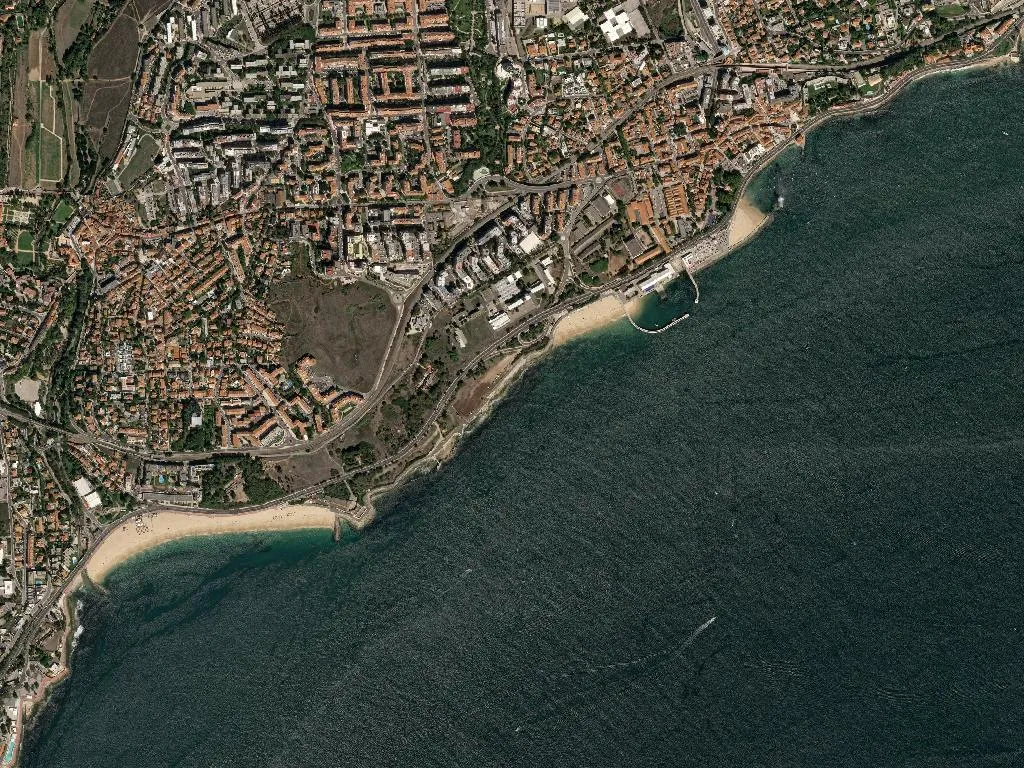
The salt wind reaches you before the water does. Long before the estuary unfurls into what looks like open ocean, the air thickens with brine and iodine, sticking to skin and narrowing the eyes. On the waterfront road between Paço de Arcos and Caxias, dawn arrives gauzy and mineral-heavy; you can taste iron on your tongue. Decades of prevailing Atlantic weather have bent the palms inland, their trunks tilting at the angle of a held breath. Here the Tagus is no longer a river – it is a tidal lake the width of a horizon, flashing back light in sheets of zinc and white.
This is the civil parish of Oeiras e São Julião da Barra, Paço de Arcos e Caxias – a name long enough to need two breaths, yet the whole territory can be walked in a morning. Within its 13 square kilometres live 58,000 people, a density higher than Porto’s. Still, pockets of silence survive: stone esplanades where gulls drown the motorway, and the slap of short waves absorbs every other sound.
The Fort that Guards the Tagus Mouth
São Julião da Barra fort rises from the basalt as if the coast itself had grown battlements. The largest coastal fortress in Portugal, it was begun in the 1560s and finished a century later to deter Dutch, English and Spanish raiders sailing up-river. Its walls – gunmetal-dark, veined with yellow lichen – drop almost vertically into the tide. Approach from the cycle lane and the structure is too large to fit inside a single gaze; you have to turn your head like a camera on a slow pan. During the 1640–68 Restoration War it was the last Portuguese stronghold to surrender to Spain – a fact that speaks both of Iberian stubbornness and the fort’s uncanny ability to absorb cannon shot. Later it served as a political prison; today the army still owns it, opening the ramparts for occasional concerts where the bass-lines echo in the cisterns.
The Palace Where a Country was Re-engineered
Two kilometres inland, the Palácio do Marquês de Pombal sits behind rationalist gardens of box hedges and gravel rides. It was here that Sebastião José de Carvalho e Melo – the Enlightenment strongman who rebuilt Lisbon after the 1755 earthquake – drafted the reforms that abolished feudal privileges, expelled the Jesuits and rewired the Portuguese state. The palace interior is closed to casual visitors, but the symmetrical parterres are public: on late-summer afternoons the shadows align so precisely they look set with a theodolite. Oeiras harbours eight other classified monuments, among them the Manueline mother church in Paço de Arcos and the 18th-century Quinta dos Anjos outside Caxias, its azulejo-clad chapel recalling the era when these were riverfront farms supplying fruit to Lisbon.
The Boy Who Would Multiply Himself
Fernando Pessoa spent part of his childhood in a narrow house on Rua da Praia, Paço de Arcos, attending the local English school before the family shipped out to South Africa. Walk the same cobbled lanes and you can still smell low-tide seaweed baking on the rocks – the kind of sensory overload his later heteronyms would hoard in lines such as “I’m nothing, I’ll be everything.” The village had already become a commuter suburb by 1900, linked to the capital by paddle-steamer and, from 1889, by the Cascais railway. That sense of being both inside and outside Lisbon – a corridor between city and Atlantic – may explain why the poet who contained multitudes began to notice his own partitions here. A plaque at number 10 marks the house; the bar next door serves espresso as short and sharp as a Pessoa poem.
Salt on the Grill, Wine from the Sand
Menus along the Avenida Marginal obey the tides: charcoal-grilled dourada (sea bream), caldeirada stew thick with monkfish, and rice scarlet with prawn heads. Order the sopa de peixe and it arrives in a clay bowl that warms your palms before the first spoonful warms your chest. The parish lies inside the Lisboa wine zone, and the local whites – Antão Vaz, Arinto, Fernão Pires – cut through the oil of grilled fish with laser-like acidity. Look for Arroz Carolino IGP from the Ribatejo flood-plains: long grains that absorb stock without turning to mush, giving the region’s seafood rice its creamy, al-dente spine. Finish with a pastel de nata caramelised almost to black, and a bica that tastes as if the beans have been roasted by Atlantic storms.
The Marginal as Spine
The red cycle lane that ribbons the coast from Lisbon to Cascais is the parish’s cardiovascular system. Shortly after sunrise, wetsuited surfers jog past commuters on e-bikes, while pensioners pause every third bench to appraise the river. At Paço de Arcos beach – a scooped cove of coarse sand between basalt outcrops – the promenade briefly steps aside and lets you into the water: cold, gin-clear, shelving steeply enough that three strokes out you’re over your head. Stay overnight – there are 367 registered beds, from a 16-room hostel inside a 19th-century villa to apartments whose balconies hover above the surf-line – and you can watch the returning theatre at dusk, when the sun flattens into a copper coin on the estuary.
Darkness arrives incrementally. Across the water the lights of Almada switch on one by one, a low constellation reflected in the turning tide. The air cools; salt crystallises on forearms. The final sound before sleep is not traffic but the metronomic slap of swell against São Julião’s rocks – the Tagus, at the exact point where it stops being a river, rehearsing its new identity as sea.