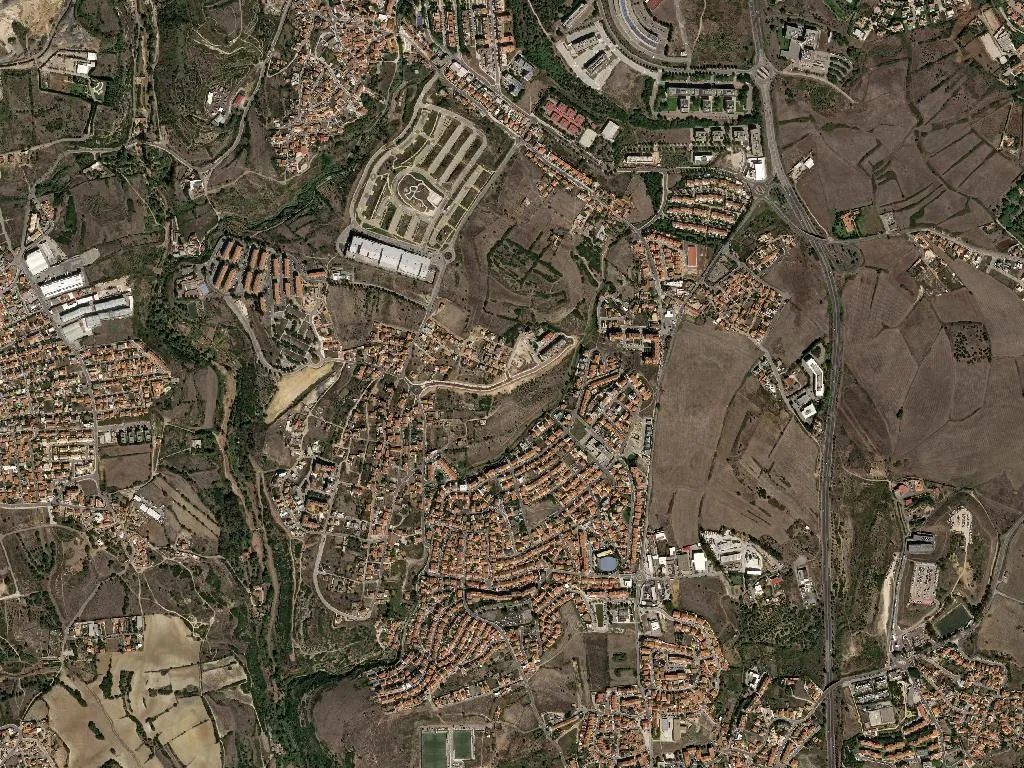
Full article about Porto Salvo: sailors' vow turned tech village
16th-century chapel, Tagus salt, glass labs; the pact still breathes above Oeiras
Hide article Read full article
Where the Tagus still keeps its side of the bargain
The wind arrives from the estuary, slips between the glass cubes of Lagoas Park and shatters the reflections on the ornamental lakes into silver splinters. It is a morning of low, slanting light, and the breeze carries the saline chill that exists only on the north bank of the Tagus between Oeiras and the Atlantic. At 105 m above sea level the air is cleaner than in Lisbon—laced with chlorophyll from the corporate gardens that wrap the business campuses. Porto Salvo, officially created in 1993, still honours a five-century-old pact made by sailors who promised the Virgin a chapel if she brought them safely home.
The caravel, the vow and the whitewash
The founding legend is precise. A 16th-century caravel limping towards the bar, rigging shredded, crew starving. They bargained: survive and we will build you a sanctuary. They did, and around 1530 the hermitage went up on a ridge above the small cove that thereafter was called Porto de Salvo—safe harbour. The chapel still stands, shoulder to the IC17 motorway, its interior a cool dimness that smells of wax and saltpetre. On the right-hand wall an 18th-century azulejo panel narrates the bargain in cobalt and manganese. Marian devotion shaped the place long before fibre-optic cables and R&D labs rewired the topography, and the name survived every administrative divorce—Barcarena in 1836, Oeiras in 1926.
The Tagus relationship was never purely spiritual. A chain of coastal forts—São Bruno in Caxias and Nossa Senhora de Porto Salvo on Cabo Raso—cross-fired across the estuary mouth to discourage Dutch and English privateers. The Porto Salvo battery, listed by the Viscount of Santarém in 1800, mounted six cannon served by 22 men; its ruins now lie under wind-shaved grasses and CCTV masts that guard the offshore data cables.
Fountains and royal shooting parties
Leave the ring-road and you can still walk the older parish. In Leião the 1720 chapel of Nossa Senhora do Socorro shelters a Manueline doorway salvaged from an earlier hermitage. A few terraces below, the Leião fountain, dated 1887, still spills into a stone trough; the Fernando Sabido fountain in Talaíde (1952) and the SIMPS fountain (1963) complete a hydraulic itinerary that once governed daily rhythms—where gossip, laundry and courtship happened under plane trees instead of under parking-lot LEDs.
At Casal da Choca the squat edifice Dom Pedro V used for partridge shoots keeps walls a metre thick—no palace, just a farmhouse muscular enough for a king who arrived between 1855 and 1860 with a Purdey under his arm. Around the fields ruined windmills stand like broken molars; one, in Casal do Deserto, was restored in 2018 by Oeiras town hall. Its refurbished sails now turn a hundred metres from the mirrored façade of Siemens Portugal—blade against byte.
Five kilometres, two centuries
The Oeiras corporate cycleway runs five kilometres between Paço de Arcos and Porto Salvo, a black-ribbon switchback through overlapping realities. You glide past lawns irrigated with treated wastewater, skirt the sculpted lakes of Lagoas Park and the cork-oak survivors of Quinta da Fonte, then coast through lunchtime micro-parks where office workers eat sushi from clear plastic coffins. Hire-bike stations appear every 400 metres—white-and-orange Gira docks that promise seamless onward motion. At the northern end Tagus Park spreads across 125 hectares of laboratories and start-ups; herons land on reflecting ponds beside buildings that house particle-physics servers.
The parish numbers 15,098 inhabitants in 7.34 km²—dense, yet perforated by breathing holes: gardens, lakes, cycle tracks where the hum of the A5 is temporarily erased. Age distribution is almost symmetric: 2,343 children under 14, 3,246 residents over 65, the middle bulk made of aerospace engineers and customer-support analysts. Aquilino Ribeiro Secondary School, opened two years before the parish itself, stages the annual Encontro de Talentos where Cape-Verdean batucadeiras share a courtyard with Ukrainian classical pianists.
Glass and rice
Porto Salvo has no vineyards left, but it lies inside the Lisboa wine zone. Arroz Carolino IGP from the Ribatejo flood-plains—long, absorbent grains that surrender starch without turning to wallpaper paste—travels 30 km west and ends up in Talaíde at O Pescador, a neighbourhood restaurant in service since 1983. Their seafood arroz is built on a stock of percebes and crab heads, the rice finished with coriander and a thread of peppery olive oil from Trás-os-Montes.
Copper sky at clocking-off time
Late afternoon, when the sun drops behind the Belém tower and the light skims the Lagoas Park water, the glass façades ignite the colour of old copper. For two minutes the business park dissolves into a miniature estuary, as if the same water that saved the 16th-century crew has been borrowed, chlorinated and pumped into ornamental lakes, still keeping its side of the bargain to offer safe passage—this time to commuters cycling home along the river of mirrored glass.