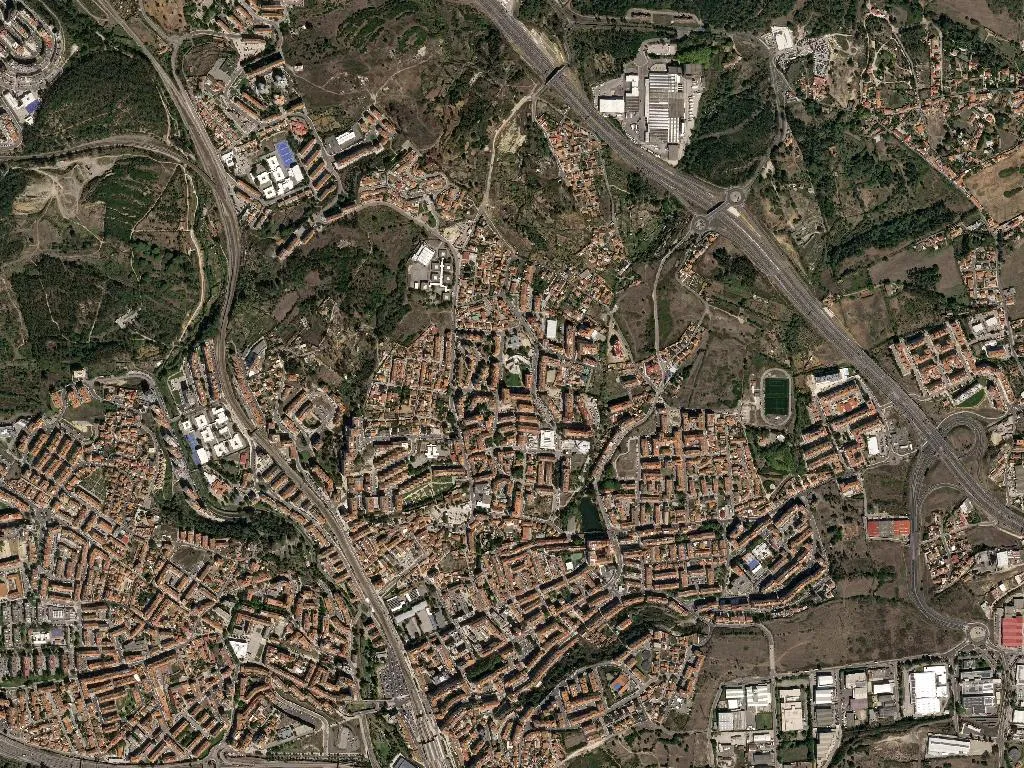
Full article about Agualva & Mira-Sintra: white water beneath tower blocks
Sintra’s unglamorous twin parishes trade castles for courgettes, balconies for palace views
Hide article Read full article
Agualva and Mira-Sintra: Where the White Water Still Runs Under the Concrete
The 125 bus wheezes to a halt at Agualva’s main roundabout and the doors sigh open. First thing you hear isn’t engines—it’s water. An underground stream, the Água Alva, slips beneath the Lidl car park, reappears as a storm drain on Estrada da Pêra, then floods the gutters on rainy afternoons so local kids can race paper boats down Rua dos Lusíadas. Agualva—“white water” in medieval Portuguese—still keeps its promise, even if the river now travels through 1970s drainage pipes on its way to the Tejo estuary. Before it gets there it secretly irrigates guerrilla vegetable plots wedged between the town-hall flats and the railway cutting.
Cross the tracks and you’re in Mira-Sintra. The only official viewpoint is the station garden wall; peer over it, through the catenary wires, and the Serra de Sintra floats in its own micro-climate, a layer-cake of mist that smells of burnt eucalyptus when the wind swings north. Houses are close enough to pass a cup of sugar balcony-to-balcony, yet every fourth window faces the mountain, pegged with washing that flaps like prayer flags while, above, the turrets of Pena Palace skewer the cloud.
Roots beneath the tarmac
The 2013 merger merely rubber-stamped what residents had always done: hop the level-crossing for bread at Zé’s bakery, take a feverish child to Agualva’s hospital, catch the 433 from Mira when the 125 doesn’t show. Human memory goes deeper. On Rua da Igreja Velha a shale-pocked stone wall is whispered to be Visigothic; no one has excavated, yet children still unearth low-denomination Roman coins and swap them for custard-filled Berliners on the way home.
Development arrived by truck: first the municipal social housing of the mid-1970s, then unemployed-workers’ co-ops, then the banks offering 100 % mortgages to civil servants. Only Quinta do Pinheiro survived, now ring-fenced by police-dog fencing, but its Rocha pears still flop over the wall and vanish into school rucksacks.
The monument and its frame
The national monument is the tiny Manueline church of São Miguel de Mira-Sintra—locals simply call it “the chapel”, the low-cost alternative to a celebratory ceremony in Sintra proper. The real pilgrimage, however, is to Dona Alda’s counter at Pastelão bakery for the seven-thirty batch of pão-de-Deus: a brioche the size of a laundry basket, glazed with coconut crust, gone by eight.
The Sintra-Cascais Natural Park begins where the Taco roundabout ends. Slip past the cemetery, through the gate that never closes, and the air changes from frying oil to damp laurel. Behind the 1º de Maio estate teenagers conduct first-time experiments with rolled cannabis, leaving Adidas treads in the iron-rich earth.
Vines, pears and the pilgrims’ shortcut
Mr António, 87, keeps the last bottles of 1995 white in his cellar annexe—grapes came from Ramilândia, now an Intermarché. At weekends he shares a glass with a grandson, remembering harvest festivals when labourers were paid in sardines and vinho tinto drawn straight from the cask.
Rocha pears survive in two rogue orchards: one behind the builders’ yard, another in the playground of Agualva’s primary school where the Technologies teacher turns the fruit into sticky jam every June. You can smell August ripeness when the wind swings south.
The Portuguese Coastal Camino sneaks under the A16 flyover; a yellow arrow painted inside the tunnel is erased weekly by tyre friction. Pilgrims stop at Café O Pingo for a galão and reassurance. “To Compostela? Love, you’ve barely started.” A spiral notebook in the counter drawer carries 2019’s most honest promise: “Next time I’ll fly”—signed, a German woman with blistered feet.
Living at seven thousand per square kilometre
That means queues outside the health centre before dawn, birthday parties in the sports hall that reek of vinegar-soaked chips, the butcher closing at seven so José can catch the train to Estoril where rent is cheaper. Seven bars host 1990s table-football machines, two cemeteries—one still accepting reservations—and a playground where mothers assemble at 4.30 to swap grievances about the teacher who keeps pupils indoors at break.
The 125 is the parish artery: 42 minutes to Rossio if the A5 behaves, 25 if you board the 07.58 express. Fare-dodgers risk a €45 on-the-spot fine; half the passengers flash a monthly pass, the other half perfect the art of selective blindness.
What remains
When the sun drops behind the tax office high-rise, light slides across kitchen tiles and ignites the fresh plaster. The mountain ridge turns bruise-purple, as though someone dimmed the colour dial by hand. Underneath, the white water keeps pushing through cracked Victorian pipes, inaudible until the tenement cistern bursts and floods the underground garage again. Aqua Alba—neither river nor legend—simply the land’s polite reminder that it was here first, waiting for the day the machines fall silent and the water can surface, clear as its own name.