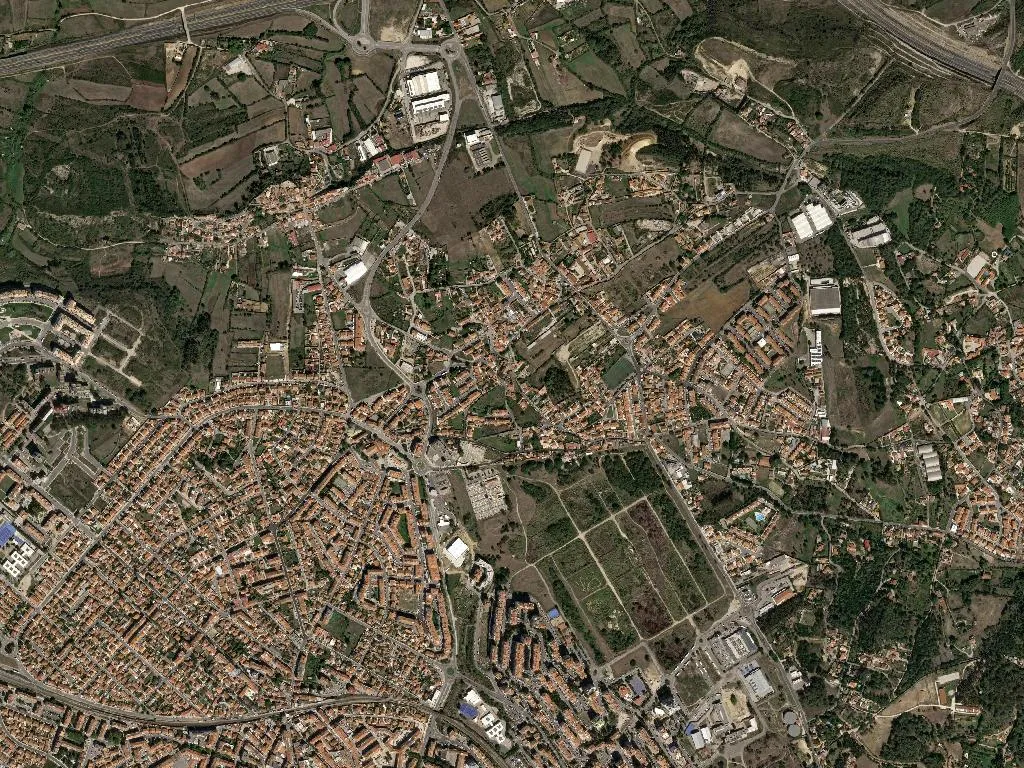
Full article about Algueirão-Mem Martins: Sintra’s suburban heartbeat
From 1380s horse-swap to commuter density, riverside paths and Baroque altars survive.
Hide article Read full article
Algueirão-Mem Martins: where the hills meet the suburb
The train doors hiss open at Algueirão and the air hits you—half mountain damp, half station-espresso. Above your head the 1887 corrugated canopy creaks in the sun, its iron ribs expanding like an old accordion. Somewhere below the car park you can hear the Ribeira de Algueirão sliding over granite, a sound that predates every apartment block here.
A name that once meant “change horses”
“Algueirão” comes from the rented mounts that were swapped here before the climb to Sintra; the form “Logueram” appears in a 1382 tax roll. Mem Martins remembers a medieval landowner called Martim Escorso whose descendants simply became “the Martinses”. The railway arrived in 1887, electricity followed, then the 1970-90 building surge that turned three hamlets into 68,649 people in 16 km²—4,300 per km², the highest parish density outside Lisbon. You feel it in the butcher’s queue that snakes past the lottery counter, in the log-jam on the EN9 roundabout, in the morning fight for the last bica at the counter.
Churches that refused to move
Baroque altarpieces stripped from hilltop hermitages now line the nave of Mem Martins parish church—gilt carvings so animated they seem to clear their throats. A five-minute walk away, the chapel of S. Sebastião is the size of a corner shop, yet on 20 January it fills with candlelight and the brass band still squeezes inside. Surviving manor houses keep their heads down: Quinta da Fonte behind high stucco, the clock-turret Palacete do Relógio now subdivided, only magenta bougainvillea announcing their presence.
The forest that hasn’t surrendered
Cross the tracks and you’re in the Sintra-Cascais Natural Park. PR4, a 4.5-km way-marked loop, leaves from platform two and climbs to the 16th-century Convent of the Capuchos. Pilgrims heading for Santiago use it as an overture to the coastal route; toddlers treat it as an adventure playground; parents debate cloud cover while pushing buggies over schist. Cork oaks show fresh extraction scars, eucalyptus smells like Wrigley’s gum, and if you arrive after rain a common kestrel hangs above the valley riding the up-draught. The Jamor river is born here—follow it for an hour and you’ll reach the Belas reservoir where illicit fishing rods poke from reeds.
What to eat (and drink) without going to Sintra
The covered market (Tues-Sat) stacks Pêra Rocha pears in late summer and queijadas arrive from Sintra’s ovens at dawn. On feast days the Negraia rotisserie rolls out leitão da Bairrada. Local wine shops keep a back shelf for Ramisco de Colares—grapes rooted in sand dunes, the wine tasting of damp bark yet miraculously alive in the glass. November brings São Martinho: chestnuts roasted outside the church, vinho novo that hasn’t finished apologising for last month’s harvest.
When the sky still has a job to do
On certain Fridays the Mem Martins football pitch swaps floodlights for telescopes. Members of the Algueirão Astronomy Club set up 200 mm reflectors and wait for the Sintra ridge to block Lisbon’s glow. If the Atlantic cloud stays away, Jupiter resolves into a tiny brass sun. Pena Palace is 15 minutes by train, but from here its ramparts look like a distant mirage—proof that the mountain, not the municipality, is still in charge.
When the last Lisbon service departs and the canopy stops creaking, the suburb exhales. All that remains is eucalyptus on the night air and the certainty that concrete may win the skirmish, but the sierra will always win the war.