Full article about Casal de Cambra: Concrete Meets Eucalyptus at 226 m
In Sintra’s youngest parish, breeze-block streets end abruptly at eucalyptus-scented granite ridges.
Hide article Read full article
226 Metres: Where the Serra Meets the Suburbs
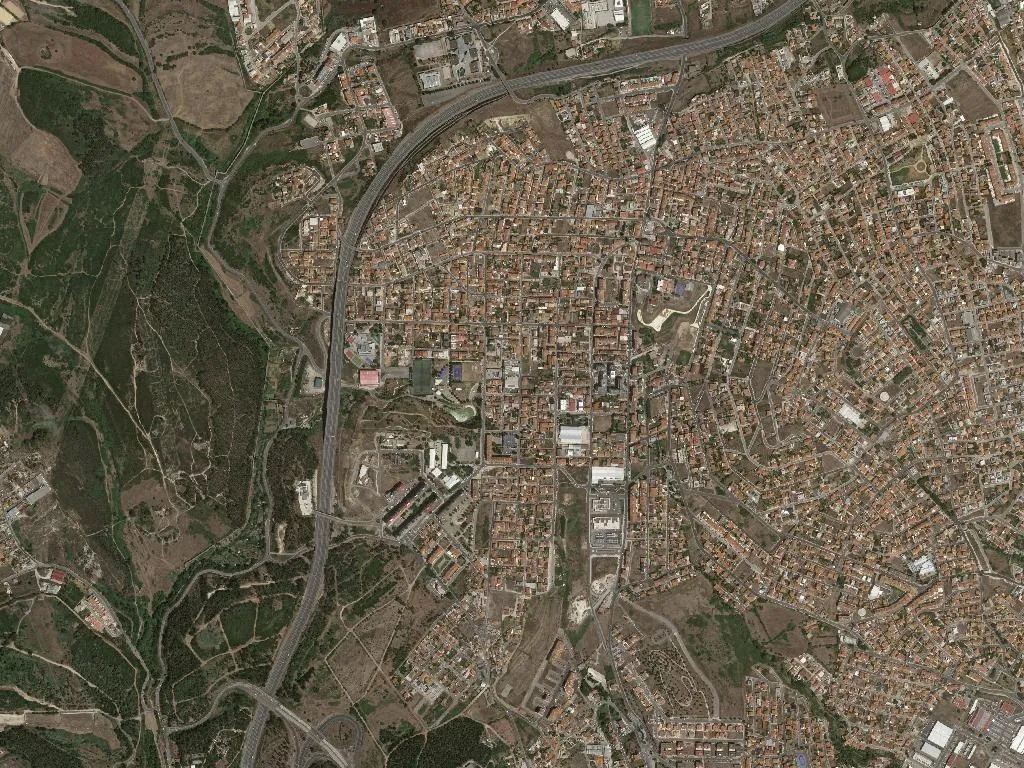
The wind arrives from the Atlantic, saturated with the cold humidity that only Sintra’s granite bulk can manufacture. It threads itself between the four- and five-storey blocks that stand shoulder-to-shoulder in Casal de Cambra, tugging at laundry on 1990s balconies and rattling the aluminium shutters. There is no palatial architecture here, no pastel-washed postcard. Instead, the palette is raw concrete and sun-bleached curtain, the horizon defined by lift shafts and satellite dishes. Yet climb to the 226-metre contour line and the city ends mid-stride: six strides past the final building the pavement simply stops, replaced by ochre earth, e the smell of eucalyptus drifts in like a change of key.
A Periphery That Put Down Roots
Casal de Cambra was sketched overnight. In the 1960s António Baptista Mota, a businessman from Alcanena, bought a ridge of cheap farmland five kilometres north-west of Lisbon’s Pontinha interchange and carved it into “quintinhas” – five-thousand-square-metre plots marketed to civil servants, tram conductors and police officers who had migrated from the provinces. The lots were halved, then quartered; breeze-block cottages sprouted without permission, then were granted amnesty. By 1997 the settlement was large enough to be baptised a civil parish; by 2021 it packed 13,347 souls into 2.4 km² – a density higher than Porto’s medieval centre.
Walk the grid at 07:45 and you’ll share the pavement with children in fluorescent smocks heading to Escola Básica 2,3 D. Fernando I, and grandfathers in plaid slippers carrying baguette halves from the Minipreço. The parish council claims 2,228 under-14s and 2,138 over-65s; the symmetry is audible in the playground behind the Igreja Paroquial Santa Marta, where the thud of a plastic football is answered by the click of knitting needles on a bench.
Sintra’s Shadow
Officially, Casal de Cambra owns one listed building: the seventeenth-century Capela de Santa Marta, rebuilt after a fire and now wedged between apartment wings like a keepsake in a coat pocket. The real monument is topographical. The settlement sits inside the Sintra-Cascais Natural Park; the Unesco-listed cultural landscape begins at the recycling bins on Rua da Caparica. From there a footpath climbs through gorse and stone-pine to the 266-metre summit of the Serra de Casal de Cambra, a 1.8-kilometre ascent that cyclists clock at 5.2 per cent average gradient. At the top Lisbon’s skyline is a faint Lego blur; below, the blocks of Bairro da Serra da Helena look almost fragile, a raft of concrete moored to the edge of a forest.
Vineyards You Can’t See, Wines You Can Drink
There are no vines in Casal de Cambra, but three of Portugal’s smallest, most obstinate DOC zones lie within a quarter of an hour’s drive. Head south-east for Bucelas and the Arinto grape delivers a lime-steel white that was already fashionable in Shakespeare’s London; swing west to Colares and the Ramisco vines, rooted in sand dunes, still resist phylloxera. Even closer, the forgotten Carcavelos appellation produces a mahogany-coloured fortified wine from the abandoned quintas outside Belas. Local restaurants list them by the glass at prices that would make a Lisboa sommelier wince – try the Adega do Gomes on Rua Pedro Julião, where a plate of grilled chouriço and a chilled Arinto cost less than the Uber home.
Sleep at Window-Height
Forget boutique conversions: Casal de Cambra offers two unlicensed guest rooms, both entered through a side gate and up an unlit stairwell. Expect net curtains, a miniature balcony, and the neighbour’s television as ambient sound. It is Portuguese domesticity unfiltered – the clatter of a pressure cooker, the evening news at full volume, the scent of grilled sardines rising through the lift shaft. Check-in is conducted by Dona Alice, treasurer of the local parents’ association, who will insist you try her homemade queijadas de Sintra before you’ve found the light switch.
The Soundtrack After Dark
By 22:30 the IC19 flyover has quietened and the orange rectangles of kitchen windows glow like votive candles. From every block comes the same muted orchestra: the hiss of rice being drained, the metallic chop of coriander on a board, a child’s laugh muffled by double glazing. No guidebook chronicles this polyphony, yet it is as faithful a record of contemporary Lisbon life as any tile-panel in the National Palace. Stay long enough and you’ll learn to distinguish the opening chords of the SIC telenovela from the bark of the beagle on the third floor – a private geography more precise than any map.