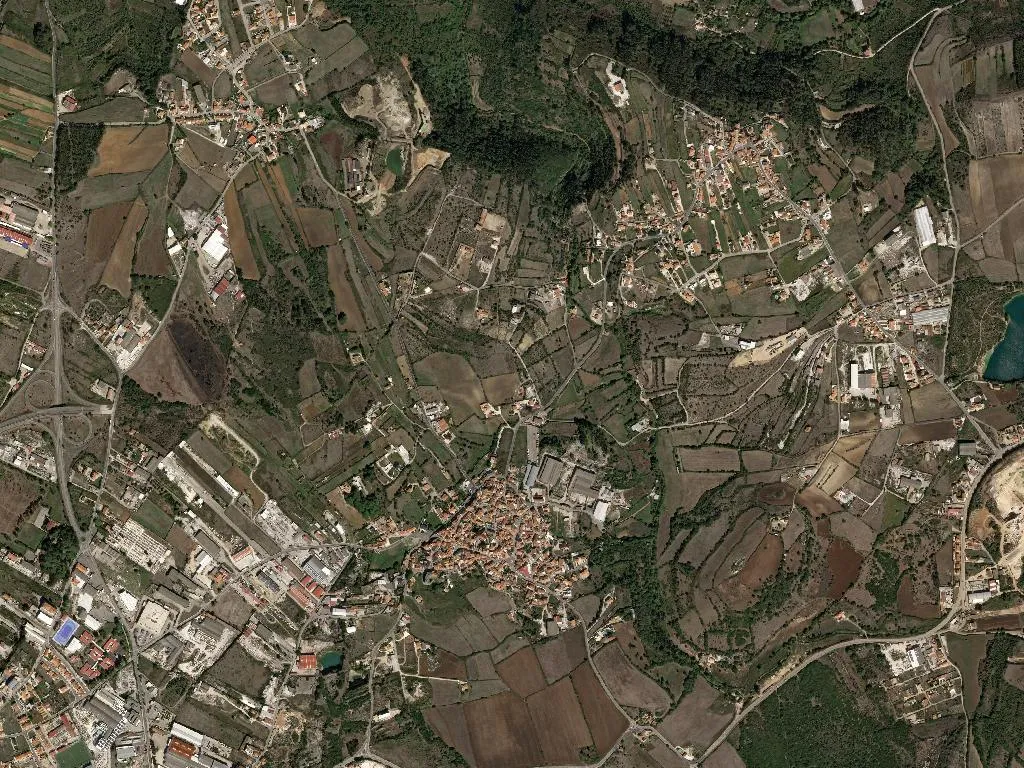
Full article about Montelavar
Walk silent orchards, 16th-century plague chapel & beeswax-lit 1781 church above Atlantic mist
Hide article Read full article
Montelavar: Where Sintra’s Moorish wind ripples pear orchards
The breeze arrives from the southwest, freighted with Atlantic moisture that Sintra’s green ridge hoards like a sponge. It slips between hedgerows of pruned pear trees, making their canopies shiver and releasing a faint scent of bruised blossom. At 152 m the single-track road levels, the Lisbon asphalt finally gives up, and the air changes: warm loam, newly scythed grass, damp limestone where the plough has scraped the bone of the land. This is the moment you enter Montelavar – technically abolished in the 2013 nationwide parish merger, yet stubbornly alive in every conversation that still begins “In our freguesia…” without a glance at the statute book.
A name drawn from hill and water
Montelavar is its own atlas: “monte”, the gentle knoll that lifts the settlement clear of the surrounding marshes; “lavar”, a nod to the streams and communal wash-houses that once governed daily routine. Medieval tax rolls already list the village within Sintra’s crown lands, when life obeyed sunrise bells and the threshing floor rather than the commuter timetable. Two years after the 2013 reform glued it to neighbouring São João das Lampas, locals still give their address as Montelavar. Population: 5,754 spread over 862 ha – a density low enough that every house keeps its own fig tree, its stone water tank painted the same ox-blood red as the parish church door.
Two churches, two kinds of stillness
Heritage here is measured in silence. The Igreja Matriz, rebuilt after the 1755 earthquake and dated 1781 on its Lioz limestone façade, anchors the village like a ship run aground. Inside, a 1792 gilded altarpiece – commissioned by the treasurer of Colares’ Misericórdia – still smells faintly of beeswax and the dust of baptismal ribbons. Five minutes away, the 16th-century Capela de São Brás was erected as a vow against plague; a side slot allowed the infected to take communion without entering. Its metre-thick granite keeps the interior refrigerator-cool even in August, a refuge for lizards as much as penitents.
Tracks through vines and pears
Since 1994 Montelavar has lain inside the Sintra-Cascais Natural Park; the following year UNESCO listed it as part of Sintra’s Cultural Landscape. The designation changes nothing on the ground – no coach parks, no selfie queues – but quietly protects 40 km of rural footpaths and the dry-stone walls that parcel the valley into a chequerboard of orchards and small vineyards. The 16th-century Quinta da Ribafria, manor house and still-functioning water-leat included, reminds visitors that minor rural nobility once summered here, endowing the 1568 chapel of Nossa Senhora da Saúde for their tenants.
Between May and September the orchards swell with Pêra Rocha do Oeste DOP, Portugal’s only pear with protected origin status. The local growers’ co-operative, founded in 1961, still pools 120 farmers and ships 70 % of the crop to national supermarkets within 48 hours. Walk the dirt lane south of the village and you’ll meet the Arinto vines of Herdade dos Gafanhas, planted in 1953 at 140 m, their Atlantic exposure giving a lemon-sharp white wine that Adega Regional restaurant has poured by the carafe since 1987. Lamb stew here is simmered exactly as the present owner’s grandmother dictated – no shortcuts, no coriander flourish.
In 2017 the Portuguese Federation of the Way of St James way-marked 12.5 km of the Coastal Route through Montelavar; yellow arrows now guide hikers from the church steps to the eucalyptus ridge above the village. Most pause at Café O Serrano, open since 1973, where Dona Fernanda – apprentice at 14, matriarch at 73 – still rises at 5 a.m. to bake queijadas (set-curd tarts) and pão-de-deus (coconut-glazed buns) in a domestic oven wedged behind the counter.
A parish that refuses to be a footnote
Demography tells its own story: 815 under-25s, 1,331 over-65s. Yet Montelavar is not a retirement museum. The primary school may have only 78 pupils (down from 180 in 1995), but the library stays open three afternoons a week thanks to the town hall’s “Reading in the Village” scheme, and the chess club meets under the orange trees. Nine legal short-stay rentals – no hotels, no pools – point to low-impact tourism. The 2019 conversion of “Grandfather’s House” by a Lisbon architect who spent childhood summers here shows how barns can become glass-walled studios without surrendering their schist skins or hand-carved window frames.
The weight of a pear in the palm
Leave by the south-east track at dawn and Seixal farm lets you pick your own Rocha pear, the skin still warm from yesterday’s sun, gritty flesh yielding with a muted snap. Joaquim Costa, fourth generation of tree-tenders, will tell you – while the juice runs over your wrist – that the original Rocha was a chance seedling spotted in a Sintra garden in 1836. Every tree in the valley is its descendant. Bite, swallow, wipe your hand on the grass: in that small transaction you understand why an administrative line on a map never mattered here. Montelavar endures as long as pears ripen and someone turns the irrigation valve at first light.