Full article about Queluz: 50,000 Tiles Whisper Beneath a Pink Palace
Salmon-pink rococo halls, azulejo-lined canals and custard-tarred mornings between Lisbon and Sintra
Hide article Read full article
Queluz: Where Water Runs Beneath 50,000 Tiles
Morning light slips through the blacksmith’s scrollwork of the palace gates and prints iron lace on the cobbles. Before you see a single pediment you hear water — a low, constant conversation between unseen fountains and the Jamor river that once named the place itself. Quellus, the Romans said: spring, source, the liquid syllable that still runs under 26,000 daily lives.
You are 125 m above sea level on a low ridge exactly halfway between Lisbon’s asphalt glare and Sintra’s misty sierra. Coaches no longer pause to change horses, yet the through-traffic has never stopped: pilgrims on the coastal Camino, commuter trains every fifteen minutes, and the slow parade of pensioners who meet at Pastelaria O Pão de Queluz when the first custard tarts leave the oven at seven.
A little Versailles that speaks Portuguese
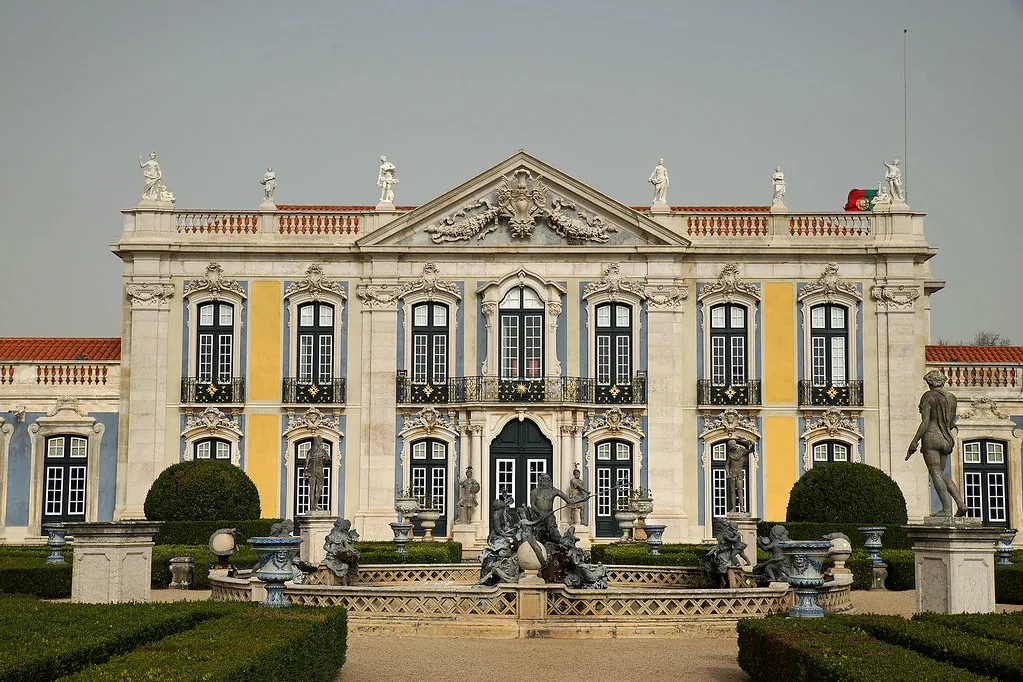
Comparisons to Versailles are usually travel-writer inflation, but here they hold. Dom Pedro III commissioned the palace in 1747 as a summer retreat from the rigours of the court in Lisbon; what rose over the next four decades is a salmon-pink exercise in rocaille fantasy – façades like piped icing, windows rhythmically spaced as musical notation. Inside, silk-lined drawing rooms follow one another in golden sequence until you reach the chapel, completed in 1752, where gilded carving by Silvestre Faria Lobo drips like frozen fireworks above panels painted by André Gonçalves. The Virgin of the Immaculate Conception presides, small and calm, as if she has already seen the 1755 earthquake come and go.
Step through the French doors and geometry reasserts itself: box parterres, cypress sentinels, gravel that crunches at precisely the right pitch of 18th-century formality. Then the gardens loosen. Follow the sound of water and you arrive at the Canal dos Azulejos, a 45-metre tiled aqueduct unique in Portugal. Roughly 50,000 tin-glazed tiles line the channel, their cobalt ships and fortresses telling the story of a maritime nation whose horizons kept expanding. After a recent restoration the mirror-smooth water doubles the narrative: above, a galleon tilts on ceramic waves; below, the same vessel dissolves into a sky where plane leaves drift like late-season snowflakes.
Between palace and periphery
Beyond the railings Queluz reveals its other life. Salazar’s regime pumped concrete here in the 1950s and 1960s, turning orchards into social housing. The result is a palimpsest: Art Nouveau kiosk on Praça da República, 1970s apartment blocks, and the surviving octave of a bandstand where Sunday concerts still feature accordion-driven música ligeira. Census data show the demographic seesaw tipping gently towards age: 4,500 residents over 65, 3,800 under 14. Stand at the bus stop on Avenida da República at rush hour and you will hear Lisbon slang layered over the rolled r of older Alentejo migrants.
Yet the strategic geography that once made Queluz royal playground now makes it useful to travellers. Sintra’s Pena Palace is 11 minutes by train; Lisbon’s Rossio is 20. In between, 24 legally registered guesthouses offer rooms at half the capital’s rate, and the coastal variant of the Camino de Santiago cuts straight through town – look for the yellow scallop on blue tiles outside the parish council building.
The Jamor and the green that refuses to leave
The river that feeds the palace fountains is only ankle-deep by midsummer, but its valley still works as a time machine. Enter beside the municipal sports complex and within five minutes the A9 motorway fades behind a curtain of willow and ash. Kingfishers patrol the deeper pools; in April the air fills with the sherbet scent of acacia. The valley is protected within Sintra-Cascais Natural Park, which means planners cannot pave it, and evening joggers share the dirt track with the occasional pilgrim still walking to Santiago the medieval way.
Queluz also sits inside the larger UNESCO-listed Cultural Landscape of Sintra. The paperwork matters: it keeps concrete at bay and keeps alive small orchards of Pêra Rocha do Oeste, the DOP-protected pear whose granular flesh tastes like white wine poured into fruit. Drive west for five minutes and you are among the last commercial vineyards of the once-famous Carcavelos appellation – rows of Arinto on sandy soils, producing a nervy white that was exported to Victorian England under the name “Lisbon Hock”. What survives is bottled by a single co-operative; find it on the list at Palace restaurant Cozinha Velha, served chilled beside a plate of leitão sandwiches.
Reflection and stone
To spend a day here is to accept simultaneity: the palace’s ceremonial axis and the supermarket carpark, baroque gilding and the smell of grilled sardines drifting from a first-floor balcony. Layers accumulate like flaking paint on an old door jamb – each coat a reign, a republic, a dictatorship, a housing boom.
Stay until the light tilts. When the sun grazes the rocaille façade the salmon deepens to burnt orange, the cypress shadows stretch like dark comets across the lawn, and the Canal dos Azulejos turns matte, a lead mirror swallowing sky and ceramic alike. For a moment the tiles and the heavens share the same cobalt, and you can no longer tell where the 18th century ends and tonight begins.