Full article about Sintra’s fog-kissed lanes where palms shade granite
Feel Atlantic mist coil round royal palaces, banana leaves and 700 millennia of footprints
Hide article Read full article
A mist that makes things up
The damp arrives at the wrists first, then the nape of the neck. Before you see Sintra, you feel it: a vegetal chill laced with moss and dark earth, rising off the uneven cobbles and mingling with the vapour the hills exhale each morning. Footsteps echo between granite walls quilted in lichen, and somewhere above the dense canopy of Japanese cedars the bell of Santa Maria tolls once, a low concussion that ricochets off stone before dissolving into the haze. Sintra never announces itself; it insinuates.
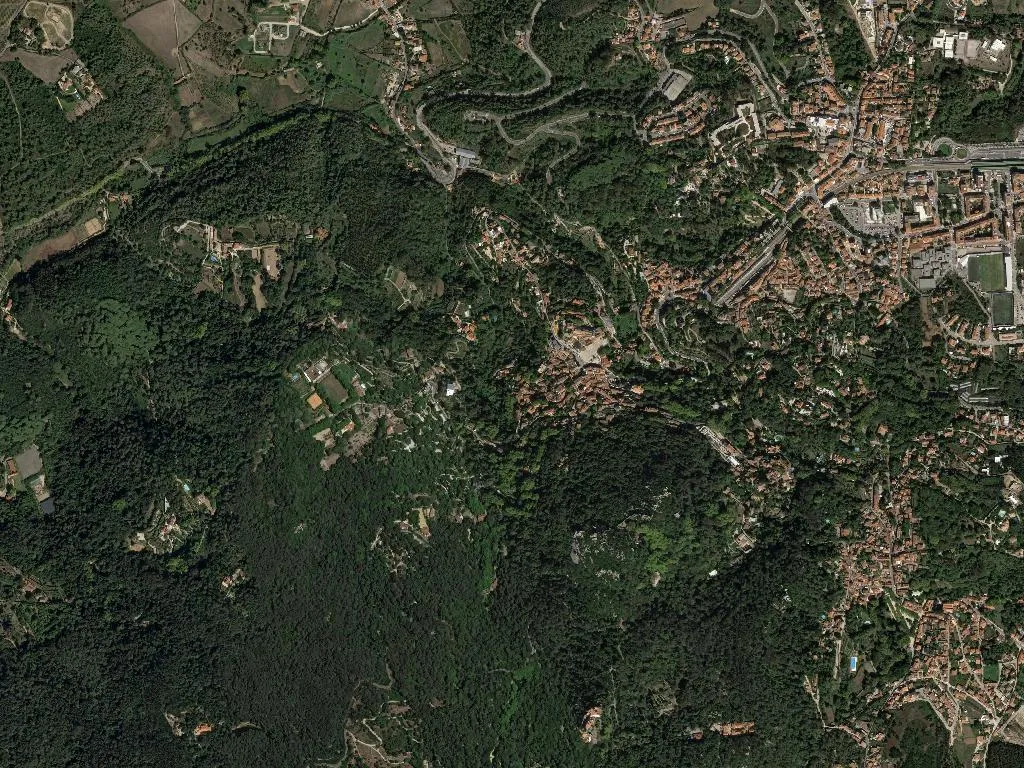
We are only 190 m above sea-level, yet the ground feels negotiable, as though altitude were negotiable. The granite massif climbs to 529 m at the Alto da Pena, while the Atlantic lies eight kilometres away in a straight line. In that short drop the rock creates its own weather – a breathable fog that lets beeches grow alongside Norfolk Island pines and allows banana-plants to flourish in private gardens, as if the tropics had slipped into a European valley. Light here doesn’t strike; it seeps, turning every surface – whitewash, schist, wrought iron – into a softer version of itself.
700,000 years beneath the sole
Human footprints in the area date back to the Lower Palaeolithic, around 700,000 BCE. The Romans christened the ridge Cynthia after their moon goddess – the origin of the name Sintra. Visigoths, Moors, crusaders: each layer incised the bedrock. Afonso Henriques seized the town in 1147, yet the parish church of Santa Maria was already standing, recorded since 1108. São Martinho is mentioned in 1255; São Pedro de Penaferrim was handed to the Order of Christ in 1314. Sancho I granted a royal charter in 1154, Afonso III renewed it a century later, and the village became the court’s summer address – a status it has never fully surrendered. On 28 June 2013 the three historic parishes were fused into a single administrative body sheltering 29,896 residents, 6,355 hectares and 26 listed monuments, eight of them classified as National Monuments.
Stone over stone, palace over priory
The National Palace’s twin conical chimneys – visible for kilometres – contain a clock that has ticked without interruption since 1628, almost four centuries of pendulum. Higher up, the eighth-century Castelo dos Mouros throws its walls across the ridge; from the battlements you can track the Tagus estuary west to the fossil-studded coastal cliffs. The nineteenth-century Pena Palace, deliberately grafted onto a Manueline monastery, was Europe’s first Romantic building to be created by layering one epoch directly onto another – a piece of architectural audacity that helped UNESCO inscribe the entire Cultural Landscape of Sintra as World Heritage in 1995.
Then comes Quinta da Regaleira, where initiatic wells spiral down through dripping rock, the sound of your own footfall echoing like company. Monserrate, Seteais, the cork-lined Capuchos friary – each of the 26 classified sites demands a different cadence. Walk between them and you are also, unawares, following a stretch of the coastal pilgrim route to Santiago that cuts through the parish and links ocean to interior.
What the convent kept sweet
Sintra’s queijadas – small cheesecake tarts – have been made by nuns since the thirteenth century, a monastic alchemy of egg yolk and fresh curd. At Piriquita bakery the travesseiros are the other local mania: shards of puff pastry snapped over almond cream, icing sugar clinging to the fingers like guilt. Try also the foliados of Santa Maria or the almond arrufadas; if you prefer salt to sugar, order eel stew from the Ribeira de Sintra or kid goat roasted in a wood-fired oven. Wash it down with Colares DOC – Europe’s only wine grown on fossilised sand dunes whose vines plunged roots beneath the phylloxera blight. In the surrounding quintas the West’s DOP Pêra Rocha pears are left to ripen; their grainy flesh and copious juice end a meal with crystalline precision.
A ridge that breathes inward
The whole parish lies inside the Sintra-Cascais Natural Park. Springs feed streams – São Pedro, São Martinho, Lamajões – that slide through ferns and exposed roots to the Tagus. The footpath linking ridge to Pena and the Moorish castle is four kilometres of shaded track scented with wet eucalyptus and pine resin. The PR 2 Mill Route and the GR 11 Atlantic Way offer exits to the beaches – Praia Grande, Adraga – whose cliffs carry Jurassic fossils. Here Dom João de Castro, viceroy of India, was born in the Paço de Penha Verde; the painter Henrique Pousão died at twenty-five in the Quinta do Ramalhão; composer Marcos Portugal was organist at Santa Maria; Eça de Queirós served as magistrate and returned Sintra to literature in The Maias. The hills store lives the way they store moisture – in invisible strata revealed only when the mist lifts.
Fourteen languages on one stone
Halfway up the slope sits a boulder nicknamed the Friendship Stone, etched in 1840 with greetings in fourteen tongues. It is neither monument nor ruin, simply proof that travellers speaking fourteen languages paused here and wanted to leave a trace. Perhaps that is the image that lingers as you descend at dusk, the fog re-settling round the National Palace chimneys, wood-smoke rising from cottages below: the certainty that this place has always lured those who needed to carve their name into rock – and that the rock, softly mossed, is still willing.