Full article about Santo Quintino: Silver-nailed saint above Lisbon’s vineyards
White-lime glare, 1520 church relics and Wellington’s cannons on a 309 m ridge
Hide article Read full article
Morning glare and white lime
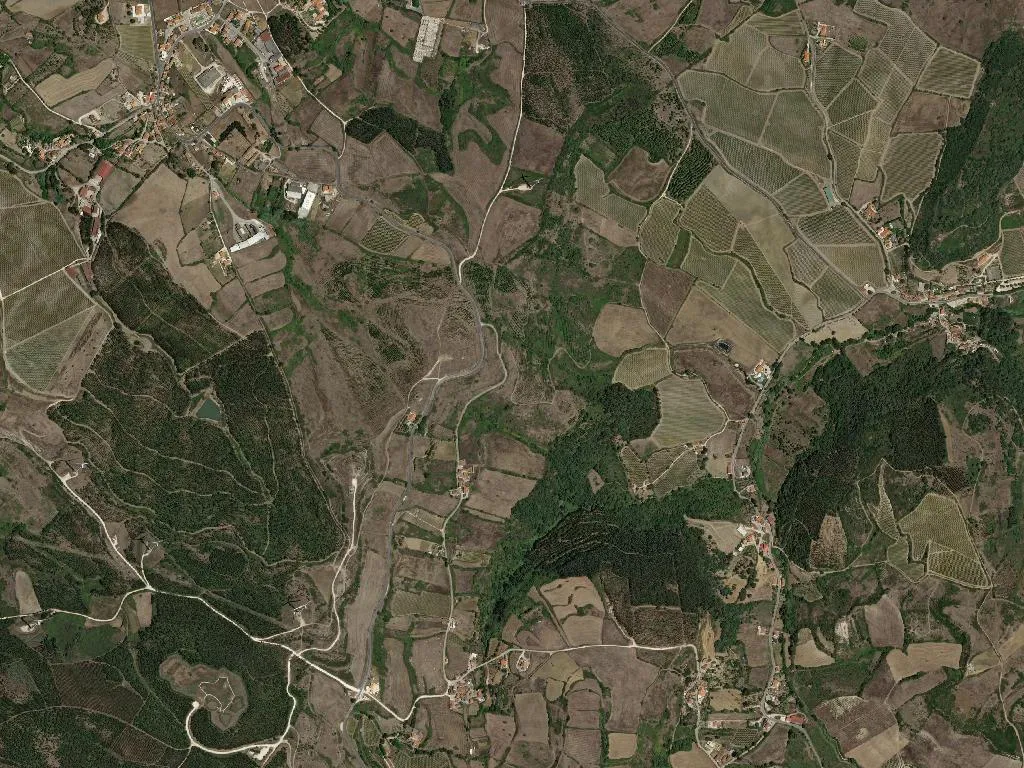
The white lime of the church front throws the morning sun back at you with almost punitive force. In Santo Quintino’s single square the hush is thick, broken only by the scrape of a chair across the calcada outside Café Central and the sparrows quarrelling on terracotta roof-edges. Up on the ridge the São Domingos windmill keeps watch, its timber sails motionless since the last sack of rye was ground in 1953. At 309 m the air arrives rinsed by the surrounding vineyards; the cooperative’s rows of Arinto and Fernão Pires run ruler-straight to the wave-like horizon.
The saint who only lives here
The parish church, raised in 1520, shelters a unique dedication: the only sanctuary in Portugal honouring St Quintin, a third-century Frankish martyr whose cult drifted south across the continent to this chalky plateau. Manueline ribs loop across the vault, but the real relic is overhead—two 17-cm silver nails crossed in the chancel vault, replicas of the instruments that pinned the saint to the tree and now the emblem on every parish letterhead. Five centuries of whispered petitions have seeped into the Pêro Pinheiro limestone; late-day light slips through the cracks and prints lacework on the flagstones furrowed by generations of boots.
When the French climbed the hill
On 15 October 1810 the ridge above the village became the western hinge of Wellington’s Lines of Torres Vedras. Forty-eight Portuguese and British cannon, 12-pounders dug into the rebuilt Forte de Alqueidão, barred Masséna’s road to Lisbon. The earthwork is now a pasture where ibéric pigs nose among the ravelins; below, the 1892 wrought-iron gate of Casal do Outeiro still squeals on its hinges, and the 1745 bell of the chapel of São Sebastião tolls the same seven-o’clock Ave Maria it rang for the French advance. From the Casais lookout at 450 m the Tagus flood plain unrolls like a green tide; on crystalline winter afternoons the Atlantic shows its own pale stripe at the edge of sight.
Calendar of rites
Every 1 and 2 November the Feira de Todos os Santos fills the lanes with the smoke of chestnut roasters and chouriço grills, a charter fair recorded since 1758. On Easter Sunday the peace is ruptured by the national motocross Grand Prix—throttles wide in the red-dust crossódromo since 1998. Between these poles the year is stitched with lesser feasts: Santo Amaro (15 January), São Tomé (21 December), Nossa Senhora da Saúde (last August Sunday) and Nossa Senhora da Fé (first May Sunday), each with processions, street auctions and communal tables ladling sopa da panela and kid-rice stew.
Taste of the Saloia uplands
At O Lagar the kitchen burns local oak to roast Serrana kid until the skin crackles, scenting the room with rosemary cut on Monte do Campo. Salt-cod arrives in 300 g slabs, house-smoked sausages hang for three weeks in granite smoke-houses, and raw-milk goat cheeses cure for 45 days on pine shelves. Meals finish with Vale do Seixos Pêra Rocha DOP—its flesh crisp, almost citrus—and conventual sweets: fios de ovos from grandmother Maria’s recipe, and warm bread from the communal wood oven that still fires every Friday. Bottles of Lisbon-region white land on the table with the limestone minerality granted by the chalk that underlies this corner of the 2017-designated Oeste Geopark.
As dusk settles, São Domingos’ shadow stretches across the vines and the matriz bell tolls 19h30. Shutters close at 20h15, lace curtains in Vila Nova glow behind first-lit windows, and the scent of oak smoke rises at 21h00. Santo Quintino offers no spectacle—only the persistence of small rituals, and the silver nails on a ceiling waiting for someone to pause long enough to read them.