Full article about A dos Cunhados: Atlantic salt on wheat-skin plains
Flat-land Lisboa parish where ocean wind salts vines, pears blush and noon shadows shrink to pinpoin
Hide article Read full article
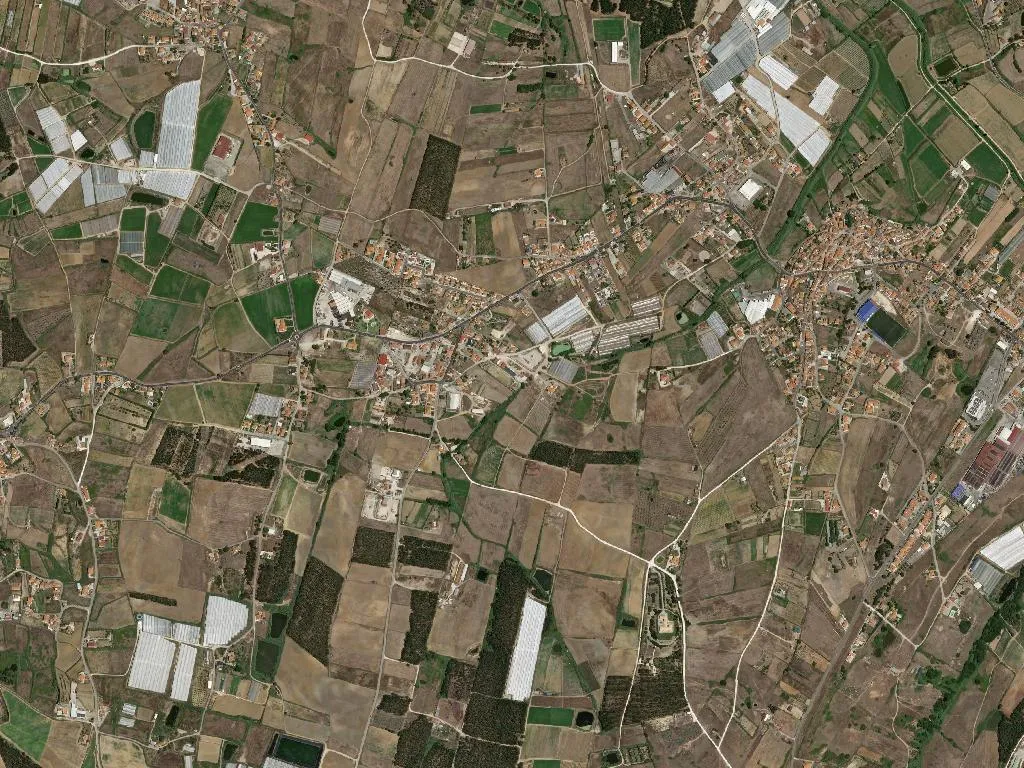
The wind clocks in first. It rolls off the Atlantic, picks up a cargo of brine, then scythes across 44 km² of land that barely clears 30 m above sea level. No sierras, no escarpments – only the slow breathing of wheat stubble, vine cordons and low limestone walls that shiver whenever the breeze changes tack. In A dos Cunhados you don’t so much see the ocean as wear it: a faint saline film settles on forearms and phone screens before breakfast and lingers until the sun climbs high enough to burn it off.
The geometry of an open plain
Spread over 4,500 hectares, the parish is an exercise in horizontality. Light arrives unfiltered, shadows at noon are stunted, and the sky owns more real estate than the ground. At 31 m average elevation the eye is given a long leash: eucalyptus windbreaks, pear orchards in white bloom, and the occasional galvanized-steel barn slide into a ruler-straight horizon. Houses sit far apart, their gardens generous enough for a vegetable plot and a woodpile; tarmac roads concede suddenly to ochre lanes without warning.
Census data shows 5,784 inhabitants, but the morning choreography suggests fewer. Cafés in the small grid around the parish church are full by 7.30 a.m.; by late afternoon the only audible engine is the irrigation pump in the lower vineyard. Grey hair outnumbers school satchels by roughly two to one – a demographic truth that shapes the tempo more than any town-hall decree.
Vines, orchards and what the soil remembers
A dos Cunhados lies inside the Lisboa wine zone, and the Atlantic draught that polishes the grapes is the same one that wrinkles your shirt. Vine leaves flick from jade to arsenic between seasons; their fruit ends up in taut, saline whites and mid-weight reds that taste faintly of crushed fennel and sea stones.
Look beyond the vineyard rows and you’ll find three protected names mapping a larger edible geography. Pêra Rocha do Oeste pears ripen to a champagne blush and crunch like a Granny Smith with better manners. Alcobaça apples swell further east, while Torres Vedras contributes the pastel de feijão – a brittle-crusted tart filled with white-bean, almond and cinnamon paste that predates the pastel de nata by at least a century. August orchards give off a musky-sweet perfume that drifts half a kilometre; it is the olfactory equivalent of biting into fruit warmed by its own sugars.
Walking to Santiago, within earshot of surf
The Portuguese Coastal Way enters the parish on a tractor-wide lane between wheat fields. Pilgrants expecting drama – granite peaks, river gorges – find instead a meditation on exposure: no shade for two kilometres, wind as constant as a metronome, sun drilling the parting in your hair. The compensation is amplitude: larks overhead, the faint thunder of unseen surf three kilometres away, and a horizon that lets you watch weather frontals draw across the sky like theatre curtains. The parish lists 136 registered beds – spare rooms in farmhouses, modest guest-quarters above cafés, a clutch of Airbnb cottages – enough to ensure a hot shower and a plate of carne de porco à alentejana without rerouting to Torres Vedras town.
Reading the ground like a palimpsest
A dos Cunhados sits inside the UNESCO-branded Geopark Oeste. Beneath the topsoil lies a Cretaceous seabed: oyster-shell limestone, rust-coloured clays, the occasional shark tooth turned to flint. After rain the rural paths blanch white where calcite outcrops; your boots come home rimmed with terracotta mud. It is a landscape whose autobiography is legible to anyone who bothers to glance down.
Salt memory
Dusk paints the fields copper. The wind drops a degree, acquires a metallic chill and keeps its salt quota. There is no postcard moment, no belvedere selfie – only the discreet revelation, when you roll down your sleeve, of a faint sugary crust on the skin. It is the Atlantic’s calling card, left after a day spent walking, tasting, looking sideways rather than up. You leave A dos Cunhados with nothing monumental to recount, yet the shower water still tastes faintly of the ocean, and tomorrow the wind will arrive before everything else, reloading itself with salt just beyond the doorstep.