Full article about Carvoeira-Carmões: granite, vines & subterranean water
Explore Carvoeira e Carmões: 13th-century granite church, vast vine nursery tunnels, calvary shrines and a 1930s water mine feeding Torres Vedras vineyards
Hide article Read full article
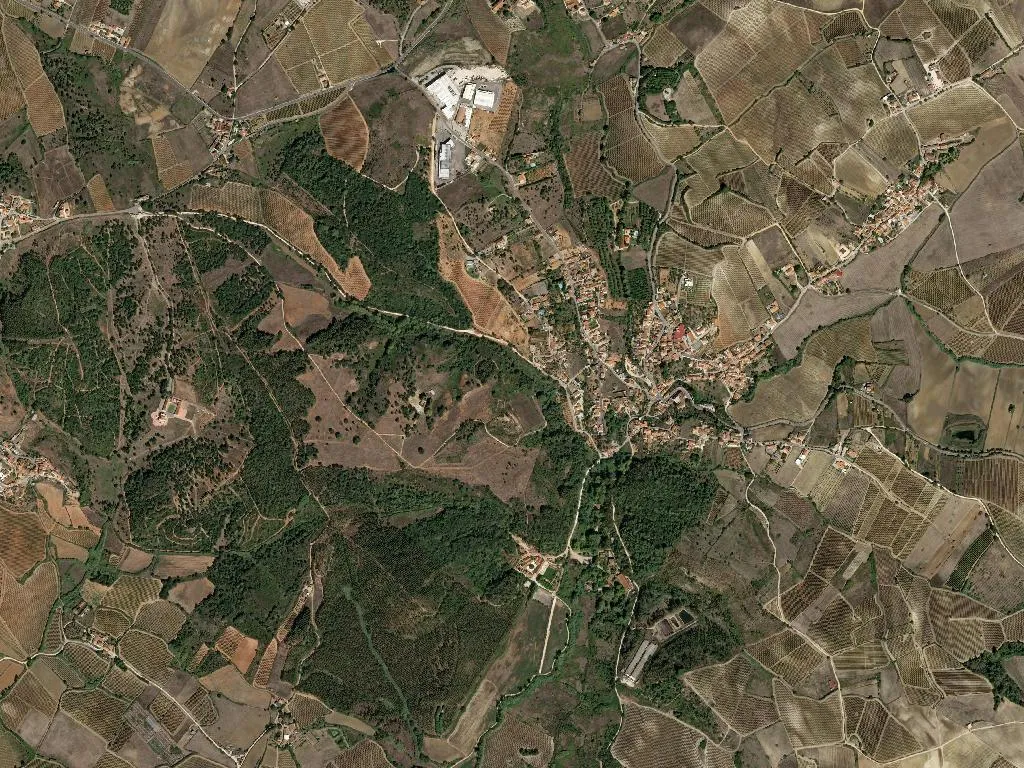
The slate-grey granite of Carvoeira’s mother church soaks up the late sun like a storage heater. Hewn five minutes away at São Julião quarry, the blocks were laid between 1245 and 1280, when the Knights of Santiago still collected tithes here. After the 1755 earthquake shook the Alentejo-maritime fault line, carpenters surrendered to masons: a timber roof was swapped for a stone vault in 1734. Outside, wind slides across terraced vineyards, carrying the smell of turned clay and bruised vine leaf. Since 1958 the same breeze has ventilated Cavaleiro & Companhia’s National Vine Nursery: 25 hectares of polytunnels dispatch 12 million grafted cuttings each winter to the Douro, Alentejo and Pico. Without this discreet grid of greenhouses, Portugal’s vineyard replanting programme would stall.
Carvoeira and Carmões were formally merged in 2013, yet the countryside had already done the paperwork. The Carvoeira water mine, sunk in 1892, still feeds both settlements; 741 registered plots share the Alto da Serra irrigation channel. Demography is less collaborative—only 221 residents are under 14, while 651 have passed 65. When the local primary school closed in 2009, the 43 remaining children began the 20-minute bus ride to Torres Vedras’ education campus.
Stone, Water and Crosses
Beside the chapel of São Julião a 1643 granite cross carries the inscription: “By the grace of God this parish was delivered from the plague.” Two kilometres away, D. Brites de Lencastre ordered the chapel of Santa Madre de Deus built at Valarinho in 1527; her coat-of-arms is still legible above the door. Carmões answered the drought of 1771 with spectacle: seven calvary shrines, erected in 1774, march up the Calvário dos Paços. The Braçal watermill, retired in 1953, keeps its wooden sails and iron axle forged across the Tagus at Serra do Pilar. Forty-seven metres below ground, the Ribeira de Carvoeira mine sends up water at a constant 14 °C through concrete pipes installed in 1936.
The Ridge that Breathes
Serra de São Julião, at 396 m, is the municipality’s roof. In 2008 Torres Vedras bought 52 ha from the Knights of Christ—successors to the original commend—and opened the Eco Parque. Luís Lopes’ 4.2 km XCO trail climbs 180 m of switchbacks through maritime pine planted after the 1935 wildfires; it hosted the national marathon championships in 2019. Across the ridge, the Green Park Sérgio Gomes—funded by EU cohesion money—lines up 47 London planes, every one raised in the municipal nursery.
Tastes that Linger
The Pastel de Feijão, a bean-and-egg-yolk tart, was trademarked in 1910 by Torres Vedras’ Confeitaria Central. Protected by a 2016 Geographical Indication, the recipe is exact: 38 % white beans, 32 % sugar, 20 % yolks, 10 % water, laminated into 256 layers. At Quinta do Rol in Carmões, Pêra Rocha pears are hand-picked between 15 August and 30 September; 40 % leave through Santarém market, the rest are sold door-to-door on Saturday mornings. The 1955 Torres Vedras co-op presses grapes from 45 parish growers into a crisp Lisboa regional white—60 % Fernão Pires, 40 % Arinto, bottled at 12.5 %.
Tracks that Cross
The Coastal Way of St James slips into the parish at the 1989 granite way-marker near Serra and exits 5.6 km later over the São Julião stream bridge. Since 2014 the local friends’ group has stamped credentials in the chapel of São Julião. Geopark Oeste lists the ridge as stop 18 on its “Defensive Landscapes” route; the viewpoint panel explains the 1973 rudist fossil find. Carmões’ 2004 sports hall, floored in solid chestnut, registers 72 youth-team footballers, though only a junior squad remains—the younger ones train in town.