Full article about Maceira: pears, pastries & limestone lanes near Lisbon
Sweet-scented orchards, bean-pastry cafés and slow village life 75 km northwest of Lisbon
Hide article Read full article
Maceira, where the air tastes of ripe October pears
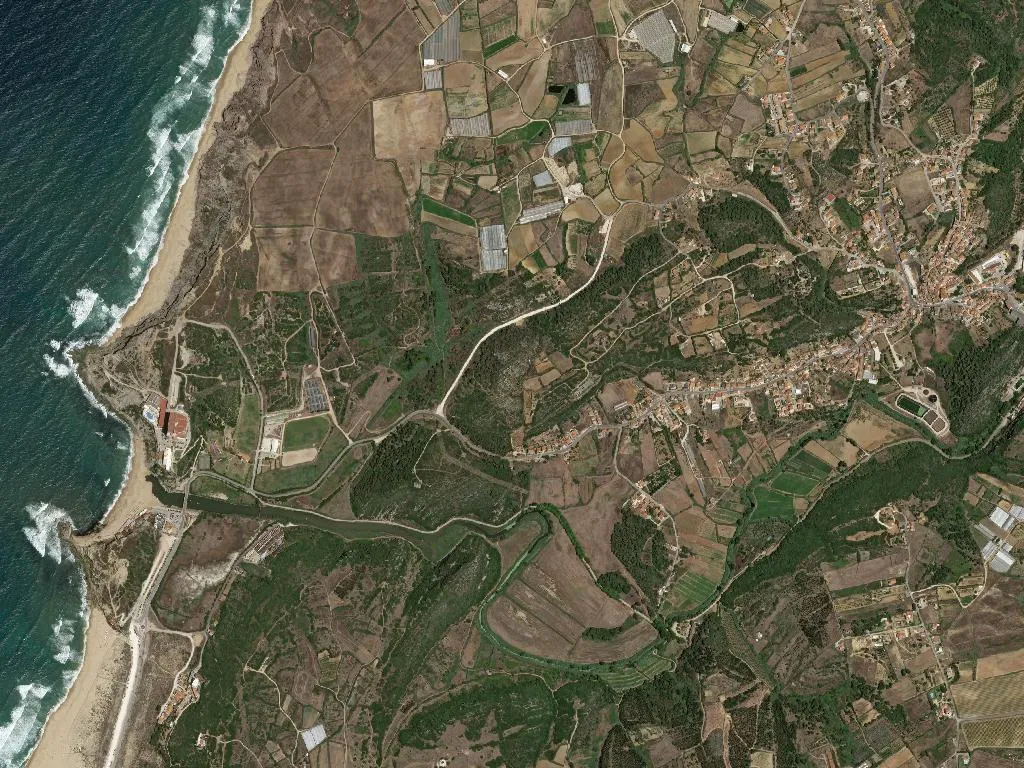
The scent arrives before the view. A vegetal sweetness—sun-softened pear flesh married to freshly-turned soil—slides into the car the moment the N9 begins its gentle drop into a valley only 75 m above sea level. There is no cinematic reveal: no cliffs, no castle keep, just a rumple of land that settles around red-tiled roofs, wire-fenced orchards and 5 784 residents who have never needed a rebrand to justify their address.
Seventy-five kilometres north-west of Lisbon, Maceira is still technically in the capital’s district, yet the clock here runs on orchard time. Children—778 of them—pour out of the primary school at 16:00 sharp; 1 240 pensioners trade gossip outside the parish council until the sun slides behind the pear rows. Between those two generations the village keeps its pulse.
Fruit that writes the map
Mention Maceira to anyone west of the A8 motorway and they will answer with a pear variety rather than a postcode. The parish sits inside the protected circle of Pêra Rocha do Oeste DOP, the apple orbit of Maçã de Alcobaça IGP, and the flaky jurisdiction of the Torres Vedras bean-pastry IGP. Limestone bedrock and Atlantic night breezes—cool, salt-laced, humidity-heavy until mid-morning—give the pears their freckled skins and granular bite. From late August the roadsides stack up with yellow crates; branches sag like overloaded coat racks; tractors buzz to the cooperative weighing station at walking pace, trailers mounded so high a single pear could roll off and start its own orchard.
The pastry is more reserved. A palm-sized tart of cooked white beans, eggs, sugar and almond, it demands a pause in a café where the espresso machine still hisses like an irritated cat. The shell shatters, the filling is the colour of fresh yolk, the sweetness murmurs rather than shouts. Order one with a bica and you will be offered a second before the cup is empty.
Stone with a listing, wine with a coastline
Maceira has two monuments on Portugal’s public-interest register: the 16th-century parish church, its Manueline portal carved with rope-twist columns, and the pink-walled Palácio do Roseiral, whose garden statuary looks perpetually on the verge of gossip. Both buildings have outlasted earthquakes, republics and tourism trends by the simple expedient of refusing to be anything other than themselves.
Vines compete with pears for the same calcareous foothold. The parish lies inside the Lisboa wine region, a strip that has quietly reinvented itself with Atlantic-tempered Arinto and Touriga Nacional. Night breezes from the ocean slow ripening, lock in acidity and lend a salty snap to the finish. Several growers now bottle under tiny labels; ask at the cooperative shop and you may leave with a chilled loureiro that tastes of green apple skin and sea fog.
Limestone, fossils and the Earth’s own archive
Maceira is a stop on the 2 300 km-long Geopark Oeste, a UNESCO-listed itinerary that turns geology into open-air literature. The exposed limestone is a ledger of Jurassic seas: every ripple holds ammonites, every bedding plane is a page of retracted ocean. A 45-minute trail from the churchyard leads to an abandoned quarry where brachiopods are wedged like coins in a fountain—no ticket booth, no interpretive board, just the stone and whoever bothers to look.
A pilgrim’s side-door to the Atlantic
The coastal variant of the Camino de Santiago skirts the parish boundary before bending inland toward Santarém. Way-markers pop up on stone walls, yellow arrows painted by farmers who have never read a guidebook. Fifteen registered lodgings—ranging from a converted hayloft to a minimalist Airbnb with orchard views—mean walkers rarely have to phone ahead. The terrain is mercifully flat; knees survive, and the next espresso is never more than 6 km away.
The soundtrack of people who stay
Maceira does not trend. No drone footage has gone viral; no pop-up street-food market materialises at weekends. What you get instead is a low-volume soundtrack: the soft pop of a pear dropping, the clink of a milk churn, a tractor reversing in B-flat. Stay until the light slants and the temperature drops just enough to raise goose-flesh, and the village shrinks to a single sensation: the weight of a sun-warmed pear in your palm, skin freckled, flesh ready to give with a quiet sigh. It is not a postcard; it is a handshake with a place that has nothing left to prove.