Full article about Tagus mud & Manueline bells in Alhandra
Alhandra, São João dos Montes e Calhandriz: Tagus-side paddies, 16th-century churches and candlelit processions 30 min from Lisbon.
Hide article Read full article
Where the Tagus pauses before the sea
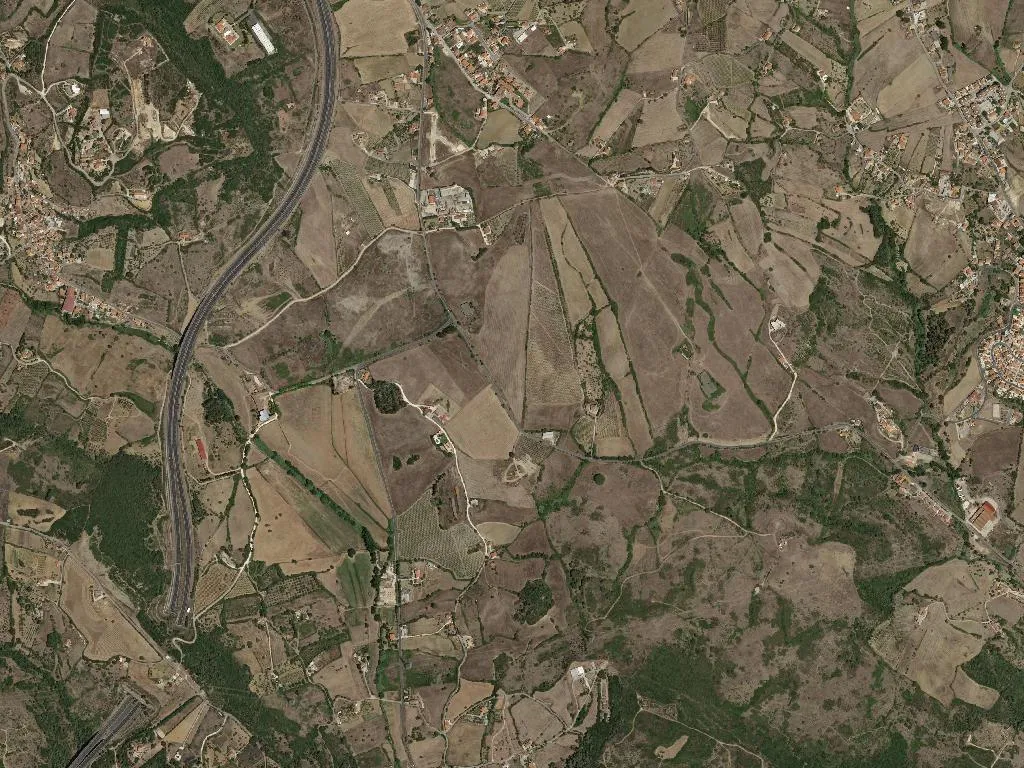
The wind combs the fields and lifts something invisible: the scent of wet alluvium, of soil that has just swallowed its morning ration of irrigation water, of vegetation beginning to ferment under a late-morning sun. Ahead, the Tagus lies wide and almost motionless, as though deliberating whether to continue the final push to the estuary. On this right bank, rising gently to 180 m, the civil parish of Alhandra, São João dos Montes and Calhandriz spills across the hills—three settlements merged by administrative diktat in 2013, yet long ago fused by the same water, the same labour and the same mud.
A name the river dictated
Local etymologists trace “Alhandra” to the Arabic al-‘Andara—arable land—and the first written mention surfaces in 1140, when Portugal’s founding king, Afonso Henriques, donated the settlement to the Knights Templar. The label still fits: between the railway and the first slopes, alluvial terraces deposited over millennia feed rice paddies, vines and pear orchards. No blockbuster monuments announce the past here; memory is sifted through the soil—lane patterns between farmsteads, lime-washed walls blistered by sun, 19th-century gateposts swallowed by bougainvillaea.
Stone, lime and the weight of the sacred
The 16th-century parish church of Alhandra, listed since 1984, rises from a medieval hermitage and shelters Mannerist altarpieces plus a 17th-century crucifix credited by locals with coaxing rain from a cloudless sky. São João dos Montes rebuilt its own church after the 1755 earthquake but left the 1692 bell tower untouched; walk inside and the timber roof smells of beeswax and river damp. Smaller roadside shrines punctuate the countryside—Nossa Senhora da Conceição in Calhandriz still stages its 8 December procession, an 18th-century tradition that fills the lanes with candlelight and the faint sweetness of roasted chestnuts.
Agricultural estates complete the architectural fabric: Quinta do Lago, Quinta da Piedade, Quinta de São Silvestre. Their moss-coated stone walls and rusted iron gates frame abandoned orange trees whose fruit drops and perfumes the air. Piedade’s 1880s manor house, once the hub of regional wine production, is now a private residence; the cellars have become garages, yet the exterior azulejos still glint cobalt in low sun.
Rice that tastes of the estuary
You cannot speak of this land without speaking of rice. The IGP-protected Arroz Carolino das Lezírias Ribatejanas is a short, plump grain that drinks stock like a sponge, turning creamy without collapsing—the essential base for duck rice or a shell-fish-laden arroz de marisco. At Taberna do Quinzenário in Alhandra, Wednesday means eel rice, a recipe Joaquim Correia inherited from his father, who in the 1960s bought silver eels straight from Tagus fishermen. The same meal will likely finish with Pêra Rocha do Oeste—DOP pears whose grainy flesh releases a syrupy juice that runs down the wrist. Introduced here in 1830, the variety thrives on Calhandriz’s limestone soils cooled by Atlantic draughts. Locals wash it all down with whites from Quinta do Lago—Fernão Pires and Arinto that carry a whisper of salinity from the nearby marshes.
Wings over the marsh
Fourteen thousand hectares of the Tagus Estuary Natural Reserve begin five minutes from Alhandra’s centre. Between October and March roughly 2,000 greater flamingos winter here, their rose bodies reflected in coppery dawn water. From the old hunting lodge—now a small interpretation centre—you can scan for black-winged stilts that nest between March and July, or listen for the croak of purple herons stalking the sapal salt flats. Silence is part of the kit: stand still on the Calhandriz creek at sunrise and the mist lifts to reveal spoonbills jostling avocets, all choreographed by the tide.
Walkers can stitch the three villages together on the 8.5-km Calhandriz loop, a rural trail that threads vineyards, centenarian olive groves and the 1876 Fonte da Pipa, still used by farmers to water mules. Yellow arrows mark the Portuguese leg of the Camino de Santiago; don’t be surprised to share the path with backpackers heading north. Since 2018 the local group “Alhandra a Caminhar” has led monthly rambles, reopening old footpaths that once connected hamlets to river quays.
The last sound of the day
Dusk thickens into gold, and for a few seconds the lezíria falls silent—no wind, no engines, no birds. Then, somewhere above the flooded rice fields of Herdade da Lagoa, a purple heron lifts off, the slap of its wings echoing like a brief, solitary applause. That is the souvenir you leave with: not the postcard view, but the quiet proof that this corner of the Tagus still keeps time to the river that named it.