Full article about Alcórrego-Maranhão: Silence under cork-oak skies
413 souls share 128 km² of Alentejo savannah, olive scent and frost-crisp dawns
Hide article Read full article
Dawn on the Alentejo Plain
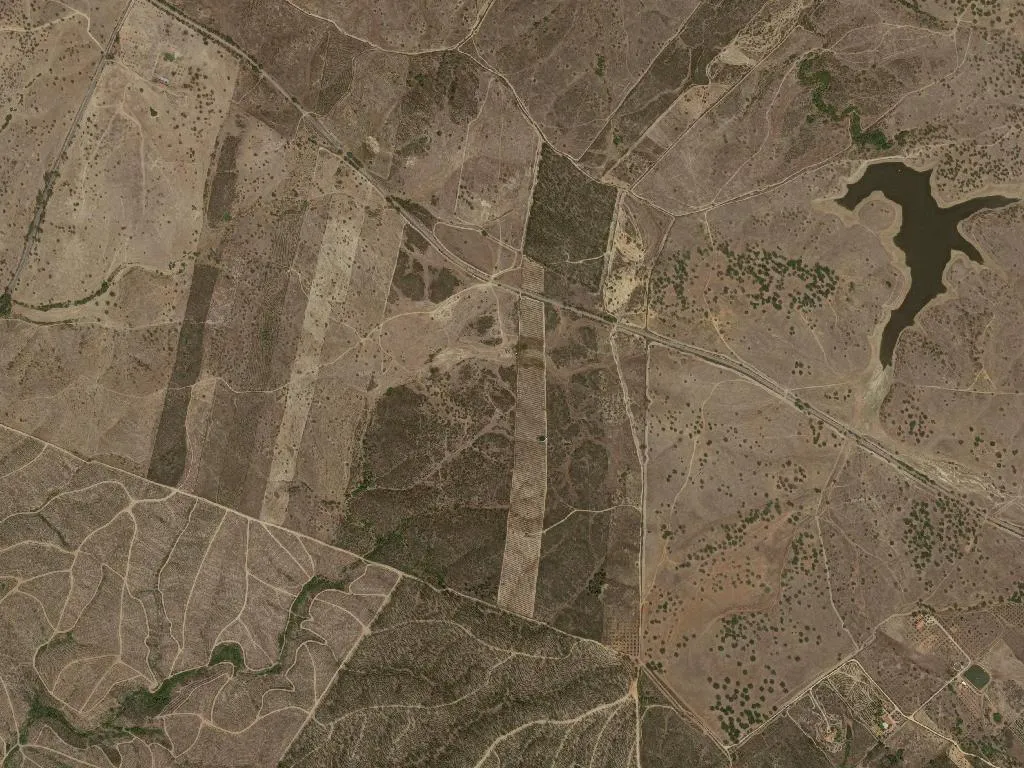
The first light scythes across 128 km² of rolling cork and holm-oak savannah, picking out the low schist walls and limewash of two hamlets whose combined population would barely fill a London double-decker. Alcórrego and Maranhão—formally the civil parish of União das Freguesias de Alcórrego e Maranhão—sit 23 km north-east of Avis in Portalegre district, three people to every square kilometre, a ratio you feel in the lung-filling amplitude of sky and the echo of your own boots on the beaten track.
What the Land Dictates
Elevation here is a modest 202 m, yet stand on any of the granite outcrops and the view unrolls like a 15th-century tapestry: olive groves planted before the Discoveries, cork oaks whose bark still feeds the wine industry, and summer stubble that turns the colour of burnt sugar under 40 °C heat. Winters bite—hoar-frost pearls the stone walls at dawn—then August arrives with the dry scent of rockrose resin and the low hum of tractors guarding against wildfire.
The soil is calcareous, forcing roots deep; the reward is olive oil bottled as Azeites do Norte Alentejano DOP, green-fruited and almost peppery on the back of the throat. In smoke-darkened larders, chouriços and paio sausages cure slowly, while wheels of Queijo Mestiço de Tolosa IGP and Queijo de Évora DOP wait under muslin. Recipes are committed to memory, not paper—bread soups thickened with cilantro, lamb stewed with mint, and acorn-fed pork that tastes faintly of caramel.
Living with Distance
Of the 413 residents on the 2021 census, 105 are over 65; only 45 are under 14. The primary school closed in 2014, its playground taken over by wild fennel. Eleven guest beds—scattered between two rural guesthouses and a handful of village rooms—are the sum of local accommodation, booked mostly by birders tracking black-shouldered kites or by cyclists tracing the Grande Rota do Guadiana.
Yet emptiness here is not absence. Silence has weight: a stork clapping its bill on a rooftop, the metallic click of a cork-stripper’s axe, the church bell in Alcórrego striking the hour with no competition. At dusk the air smells of newly lit oak; smoke rises straight up, drawing vertical lines on a horizon that still belongs, unquestioned, to the land.