Full article about Figueira e Barros: Alentejo’s Hush of Wheat & Whitewash
Sun-scorched plain, 248 souls, thistle-rennet cheese and olive oil pressed in granite mills.
Hide article Read full article
A Landscape of Stillness and Sunlight
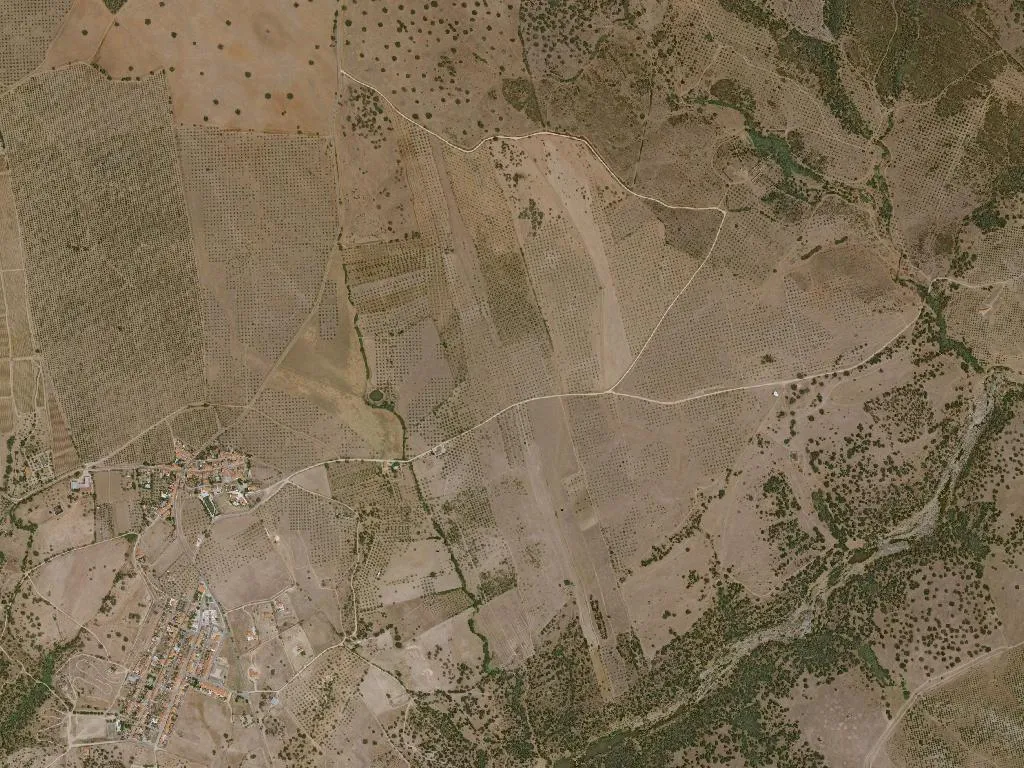
The plain unfurls beneath a white glare that warms the air before it reaches the ground. Heat pools in the terra-cotta earth, between holm oaks spaced like snapped parasols and wheat fields folded like rugs just shaken out. On the horizon a low, whitewashed huddle of houses interrupts the line as rudely as someone cutting across a conversation. Figueira e Barros—two hamlets fused into a single civil parish—occupies 70 km² of inner Alentejo where fewer than four people live to every square kilometre.
Two hundred and forty-eight souls inhabit this tract of wide silences, the head-count of a single London double-decker. The census mathematics sketch a familiar graph: thirty-six under-18s (one primary-school class), eighty-one over-65s, three tourist lodgings that are simply private houses whose owners leave the key under the pot and don’t mind if you skip breakfast. At 175 m above sea level the land rolls gently between vines and olives, the crops that still pay the parish’s bills much as a pot of bean stew still pays for lunch.
Olive Oil, Cheese and Wine: the Territory’s Trinity
Here gastronomy is not folklore but ledger and identity, as bread was for my grandmother who baked because “that’s what we’ve always done”. Azeite do Norte Alentejano DOP comes from the olives stippling every slope, crushed in mills whose granite presses turn like the one my grandfather refuses to scrap “because it still works”. In the village shop you’ll find Queijo Mestiço de Tolosa IGP and Queijo de Évora DOP, cheeses that taste of thistle rennet and of shepherding families who still move their flocks along the Serra de São Mamede.
On the same modest shelf sit rock-hard wheaten loaves (the sort you’d dunk forever), sausages smoked over holly oak in sheds that smell of winter and time without haste, and hand-potted preserves that could fit in a coat pocket yet see a household through January. There is no tourist gloss, only the logic of people who eat what they grow and sell what is left, much like selling the neighbour the surplus of last year’s grapes.
The Visible Everyday
Walking through Figueira e Barros means negotiating streets so empty your footsteps echo like a museum at closing time. Windows the width of a hand are painted kingfisher-blue or sun-bleached ochre, hinting at interiors kept cool by walls thicker than a doorstep. In back gardens fig trees shade cane-bottom chairs that creak like café furniture; hens scratch between geraniums crisped to parchment by the afternoon.
Life is scheduled by temperature—at dawn when the school bus coughs awake, and at dusk when doors finally open and voices swap abridged news: how the harvest is going, whether it will rain, what olive oil is fetching this week, the way men once traded headlines over a cigarette at the barber’s.
There is a brutal honesty to the scene. Nothing has been arranged for the passing eye. Secondary roads are narrow as corridors; tarmac is crazed like overheated terracotta. Fields are not edged with picturesque dry-stone but with the same barbed wire that works anywhere else. Perhaps it is this refusal to perform that makes the place legible: Alentejo without the filter, where 248 people keep alive a territory that could empty overnight like a carelessly corked bottle.
The setting sun ignites the horizon, turning the whitewash the colour of marmalade, the shade my mother once dyed my father’s old shirts to make them “new”. Somewhere a church bell strikes six—a brief metallic note the wind carries across the stubble as casually as a remark no one asked to hear.