Full article about Silent Sherry Light over Nossa Senhora da Graça dos Degolado
Campo Maior parish where 646 souls share 3,000 ha of cork oak, thyme scent and blood-stained lore
Hide article Read full article
The bell that rings over an almost-empty plain
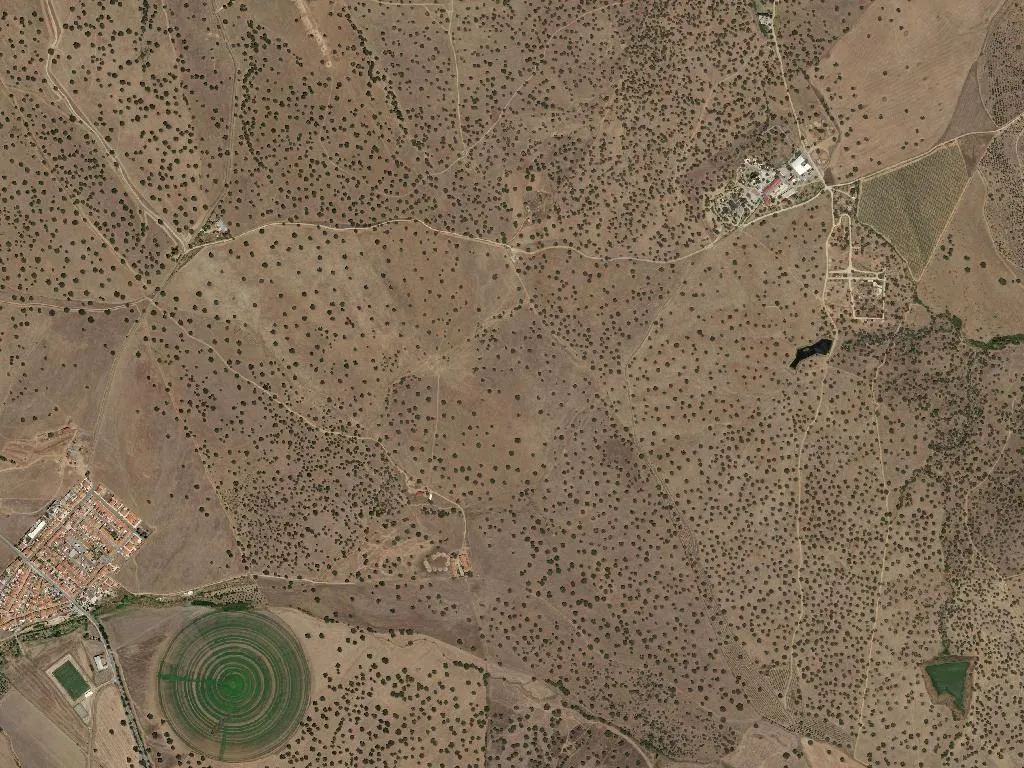
The parish church tolls three times. Sound rolls across cork oak and holm oak, slips down lanes of chipping cobbles, glances off whitewashed walls with their brick-edged cornices, then dissolves into the hush of 3,000 rolling hectares. September light here is the colour of sherry—dry, bright, weighty—sifting through evergreen leaves while the air smells of baked earth and crushed white thyme. Nossa Senhora da Graça dos Degolados, one of the least inhabited parishes in Campo Maior, counts only 646 souls. At 1.8 people per square kilometre the silence is almost topographical: you can pace out the gap between human voices.
A name inked in blood
"Degolados"—"the beheaded"—is unique to the Portuguese map. Local lore variously blames Moorish reprisals, Castilian raids or the reprisals that followed. The details evaporated in oral retelling; only the blunt warning in the place-name remains. Facing the small praça, the parish church wears an 18th-century gilded altarpiece inside its modest stone portal. In a side reliquary rests a fragment of Saint Bartholomew—flayed, legend says—brought back by men who fought to restore Portuguese independence in 1640. A few strides away, the chapel of São Brás keeps 17th-century tiles whose blues and ochres still breathe through salt-damp walls.
Borderland geography
Set at 299 m above sea level, the parish rides a gentle swell of plateau scored by winter streams that drain south-east to the Caia, the river that doubles as the Spanish frontier. At Cabeço da Forca—"Gallows Hill"—shallow ditches and a weather-watched stone platform outline a lookout used from the Reconquista to the Napoleonic wars. Beyond, the Alentejo montado stretches like a savanna in miniature: cork and holm oak spaced for sheep, shade for fighting bulls, perches for great bustards that lift in lumbering applause when disturbed. In April rosemary and Tuberaria guttata stipple the ground with lilac and butter-yellow, scents intensifying as temperatures rise.
What the land tastes like
Cooking here predates the tourist calendar and sees no reason to change. Sopa de baldroegas—a purslane broth thickened with poached egg—opens the table, followed by lamb stew scented with garden mint, or garlic-açorda heavy with coriander. In January kid goat slow-cooks in clay with red wine, bay and smoked paprika until the sauce lacquers the spoon. The finishing pour is always DOP Azeites do Norte Alentejano, cold-extracted from cobrançosa and galega olives. To close, Queijo Mestiço de Tolola IGP—sheep-and-goat curd aged sixty days—oozes just enough to bond with rough-crusted bread.
Calendar of the stubborn
The first Sunday after 1 September belongs to Nossa Senhora da Graça. After high mass the statue processes beneath balconies strung with paper flowers, then the square fills with música alentejana—accordion and cavaquinho in lilting 3/4 time. Women knead, fold and egg-glaze the "degolado", a bread-shaped puff filled with doce de ovos whose name nods to the parish legend; it appears only on this day. In mid-August the "corte da palha" re-enacts hand-reaping and threshing in honour of São Brás, accompanied by cantigas ao desafio, improvised call-and-response verses. On winter nights a handful of men still practise "fado dos homens" around a fireplace, passing down satire and local memory in modal minor keys.
Wind combs the oaks, carrying Spain on its back. Inside the church candle-flame licks the gold leaf; outside, a peregrine quarters the field, tracing the boundary where people thin out and stories begin.