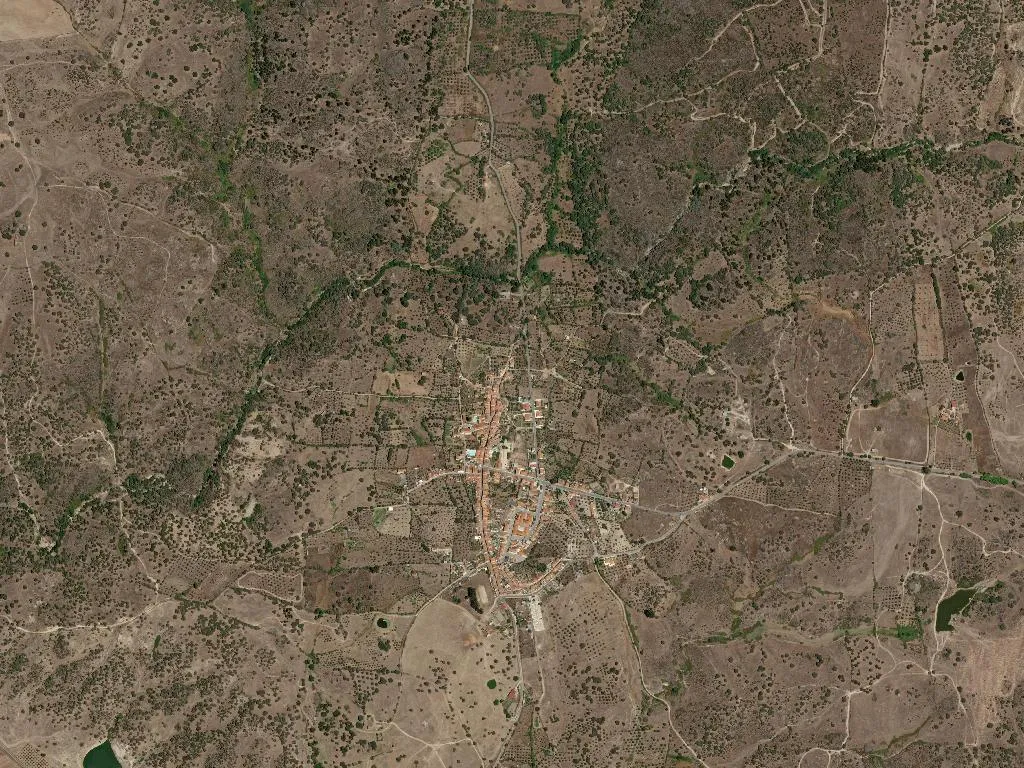
Full article about Aldeia da Mata
Granite thresholds glow at sunset while 313 neighbours age their queijo in lofted breezes of Montado
Hide article Read full article
Granite thresholds, 313 neighbours
The late sun strikes the uneven cobbles and warms the granite thresholds until they glow like small hearths. In Aldeia da Mata, silence has body: not the hush of abandonment but the deliberate quiet of people who can name every dog, every olive trunk, every gate latch across 37 km² of Montado pasture. With only 313 residents, the parish unfurls east of Crato in a slow-motion conversation between cork oak green, ploughed-ochre soil and the silver-grey scribble of ancient oliveires on the horizon.
Knights, tithes and exile
The place name is literal – “mata” once described the dense maquis that clothed the north-east flank of the Serra de São Mamede, supplying firewood and forage to 16th-century smallholders. From the 1600s the village answered to the Knights Hospitaller, whose ledgers recorded “twenty hearths” paying rent in wheat and olive oil, currencies still honoured at the weekly market. A royal charter of 1836 promoted the settlement to civil parish, yet the architectural ledger remains stubbornly medieval: whitewashed mud walls, dressed-stone doorways, arrow-slit windows that shrug off August heat. Emigration halved the headcount after 1960; today 174 residents are over 65 and only 22 are under 15, giving the primary school the hush of a library.
Butter-coloured oil and sheep-fat cheese
Flavour arrives before explanation. At Sunday lunch the table is laid with Norte Alentejano DOP olive oil the colour of churned butter, pressed in stone lagares within smelling distance. Queijo de Nisa DOP follows – hard-curd, intense, aged on wooden slats in draughty lofts. The lesser-known Mestiço de Tolola IGP, a 70/30 blend of sheep and goat milk, is spoonable at room temperature, tasting faintly of thyme and lanolin. Bread is still baked in wood-fired ovens built into the side walls of houses; the dough is started before dawn so the crust can crack in time for the midday siren.
Eight places to lay your head
There are no hotels, only eight self-catering houses scattered among the olives. Expect stone floors that drink up the cool, ceilings high enough for a loom, and hammocks slung between two cork trees. At dawn you wake to roosters, at dusk to the soft percussion of sheep bells on their way back from the Seda stream. With eight inhabitants per square kilometre, the luxury is cognitive: space to hear your own pulse, and darkness so complete the Milky Way feels like a civic installation.
When the generator at the café finally coughs into silence, lights switch on one by one, slow as constellations. Midnight brings wood-smoke and the retained warmth of granite under bare feet. Aldeia da Mata refuses to be summarised; it is simply breathed in.