Full article about Elvas: Footsteps Echo Inside Europe’s Mightiest Fortress
Walk Assunção to Santo Ildefonso where sun-bleached ramparts bristle above Alentejo cork plains.
Hide article Read full article
A fortress that breathes
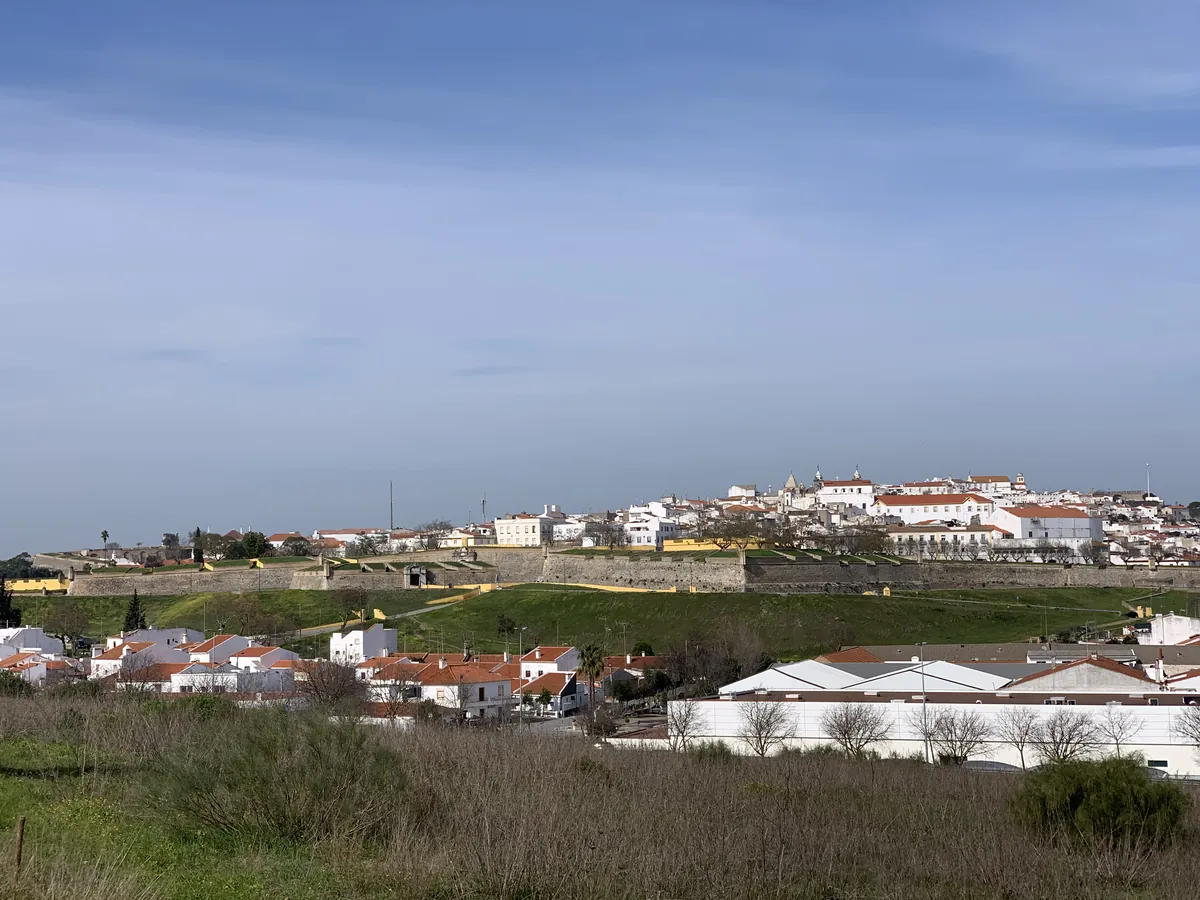
Your footfall arrives before you do. On the uneven cobbles that climb from Olivença Gate the sound ricochets off whitewashed stone and snaps back in tight echo, as though the walls themselves were answering whoever enters. The air smells of dry minerals – lime, packed earth, late-afternoon heat rising off granite. Bastion-shadows slice the ground into clean geometry, and the low Alentejo sun turns every corner into a study in contrast: absolute white façades against matte-black wrought-iron doors. You are standing inside the largest bastioned fortress-city on earth, yet the first surprise is not the scale – seven kilometres of wall – but the way it folds itself around you without announcement.
Stone upon stone, war upon war
The civil parish of Assunção, Ajuda, Salvador and Santo Ildefonso is Elvas in its entirety: 843 hectares of Unesco World Heritage listed in 2012 as a “Garrison Border Town”. Taken from the Moors in 1226 and immediately granted a royal charter by Sancho II, the promontory spent the next five centuries accumulating layers of military and religious masonry. The Moorish castle crowns the summit; from its Queen Saint Isabel miradouro the view unrolls across the crystalline plateau of northern Alentejo – cork and holm-oak montado rippling southward, regimented plum orchards marching east to the Spanish frontier. At 237 m above sea level the landscape feels simultaneously exposed and cupped: the horizon is wide, but the seventeenth- and eighteenth-century bastions – directed in part by military engineer José Fernandes de Almeida – close the perimeter like a clenched fist.
Forte da Graça on the northern hill and Forte de Santa Luzia to the south-east watch one another like petrified sentinels. Climb Graça at dusk and you understand instantly why Francisco de Sá e Menezes chose these ridges for the decisive 1659 battle against Castilian troops. Cavalry barracks, artillery sheds, an eighteenth-century military hospital: all remain, repurposed but legible, an open-air manual of war architecture buffeted by wind.
Water that ran downhill
Half-way along the two-hour, three-kilometre yellow-marked wall-walk the Amoreira Aqueduct materialises in the middle distance: 843 stone arches striding 8.5 km from spring to city, still feeding Elvas by gravity alone. Finished in the early 1600s, the structure crosses rolling country with the quiet insistence of something solving a practical problem and asking for no applause. Follow the farm track beneath it for four kilometres and you reach the drying patios of Herdade da Ajuda – low earth platforms where plums turn from green to translucent amber during six weeks of summer sun. Ameixa d’Elvas is the only fresh plum in Europe with protected designation of origin; its sweet-acid perfume drifts over the fields like an olfactory signature.
Four churches, four temperaments
The parish names – Assumption, Help, Saviour, Saint Ildephonsus – echo a medieval division of spiritual labour. The mother church, Santa Maria da Assunção, carries a Manueline nave and a gilded altarpiece; solemnity concentrated. Nearby, the Igreja da Ajuda is unique: the only Portuguese church dedicated to Our Lady of Help outside a maritime context, built not for fishermen but for soldiers and merchants setting out towards Castile or Santiago. Its Easter-Monday mass, once accompanied by folk bands and improvised verse, is now a low-flame affair, a single ember kept alive. The Jesuit college of São Salvador, inaugurated in 1556, is today the municipal theatre – bare stone acoustics now echoing applause rather than psalms. Santo Ildefonso filters daylight through eighteenth-century azulejos in a cool grey-blue that stays fresh even when the thermometer nudges 40 °C.
Garlic-laced bread soup and plum-brandy nightcaps
Cookery here is Alentejan to the marrow, but with a local accent. Açorda de bacalhau arrives with the bread on the cusp of disintegration, fresh coriander snapping between teeth. Lamb stew carries the weight of the region’s sharp winter nights – frost so hard it justifies every spoonful of broth. Spring brings migas with wild asparagus gathered while the temporary streams of São Pedro and São Domingos still run toward the Caia river. Finish with sericaia – conventual egg custard dusted with cinnamon and topped with a poached Elvas plum – and a glass of Trincadeira or Aragonez, or perhaps a thimble of thick plum liqueur that warms the throat like a slow goodbye. Round it off with DOP olives from Elvas and Campo Maior, northern-Alentejo olive oil and Tolosa’s Mestiço sheep-and-goat cheese – a flavour map you can walk in half an hour.
Where azure-winged magpies cross the walls
At sunset below Forte de Santa Luzia the cork oak glows honey-coloured and birdwatchers fall silent. Azure-winged magpies – cobalt flashes against the soil – flit between the trees. Booted eagles circle lazily; the occasional black vulture skims the horizon like a torn umbrella. Nine thousand people inhabit this parish of almost ten thousand hectares; the low density translates into wide intervals between voices. Fifty-seven places to stay range from attic flats to manor rooms with carved coats of arms, and logistics are simple: the intra-muros city is flat, walkable, and the tourist office rents bikes for the 12 km spin to the Caia reservoir.
Leave by Olivença Gate at nightfall and you take with you a sound heard nowhere else: the metallic creak of ornamental cannon on the bastions when the dry easterly levante, freighted with lime dust, blows in from Spain. It is the noise of several kilometres of wall breathing in unison.