Full article about Barbacena & Vila Fernando: Echoes in Lime-Washed Stone
Medieval Alentejo hamlets stitched by olive groves, plague chapels and silent semaphore towers
Hide article Read full article
Two Villages, One Memory
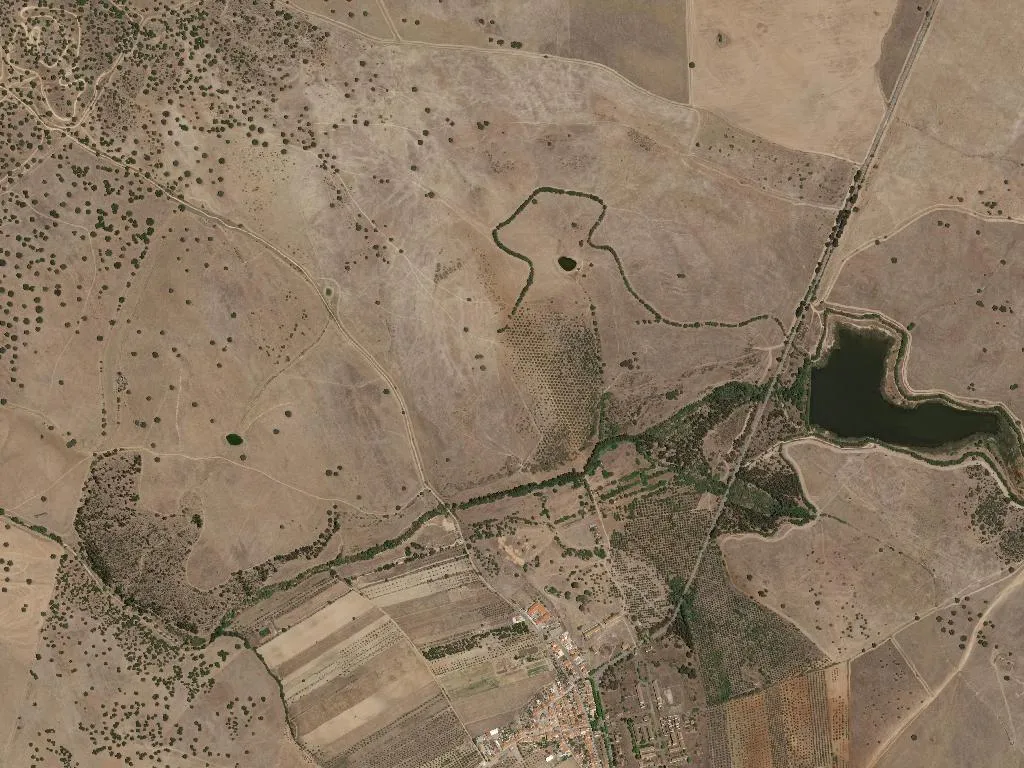
Lime-wash catches the light and flares against the tawny earth. Beyond the last house, the Alentejo rolls out like unpressed linen, stitched only by the dark green knots of holm oaks and the silver blur of olive groves. Sound travels slowly here: the hush is so complete you can isolate the wind riffling through wild oats, a crested lark sprinkling notes over the wheat, your own soles scuffing the granite setts. Barbacena inhales, counts to five, exhales—no one has ever explained to the village that the 21st century happened.
The civil parish of Barbacena e Vila Fernando was created by administrative merger in 2013, yet its pedigree is medieval. Barbacena held town status and its own municipal council from 1273 until 1837; neighbouring Vila Fernando (once Aldeia da Conceição) governed itself until 1836. Together they now shelter 801 residents across 82 km²—roughly ten souls per square kilometre, a ratio that allows every household a personal horizon. Philologists still argue over the name: either the Latin “Barbaris Scena”, the hut of the barbarians, or a corruption of “barvosas”, the tough grasses that cattle refuse. Both versions feel true; here history accretes like sediment.
Stone, Lime, Faith and Frontier
Five classified monuments punctuate the parish. The mother church of Barbacena, begun in the 1520s, hides a Manueline altarpiece carved with the precision of jewellery; few visitors notice the tiny armillary spheres tucked among the vines. On the old road to Badajoz, the single-nave chapel of São Brás (1598) was vowed by survivors of the plague who watched the border close and the carts burn. In the cork estate of Orada, a semaphore tower—Portugal’s 19th-century optical-telegraph line—still stands, a semaphore ghost relaying long-dead dispatches between Lisbon and the frontier 180 km away.
This hinterland lies inside the UNESCO-listed Garrison Town of Elvas, but the martial footprint is subtler than star-shaped ramparts. At Quinta da Torre, Wellington established headquarters during the 1811-12 winter of the Peninsular War; the stone cistern in the courtyard held enough water for 4,000 British and Portuguese troops. Two kilometres south, the shallow meres of Vila Fernando fed the allied cavalry the night before the bloody breach of Badajoz. Locals say the herons still avoid the reeds where the horses watered.
Flavours That Linger
Food arrives at the pace it grows. Ameixa d’Elvas plums swell on irrigated terraces until their skins burst; the fruit is then sun-dried, steeped in sugar syrup for five weeks, and emerges as bronze medallions of sweet-acid intensity. Olive groves planted before the 1755 earthquake yield oil under the Norte Alentejano DOP, pressed in stone lagares whose granite troughs are worn smooth like font basins. Elvas table olives—DOP again—are cracked, salted, and scented with shaved garlic; the cure lasts six months, timed to coincide with the first new wine. Tolosa’s Mestiço cheese, a sheep-goat blend, rolls in coarse salt, developing a butter-coloured paste that tastes of thistle and straw.
Wednesday is migas day at Café Central on Rua de São Sebastião: Maria dos Anjos folds yesterday’s bread into pork-rib drippings, adding spinach and a whisper of mint. Vila Fernando’s weekend-only restaurant, Casa do Largo, serves coelho à caçador—rabbit stewed with tomato, lard, and a shot of aguardiente—under a ceiling of smoke-blackened beams. If the bakery timer aligns, you will find bolinhos de tacho, fist-sized pork-fat cakes flavoured with orange zest and cinnamon, the same snack labourers pocketed when they walked to the fields at dawn.
The Weight of Silence
Demography writes its own diary: 318 residents are over 65; just 75 are under 25. By mid-afternoon the streets belong to swallows and the occasional tractor returning from the olive terraces. Shutters stay half-closed, not in hostility but in habit; television light flickers behind them like votive candles. Yet abandonment has its etiquette—walls are freshly whitewashed each spring, gutters cleared before the first autumn storm, geraniums watered even when the house is empty.
On Tuesdays the parish hall hosts a domino club whose youngest member is 68. The library—three rooms above the chemist—opens Monday, Wednesday, and Friday afternoons, staffed by 78-year-old Dona Amélia, who stamps due dates with the solemnity of a notary. When the regional train to Portalegre whistles across the plain, someone always pauses, trowel in hand, to watch the single carriage rattle past; the sound is a telegram from a world that no longer requires their permission to turn.
Dusk arrives sideways, firing the lime-wash to copper. Swifts cut arcs overhead, and the air smells of bread cooling on wicker racks. In Barbacena e Vila Fernando time is not kept but cultivated: it is measured in olive crops, in the slow erosion of granite steps, in the interval between one locomotive whistle and the next. To cross this land is to relearn the luxury of duration—because here, the horizon is not a line you reach; it is a agreement you keep.