Full article about São Saturnino: where olive roots outnumber people
Silent hamlet in Portalegre where 234 souls tend pre-1900 trees across 4,000 cracked hectares
Hide article Read full article
The silence between furrows
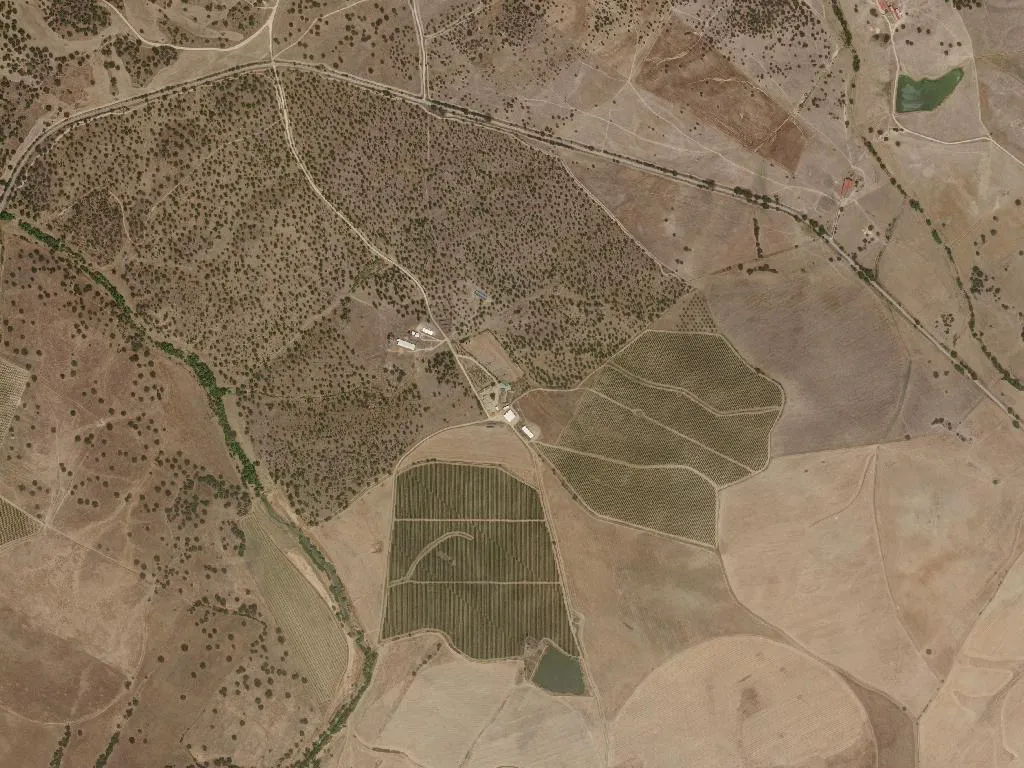
Ochre and olive-green stretch to the horizon, but anyone who knows São Saturnino will tell you the colour is temporary: by March of a dry year the soil has already started to crack. Between Cabeço da Atalaia and Vale de Figueira the century-old olive groves cling on—locals insist the trees on the old Pego estate were in the ground before 1900, when rent was still paid to the Count of Fronteira. Today 234 souls share just over 4,000 hectares; many of the houses visible from the M514 are stone shells whose doors have been painted blue, a grandparent’s trick to ward off the evil eye.
Geography of absence
Population density is 5.2 people per km², yet the statistic feels abstract: on some afternoons you can drive the seven kilometres from the hamlet of São Saturnino to Lugar da Serra without meeting another vehicle. The only movement is the 18:00 patrol jeep of the GNR police. Average elevation hovers around 200 m, rising to 319 m at Cume da Pedra in the south; from here the tower of Fronteira’s town hall is visible 12 km away—a journey that, before the asphalt arrived in 1963, took two days by ox cart.
Taste and provenance
The olive oil carries the Norte Alentejano DOP seal, yet conversation here centres on the Fronteira cooperative, founded in 1954, where a handful of growers still deliver their fruit. The mill operates only from mid-October to 30 November; anyone without a quota drives 35 km to the lagar in Monforte. At table the cheese is almost always Merino sheep, bought at Fronteira’s Wednesday market or bartered for hay with shepherds from Tolosa. Bread is made from soft-wheat flour, proved for 24 hours; there is no village bakery, so anyone without a wood-fired oven drives to Padaria Central before 09:00, in time to return before the Rede Expresso coach leaves for Évora.
A place people pass through
Four tourist lodgings are registered: three rural houses (two in Lugar da Serra, one in the hamlet) and a converted annexe of the primary school, closed since 2009 when only three pupils remained. There is no café or grocery—the last, Mercearia da Conceição, shut in 2017 when its 92-year-old owner died. Petrol or milk requires a trip to Fronteira; for listed heritage you drive 18 km to Castelo de Vide’s Menhir da Meada. What lingers instead is the April scent of burnt rockrose, the first taste of new oil at the cooperative before it is pumped into stainless-steel tanks, and the absolute silence after 22:00, when even Sr Agostinho’s dog stops barking.