Full article about Margem: where rosemary drifts above the Tagus shimmer
Silent olive groves, cork trunks and 80 cm lime walls guard a village ageing in slow time
Hide article Read full article
Rosemary heat
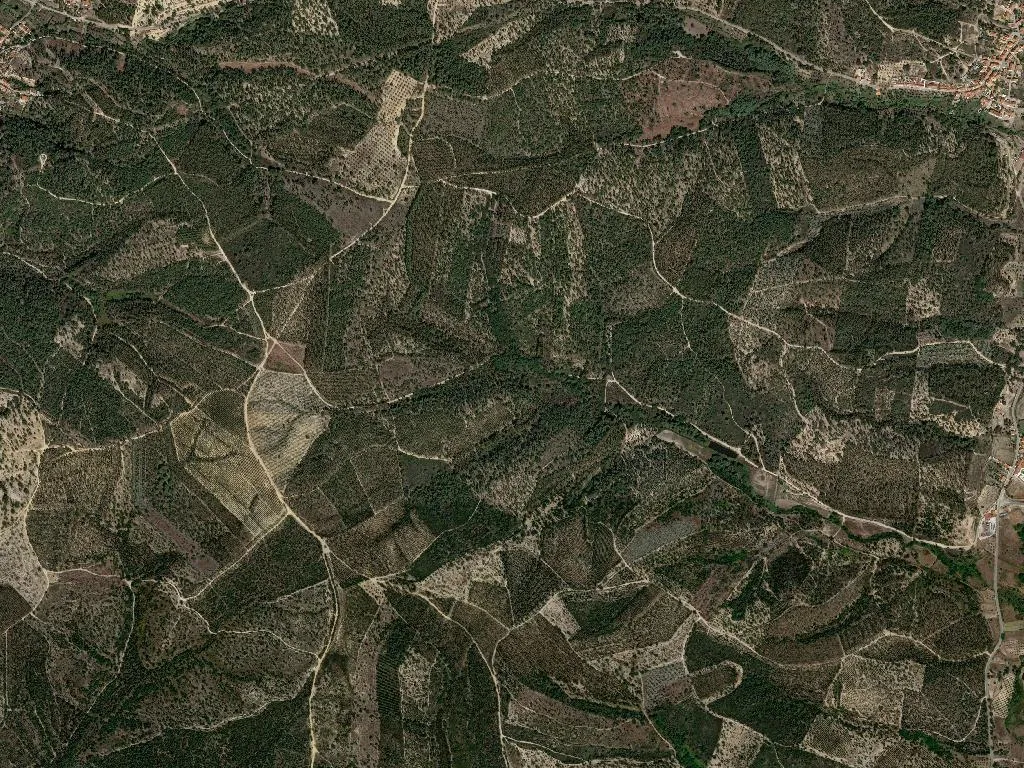
The scent of dried rosemary lifts off the valley floor as soon as the sun touches the schist. From the wheel of a car on the M606, you see cork oaks standing solitary, their charcoal trunks stamped against rust-coloured earth, and hear nothing but a skylark somewhere overhead. Margem occupies the hinge between Alentejo’s open plains and Ribatejo’s rippled lowlands; 241 m of altitude is all that’s needed to tilt the view and let the Tagus shimmer in the hinterland.
Six-hundred-and-forty-one people share 5,893 ha here – a density of 10.9 souls per km² that you feel in the hush between farmsteads and in the minutes that can pass before another vehicle appears. The 2021 census reads like a demographic elegy: 266 residents over 65, only 55 under 14. Yet age is measured more accurately in the 80 cm-thick lime walls of Vale Grande’s nineteenth-century cottages, in the unhurried doorway debates at the grocery “O Pires”, and in olive groves that still yield DOP Ribatejo oil, certified since 1999.
Neither here nor there
Officially Alentejano since the municipality of Gavião swallowed the parish in 1836, Margem tastes Ribatejo in its Protected oils and feels it in the river’s damp breath. The combination shows in the land: cork harvest on a nine-year rotation, but also cordovil and galega olives; southern dryness, yet riparian tamarisk and willow marking the Margem stream and Vale Grande rivulet.
Tolosa’s mestiço goat’s cheese (IGP since 2000) arrives on local tables after a short journey from the Serrana herds that graze the Barbaído and Vale de Gatos commons. Raw milk is cured in brine, firms to a semi-soft paste in 15–30 days, and develops a butter-coloured rind. Break it open with Vale Grande’s wood-fired sourdough – a crust you could play percussion on – and drizzle with oil from Gavião’s farmers’ co-operative. The flavour carries the thrift of a place that wasted nothing, not even when the Fonte Nova cork factory kept the village clock between 1936 and 1984.
Slower motion
Crowds simply do not occur. Annual overnight stays hover around 1,200, shared between two licensed houses: Casa da Eira and Monte da Aparição, both converted private homes. Arrival demands patience – the Beira Baixa railway closed in 2010 and Rede Expressos coaches stop twice a day in Gavião, 12 km away. Most drivers leave the A23 at junction 14, thread onto the EN18, then surrender to the M606 and M512 until GPS reception stutters.
Culture surfaces without display cases; the nearest museum is 18 km off in Belver. Instead, it follows the calendar: September hand-picking at the Carrascos olive grove; December matança of black Alentejo pigs, still done the way agricultural engineer Francisco Dias Costa set down in 1954; March moon-phase pruning of the cork oaks. The 8 km Ribeira de Margem walking loop, sign-posted by the town hall in 2018, climbs to the Barbaído ridge at 350 m – enough elevation to work up an appetite, nothing more.
Horizontal light
By 18:30 high-summer light lies almost flat, modelling every wrinkle. The 380-million-year-old Gavião Anticline zig-zags between Vale de Gatos and Barbaído, its grey schist suddenly three-dimensional. Granite door-jambs in the riverside hamlet of Margem do Tejo – first mentioned in 1601 – catch a soft shine, polished by four centuries of comings and goings.
Silence thickens, broken only by Joaquim Pires’ John Deere descending from the cork montado and the distant bark of the Matos estate’s dog. Scents linger: earth baked to 28°C, cork logs starting to smoulder in kitchen fireplaces, goat cheese breathing quietly in an 80 cm-thick pantry. You realise Margem is not somewhere you tick off; it is something you inhale.