Full article about Santo António das Areias: cork-oak dawn & granite echoes
Marvão’s hill-top parish breathes 1748 calvary, Salazar rows and Sever river pools
Hide article Read full article
Morning light, granite and the scent of cork
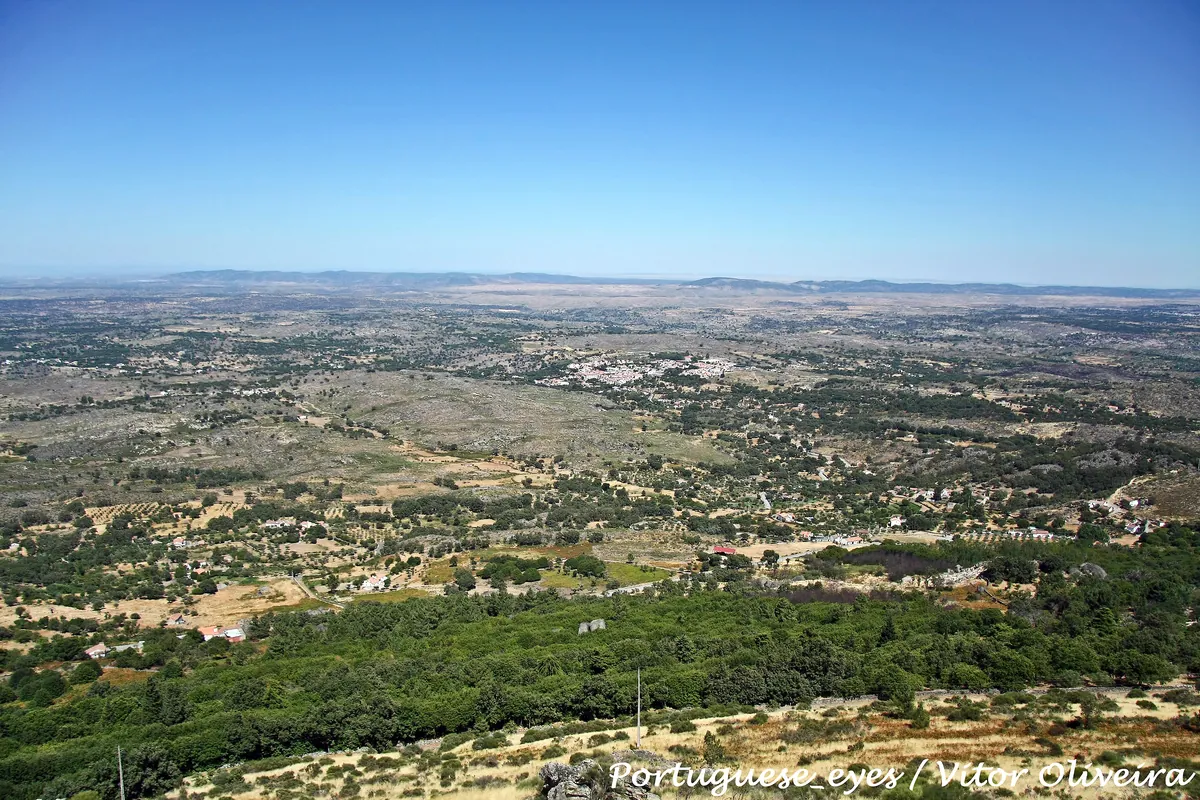
Dawn slips in sideways through the cork oaks and strikes the granite calvary: 1748 carved deep into the stone, though nobody is counting. The air smells of baked earth, freshly stripped cork and, when the wind swings up from the valley, the cool trace of the Sever stream curling between holm oaks. Here, on the north-western flank of the Serra de São Mamede at 492 m, the sandy soil baptised the parish—Santo António das Areias—and shaped centuries of subsistence from cork, olive and rain-fed wheat.
Houses, labour and a New-State avenue
Life radiates from the 16th-century mother church whose Mannerist altarpiece and 18th-century azulejos endure with the restrained grace of Alentejo interiors. More telling is the Bairro da Avenida 25 de Abril: fifty state-built houses erected in two tranches between 1946 and 1965 for rural workers. Uniform white façades, ruler-straight pavement, identical doors and windows—an architectural ledger of Salazar’s social engineering that neither time nor fresh paint can erase. The former Telescola, now folded into the community centre, broadcast lessons by television until 1987; the wooden desks are gone, replaced by canteen chairs, yet the corridors still echo with the flicker of black-and-white memories.
River pools, granite lips and silent mills
The Sever cuts east–west, scooping out natural pools and pocket waterfalls. At Abegoa’s river-beach the water slides over schist slabs with a hush loud enough to drown blackbirds, the spot where children cycle down in July and old women once beat linen against stone. Downstream the Ponte Velha keeps its medieval arches; once it took carts and troops, now it props up hikers on the PR 3 “Vale do Sever”, an 11-km loop that links the village to the Roman ruins of Ammaia. Along the path, stone olive presses and roofless watermills punctuate the undergrowth—full-stops to an economy that survives only in the phrase “tempo do pão de milho” whispered by grandparents.
Açorda, chestnuts and northern Alentejo oil
The kitchen larder is governed by DOP and IGP labels: Norte Alentejano olive oil, Marvão-Portalegre chestnuts, Nisa sheep’s-milk cheese, Tolosa mixed-milk cheese. In the community-café dining room, açorda de bacalhau arrives steaming, coriander sharp, bread sodden—if Zé Pinto is cooking, garlic is non-negotiable. Chestnut cake appears every autumn: local flour, honey, eggs, nothing else, now baked by granddaughters scrolling recipes on their phones. Lamb stew and wood-oven kid are reserved for long-table occasions—meaning almost every time an outsider turns up.
The quiet feast of Saint Anthony
Forget three-day fairs and neon processions. On 13 June the parish gathers for open-air mass and a modest party run by the parish council and community centre. All Souls’ Pão-por-Deus and January’s Cantar dos Reis still happen, unadorned, because Dona Aurélia remembers every verse. Since 2021 the “Andanças no Marvão” walking festival pauses here for Alentejo folk music, but the draw is participation, not performance: voter turnout hovers above 75 % even though the population is one of the sparsest in the Alto Alentejo. Casting a ballot is treated like dropping into the café—done for habit, conviviality and because someone will surely ask, “So, didn’t you vote?”
The football pitch of Grupo Desportivo Arenense—the only natural grass in the municipality—spreads green and largely empty, ringed by cork oaks sieving the late light. Between that domestic emerald and the wild green of the ridge, the village distils itself: labour, water, stone, memory—and the weighted silence of those who know how to wait. At dusk you may still spot Joaquim from the café locking up with the iron key he’s carried since 1973. And that, my friend, is everything you need to know about this place.